
Braiteoir Leibhéal Optúil le haghaidh Cosaint Ró-Shreabhadh
Cuidíonn cosaint ró-shreabhadh braiteoir leibhéal optúil le stop a chur le ró-dhoirteadh umar sula ndéanann sé damáiste do chaidéil, Caibinéid, urláir, trealamh táirgeachta, nó painéil leictreacha. Soláthraíonn HojellyTek lasca ardleibhéil optúla le haghaidh ciorcaid aláraim ró-shreabhadh, ciorcaid scoite caidéil, Córais múchta comhla, agus braite ardleibhéil umar-bharr nuair is fearr freagairt tapa solad-stáit thar snámhphointe meicniúil a d'fhéadfadh cloí, claonadh, salach, nó teipeann orthu gluaiseacht faoi shaoirse.
Do thógálaithe trealaimh OEM, Comhtháthóirí Córais Umar, agus ceannaitheoirí tionsclaíocha, Cumraímid braiteoirí leibhéal optúla fótaileictreach chun an leacht a mheaitseáil, Suíomh gléasta, ciorcad rialaithe, agus loighic aláraim.
Cumas Cosanta Ró-Shreabhadh
Díríonn ár seirbhís cosanta ró-shreabhadh optúil ar an gciorcad aláraim, ní monatóireacht ghinearálta ar umar. Tá an sprioc simplí: an pointe ardleibhéil a bhrath go tapa agus comhartha iontaofa a sheoladh chuig an rialtóir sula sroicheann an leacht an pointe doirteadh.
I measc na bhfoirmíochtaí tipiciúla tá:
- Lasc optúil ardleibhéil le haghaidh aláram ró-shreabhadh umar
- Lasc leibhéal optúil suite ar an mbarr umar chun cosc a chur ar ró-dhoirteadh
- Comhartha stad caidéil nuair a shroicheann leacht an pointe ard
- Comhartha dúnta comhla solenoid le haghaidh múchadh inlet
- Ionchur PLC le haghaidh loighic aláraim ardleibhéil
- Dordánaí logánta, beacon, nó aschur táscaire painéil
- Braiteoir ard-ard iomarcach le haghaidh cúltaca sábháilteachta
- Tithíocht OEM / ODM, snáthaid, cábla, cónascaire, agus saincheaptha aschuir
Le haghaidh braite caighdeánach leibhéal pointe, Is féidir le ceannaitheoirí athbhreithniú a dhéanamh freisin ar ár Braiteoir Leibhéal Optúil raon agus ár Athraigh leibhéal pointe Roghanna.
Cén fáth go n-éilíonn damáiste ró-shreabhadh braite tapa ardleibhéil
Is annamh a bhíonn ró-shreabhadh umar ach fadhb caillteanais leachtach. I gcórais thionsclaíocha agus OEM, Is féidir le ró-dhoirteadh damáiste a dhéanamh do mhótair in aice láimhe, críochfoirt sreangaithe, Caibinéid caidéil, urranna ceallraí, braiteoirí, Meaisíní Pacáistithe, Boird rialaithe, agus trealamh urláir. I gceimiceach, ola, imoibrí, cuisnithe, nó córais bhreosla, Is féidir le ró-shreabhadh costais glantacháin a chruthú freisin, Guaiseacha duillín, éilliú, agus downtime próisis.
Dá bhrí sin, ní mór don chiorcad aláraim ardleibhéil freagairt sula sroichtear an líne ró-shreabhadh. Is féidir le snámhphointe meicniúil oibriú go maith i go leor umair bhunúsacha, ach braitheann sé ar shaorghluaiseacht. Má ghreamaíonn an lámh snámhphointe, na fouls hinge, Cuimilt an snámhphointe i gcoinne an bhalla umar, nó iarmhar duilleoga leachtacha slaodach, B'fhéidir nach n-athróidh an lasc staid ag an leibhéal ceart.
Níl aon lámh ar snámh ag lasc ardleibhéil optúil. Tá an barr braite socraithe ag an bpointe aláraim. Nuair a théann leacht i dteagmháil leis an rinn priosma, Athraíonn an braiteoir staid aschuir agus seolann sé comhartha chuig an aláram, PLC, tosaithe caidéil, nó ciorcad comhla. Fágann sé seo go bhfuil sé oiriúnach d'umair dhlúth, spásanna cúnga, taiscumair bheaga, Cartúis OEM, agus córais ina bhfuil riosca teipe ag baint le páirteanna gluaiseachta.
Conas a Oibríonn an Lasc Ardleibhéil Optúil
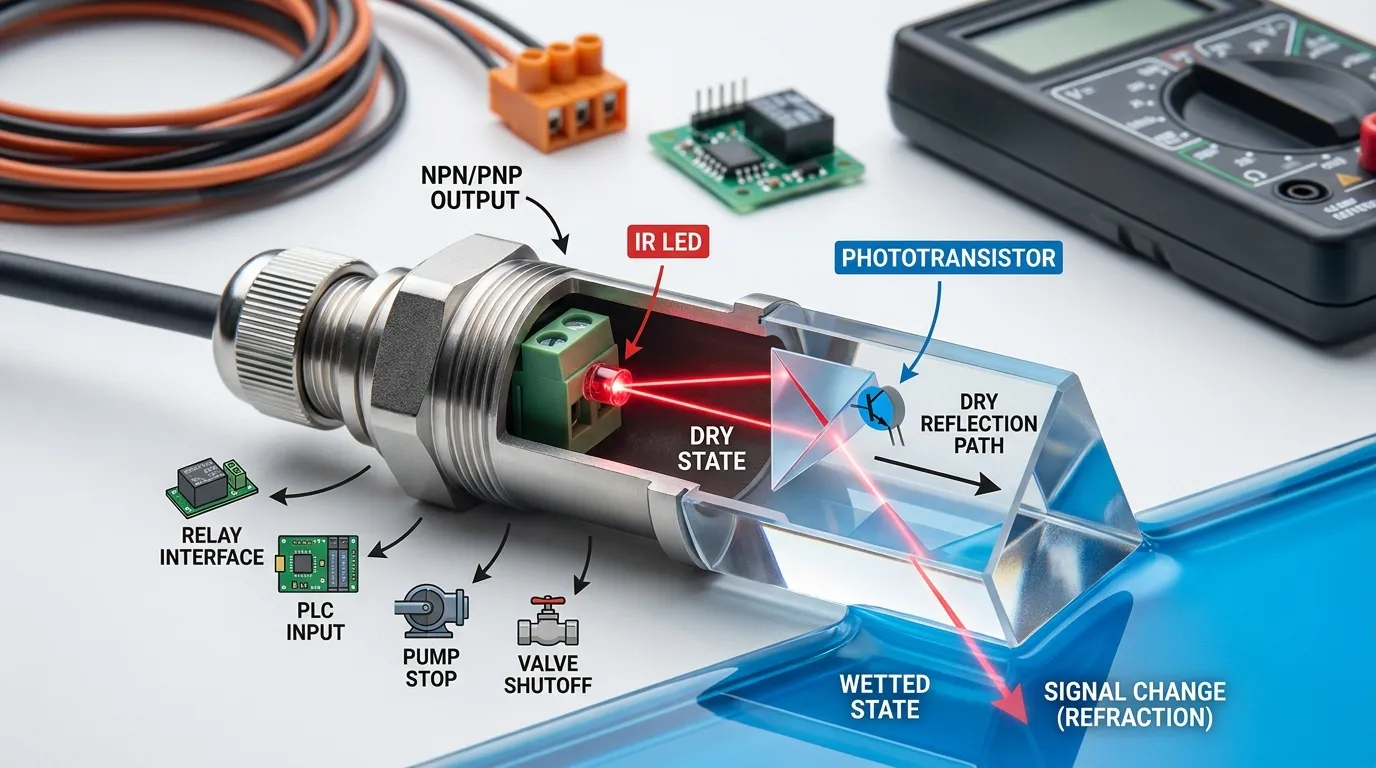
Taobh istigh den rinn braiteora, seolann LED infridhearg solas isteach i bpriosma. Faigheann fóta-trasraitheoir an solas frithchaite. San aer, léiríonn an priosma an bhíoma infridhearg ar ais i dtreo an ghlacadóra. Nuair a chlúdaíonn leacht an priosma, Athraíonn an coinníoll athraonta, Filleann níos lú solais ar an nglacadóir, agus an stát aschuir lasca ciorcad leictreonach.
Tá an prionsabal braite tirim-versus-fliuch seo úsáideach le haghaidh cosaint ró-shreabhadh toisc nach dteastaíonn achar taistil fada ón braiteoir. Tá an pointe lasctha gar don rinn braiteoir fisiceach, mar sin is féidir an seasamh ardleibhéil a chur in aice le barr an umair, faoi bhun an chalafoirt ró-shreabhadh nó an corrlach sábháilteachta.
Ag brath ar chóras rialaithe an cheannaitheora, is féidir an t-aschur a chumrú le haghaidh ionchur díreach PLC, Boird aláraim ísealvoltais, ciorcaid comhéadan sealaíochta, nó leictreonaic OEM saincheaptha. Tá aschuir NPN agus PNP coitianta do chórais rialaithe dhigiteacha. Do chórais leibhéil leanúnacha, 4Is féidir -20 mA a úsáid, Ach is gnách go n-úsáideann cosaint ró-shreabhadh lasc pointe-leibhéal toisc nach dteastaíonn ach aláram ardleibhéil nó comhartha scoite ón gciorcad.
Aláraim Ardleibhéil vs Múchadh Uathoibríoch
Ba chóir cosaint ró-shreabhadh a dhearadh timpeall ar an méid a chaithfidh tarlú nuair a shroichtear an pointe ardleibhéil.
An ciorcad aláraim amháin rabhadh don oibreoir trí dordánaí, túr solais, taispeáint, Aláram PLC, nó comhartha iargúlta. Tá sé seo oiriúnach nuair a bhíonn deimhniú daonna ag teastáil sula stopann tú próiseas, nó nuair a bhíonn an t-umar mar chuid de stáisiún líonta láimhe.
An ciorcad múchta uathoibríoch Stopann insreabhadh gan fanacht le hoibreoir. Is féidir leis an gcomhartha braiteora caidéal líonta a stopadh, Dún Comhla Inlet, Caidéal dosing a dhíchumasú, nó idirghlasáil rialaitheora a spreagadh. Is fearr é seo nuair a d'fhéadfadh ró-shreabhadh damáiste a dhéanamh do threalamh go tapa nó nuair a d'fhéadfadh líonadh tarlú gan aire.
Úsáideann go leor córais thionsclaíocha an dá cheann: Spreagann an chéad braiteoir ardleibhéil aláram agus stopann sé ag líonadh, cé go bhfeidhmíonn an dara braiteoir ard-ard mar chúltaca iomarcach. Ba chóir an braiteoir cúltaca a shreangú isteach in aláram neamhspleách nó loighic sábháilteachta nuair is féidir, ní hamháin sa riocht bogearraí céanna.
I gcás córais ina bhfuil an modh teip os coinne tábhachtach freisin, mar shampla caidéal a chosc ó rith gan leacht, féach ar ár Cosaint tirim-reáchtáil caidéil Feidhmchlár.
Roghanna Sreangaithe Scoite Ardleibhéil
Braitheann an dearadh sreangú ar cibé an dtéann an comhartha braiteora chuig PLC, Modúl sealaíochta, rialaitheoir caidéil, tiománaí comhla, nó bord aláraim. Ag céim RFQ, Deimhníonn ár bhfoireann voltas soláthair, Cineál Aschuir, Gnáthstaid, fad cábla, cónascaire, agus cé acu ba chóir go mbeadh an comhartha gníomhach nuair a bhíonn sé tirim nó gníomhach nuair a bhíonn sé fliuch.
| Feidhm Ardleibhéil | Conair Comhartha Tipiciúil | Rogha Aschuir Coiteann | Gníomh Cuarda |
|---|---|---|---|
| Aláram ró-shreabhadh logánta | Braiteoir → bord aláraim → dordánaí / beacon | NPN, PNP, nó comhéadan sealaíochta | Casann sé ar aláram amhairc nó inchloiste nuair a bhíonn an barr fliuch |
| Ionchur ardleibhéil PLC | Braiteoir → ionchur digiteach PLC | NPN nó PNP | Cláraíonn PLC coinníoll ardleibhéil agus ritheann loighic aláraim |
| Gearradh caidéil | Braiteoir → sealaíochta / rialaitheoir → tosaithe caidéil | NPN / PNP le comhéadan sealaíochta | Stopann caidéal líonta nuair a shroicheann leacht pointe ard |
| Múchadh comhla | Braiteoir → rialaitheoir / tiománaí → comhla solenoid | NPN / PNP nó comhéadan sealaíochta | Dúnann comhla inlet chun cosc a chur ar líonadh breise |
| Aláram ard-ard iomarcach | An dara braiteoir → ionchur nó aláram neamhspleách | Aschur digiteach ar leithligh | Rabhadh cúltaca má theipeann ar an gcéad chéim rialaithe |
| Bord rialaithe OEM | Braiteoir → ionchur PCB saincheaptha | Aschur nó cónascaire trasraitheoir saincheaptha | Comhtháthaíonn cosaint ró-shreabhadh i leictreonaic trealaimh |
Maidir le córais atá ríthábhachtach ó thaobh sábháilteachta de, Níor cheart déileáil leis an braiteoir mar fheiste sábháilteachta neamhspleách mura ndéantar an ailtireacht rialaithe iomlán a dhearadh agus a bhailíochtú chun na críche sin. Is é ról praiticiúil an lasc optúil ná soláthar tapa, Brath ardleibhéil in-athdhéanta don aláram nó don chiorcad scoite.
iomarcaíocht leis an dara braiteoir ard-ard
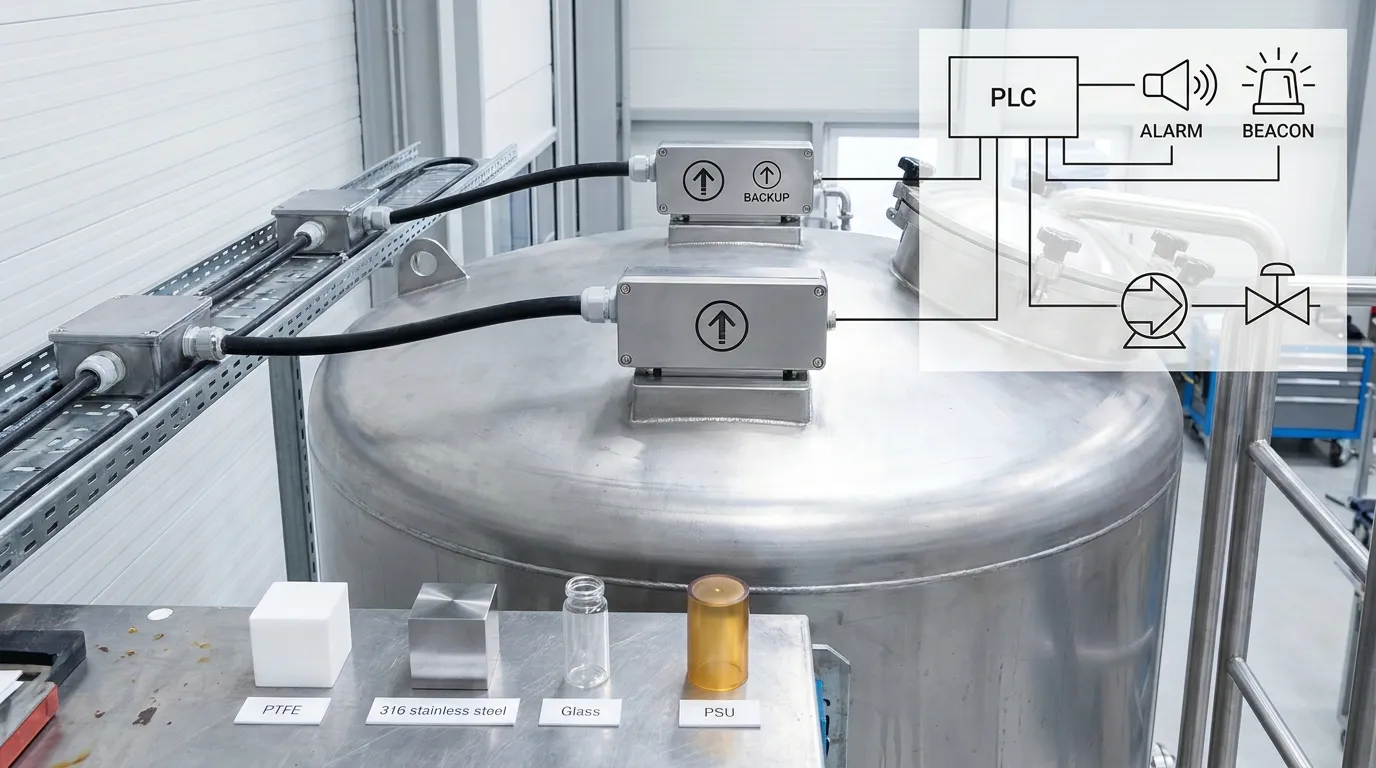
Is minic a bhíonn braiteoir optúil ardleibhéil amháin go leor le haghaidh cosaint trealaimh shimplí. Cén dóigh faoin spéir a ...?, moltar an dara braiteoir nuair a d'fhéadfadh ró-shreabhadh damáiste a dhéanamh do threalamh daor, limistéar táirgthe a thruailliú, nó doirteadh guaiseach a chruthú.
Is féidir an chéad braiteoir a chur ag an ngnáthphointe stad aláraim ardleibhéil nó líonta. Ba chóir an dara braiteoir a shuiteáil beagán níos airde, Faoi bhun an fhíorphointe ró-shreabhadh, mar chomhartha éigeandála ard-ard. Is féidir leis an dara comhartha seo beacon ar leithligh a ghníomhachtú, Seol Locht Rialaitheora, Díchumasaigh an t-ordú líonta, nó athshocrú láimhe a cheangal.
Cuidíonn iomarcaíocht le cosaint i gcoinne lochtanna sreangaithe, Earráidí clárúcháin rialaitheora, Inlet blocáilte, Comhlaí teipthe, Socruithe oibreora míchearta, nó cábla braiteoir príomhúil damáiste. Tugann sé diagnóis locht níos soiléire d'fhoirne cothabhála freisin: má spreagann an braiteoir ard-ard, Níor rialaigh an gnáthstad ardleibhéil an teagmhas líonta mar a bhíothas ag súil leis.
Gléasta Tank-Top le haghaidh Cosaint Overspill
Is gnách go suiteáiltear braiteoirí ró-shreabhadh ó bharr an umar nó ón mballa taobh uachtarach. Coinníonn gléasadh umar-barr an barr braite ag an bpointe ardleibhéil agus an cábla ag imeacht os cionn an limistéir leachtach. Is minic a bhíonn sé oiriúnach d'umair phlaisteacha, taiscumair cuisnithe, Umair Dosing, umair uisce, umair imoibrí, agus coimeádáin leachtacha OEM.
I measc na bpríomhroghanna gléasta tá gléasadh snáithithe, gléasta painéil, suiteáil i stíl chomhbhrúite, nó feistiú OEM saincheaptha. Ba chóir go mbeadh méid an snáithe agus an modh séalaithe ag teacht le tiús balla an umair, dearadh caipín, agus timpeallacht seirbhíse. Le haghaidh go leor feidhmchlár, Is féidir braiteoir optúil dlúth a shuiteáil san áit nach mbeadh dóthain imréitigh ag lasc snámhphointe chun bogadh.
Ba chóir an barr braite a shuíomh faoi bhun an phointe doirteadh le corrlach leordhóthanach le haghaidh moill stad caidéil, Am dúnta comhla, suaiteacht leachtach, cúr, nó gluaiseacht tonn. Má tá splancscáileán láidir ag an umar, feadán stilling, suíomh sciath, Moill Bogearraí, nó d'fhéadfaí scagadh loighic a mheas, ach níor chóir go mbeadh an mhoill chomh fada sin go gcuireann sé an ruaig ar an gcosaint ró-shreabhadh.
Le haghaidh iarratais umar i margadh na hIndia, Tacaímid freisin Braiteoir ró-shreabhadh d'umair tionscadail le cumraíocht OEM agus tacaíocht onnmhairithe.
Ábhair agus Sonraíochtaí a Dhearbhú
Caithfidh an corp braiteora agus na codanna fliucha an leacht a mheaitseáil. Is féidir le HojellyTek roghanna mar PSU a phlé, PTFE, 316 cruach dhosmálta, nó gloine ag brath ar chomhoiriúnacht na meán, Coinníollacha glantacháin, agus riachtanais mheicniúla.
Sula n-ordaítear, Deimhnigh:
- Cineál leachtach: uisce, cuisnithe, ola, breosla, ceimiceach, imoibrí, glantach, nó leacht measctha
- Cibé an bhfuil an leacht soiléir, daite, cúr, greamaitheach, sciath, nó suaite
- Ábhar umar agus tiús balla
- Stíl gléasta: umar-barr, taobhbhalla, snáithithe, Flange, nó feistiú saincheaptha
- Aschur riachtanach: NPN, PNP, Comhéadan Sealaíochta, analógach, nó comhartha boird OEM
- Voltas soláthair a theastaíonn ón rialtóir nó ón mbord aláraim
- Gnáthstát: aláram nuair a bhíonn sé fliuch nó aláram nuair a bhíonn sé tirim
- Fad cábla, cineál cónascaire, riachtanais dath sreinge, agus riachtanais chosanta IP
- Cibé an bhfuil an dara braiteoir ard-ard ag teastáil
- Ceanglais maidir le ceann scríbe onnmhairithe agus doiciméadú
Do na meáin ionsaitheacha, limistéir ardteochta, nó tionscadail limistéir ghuaiseacha, Ba chóir athbhreithniú cúramach a dhéanamh ar roghnú ábhair agus imfhálaithe sula gceadaítear samplaí.
Optúil vs Snámhphointe le haghaidh Ciorcaid Aláraim Overflow
| Pointe Roghnúcháin | Lasc Ardleibhéil Optúil | Athraigh Snámhphointe Meicniúil |
|---|---|---|
| Páirteanna ag gluaiseacht | Gan aon lámh snámhphointe nó hinge | Éilíonn gluaiseacht snámhphointe |
| Pointe freagartha | Lasca nuair a shroicheann leacht barr priosma | Braitheann ar thaisteal snámhphointe agus uillinn |
| Oiriúnach umar dlúth | Maith do spásanna caol OEM | Teastaíonn imréiteach gluaiseachta uaidh |
| Riosca leachtach greamaitheach | Níl aon snámhphointe le greamú, ach caithfear sciath a mheas | Is féidir le snámhphointe bata, salach, nó subh |
| Solúbthacht gléasta | Oiriúnach le haghaidh gléasta umar-barr nó taobh | Tá treoshuíomh agus cosán gluaiseachta tábhachtach |
| Úsáid ciorcad aláraim | Oiriúnach láidir d'aláram digiteach ardleibhéil | Coitianta in umair shimplí |
| Imní chothabhála | Seiceáil glaineacht priosma agus sláine cábla | Seiceáil gluaiseacht snámhphointe, inse, agus tógáil suas |
Seicliosta um Chosaint Ró-Shreabhadh
Bain úsáid as an seicliosta seo agus RFQ á sheoladh agat le haghaidh tionscadal cosanta ró-shreabhadh braiteoir leibhéal optúil:
- Sainmhínigh an pointe aláraim ardleibhéil cruinn taobh istigh den umar.
- Deimhnigh an fad idir an pointe aláraim agus an fíorphointe ró-shreabhadh.
- Déan cinneadh ar chóir don braiteoir ach aláram a spreagadh nó stop a chur le líonadh.
- Sonraigh an dtéann an t-aschur chuig PLC, sealaíocht, rialaitheoir caidéil, tiománaí comhla, nó bord aláraim.
- Deimhnigh NPN, PNP, Comhéadan Sealaíochta, nó riachtanas aschuir saincheaptha.
- Déan cinneadh an bhfuil gá le dara braiteoir cúltaca ard-ard.
- Deimhnigh comhoiriúnacht leachtach le PSU, PTFE, 316 cruach dhosmálta, gloine, nó ábhair fhliucha eile.
- Treo gléasta a sholáthar: umar-barr, taobhbhalla, suite ar chaipín, snáithithe, nó saincheaptha OEM.
- Seiceáil an bhfuil splancscáileán, cúr, sciath, nó d'fhéadfadh suaitheadh tionchar a imirt ar an bpointe ardleibhéil.
- Deimhnigh fad cábla, cónascaire, treo scoir sreang, agus ceanglais séalaithe.
- Deimhnigh cainníocht samplach, Riachtanais líníochta, agus ionchais bhaisc táirgeachta.
5-Próiseas Seirbhíse Céim
1. Fiosrúchán
Seol líníocht an umair, cineál leachtach, ciorcad rialaithe, post ardleibhéil, agus aschur sprioc. Tá grianghraif den limistéar umar úsáideach nuair a bhíonn spás teoranta.
2. Spec agus Saincheaptha
Deimhníonn ár bhfoireann innealtóireachta an struchtúr braite, Ábhar fliuch, Cineál Aschuir, snáithe gléasta, cábla, cónascaire, agus loighic aláraim.
3. Sampla
Is féidir sampla a ullmhú le haghaidh tástála oiriúnacha, Fíorú lasctha fliuch / tirim, agus seiceálacha comhoiriúnachta rialaitheora.
4. Táirgeadh agus QC
Tar éis dearbhú samplach, Leanann an táirgeadh an chumraíocht cheadaithe. Díríonn seiceálacha eochracha ar chuma, sreangú, feidhm lasctha, agus riachtanais a bhaineann go sonrach leis an gcustaiméir.
5. Loingseoireacht
Mar mhonaróir agus onnmhaireoir Shenzhen, Tacaíonn HojellyTek le ceannaitheoirí thar lear sna Stáit Aontaithe, TÁIMID, An India, agus margaí eile a bhfuil comhordú cumarsáide agus doiciméadúcháin atá réidh le honnmhairiú.
Cén fáth a n-oibríonn sé le HojellyTek
Díríonn HojellyTek ar bhrath optúil fótaileictreach agus braite leibhéal leachtach, le R inmheánach&Tacaíocht D agus OEM / ODM do struchtúr braiteora, ábhar, cábla, cónascaire, agus saincheaptha aschuir. Tacaímid le ceannaitheoirí a dteastaíonn plé innealtóireachta praiticiúil uathu roimh tháirgeadh, ní hamháin uimhir pháirt chatalóige.
Le haghaidh tionscadail umar cliste nó trealaimh nasctha, is féidir lenár bhfoireann comhtháthú a bhaineann le Tuya agus Smart Life a phlé freisin nuair a bhaineann sé le dearadh iomlán na feiste.
Ceisteanna CCanna
Conas a oibríonn cosaint ró-shreabhadh braiteoir leibhéal optúil?
Úsáideann cosaint ró-shreabhadh braiteoir leibhéal optúil LED infridhearg, Fóta-trasraitheoir, agus barr priosma chun a bhrath nuair a shroicheann leacht an pointe ardleibhéil. Nuair a athraíonn an barr ó thirim go fliuch, na lasca aschuir agus is féidir leo aláram a spreagadh, Stad caidéil, comhla dúnadh, nó comhartha ardleibhéil PLC.
An bhfuil lasc optúil níos fearr ná lasc snámhphointe le haghaidh aláraim ró-shreabhadh?
Le haghaidh umair dhlúth nó riosca greamaitheach-snámhphointe, Is minic a bhíonn lasc optúil níos fearr toisc nach bhfuil aon lámh snámhphointe ag gluaiseacht. Athraíonn sé ag barr an phriosma in ionad a bheith ag brath ar thaisteal meicniúil. Sciath leachtach, Comhoiriúnacht cheimiceach, agus caithfear seasamh gléasta a sheiceáil fós.
An féidir leis an braiteoir caidéal a stopadh go huathoibríoch?
Tá, má tá an ciorcad rialaithe deartha dó. Is féidir leis an aschur braiteoir optúil dul chuig PLC, Modúl sealaíochta, rialaitheoir caidéil, nó ciorcad idirghlasála a stopann an caidéal líonta nuair a shroichtear an pointe ardleibhéil.
Ar cheart dom braiteoir amháin nó dhá bhraiteoir a úsáid?
Bain úsáid as braiteoir ardleibhéil amháin le haghaidh aláram ró-shreabhadh bunúsach nó stad líonta. Cuir an dara braiteoir ard-ard leis nuair a d'fhéadfadh ró-shreabhadh damáiste a dhéanamh do threalamh daor, saincheisteanna sábháilteachta a chruthú, nó loighic aláraim cúltaca a cheangal.
Cá háit ar chóir an braiteoir a shuiteáil?
Úsáideann an chuid is mó de na hiarratais ró-shreabhadh gléasta umar-barr nó taobhbhalla uachtarach. Ba chóir go suífeadh an barr priosma faoi bhun an phointe ró-shreabhadh iarbhír le corrlach leordhóthanach le haghaidh moill caidéil, Am dúnta comhla, splancscáileán, agus gluaiseacht leachtach.
Cén fhaisnéis ba chóir dom a sheoladh le haghaidh luachan?
Seol an cineál leachtach, Líníocht umar nó grianghraif, Suíomh gléasta, voltas soláthair, Cineál Aschuir, Gnáthstaid Aláraim, riachtanais cábla nó cónascaire, agus cibé an rialaíonn an braiteoir aláram, Caidéal, comhla, PLC, nó cúltaca ciorcad ard-ard.
Iarratas ar luachan
Seol do líníocht cosanta ró-shreabhadh, cineál leachtach, ciorcad rialaithe, agus sprioc modh gléasta chuig HojellyTek trí WhatsApp nó ríomhphost. Is féidir lenár bhfoireann cumraíocht lasc optúil ardleibhéil a mholadh le haghaidh aláraim amháin, Múchadh uathoibríoch, nó cosaint ró-shreabhadh ard-ard iomarcach.


