
Braiteoir Leibhéal Optúil le haghaidh Caidéal Cosaint Tirim-Rith
Cosaint rith tirim caidéil braiteoir leibhéal optúil Cuidíonn sé le caidéal a stopadh sula dtiteann leacht faoi bhun an phointe súchán sábháilte agus is cúis le rónta dóite, impellers damáiste, róthéamh, nó iontógáil aeir. Soláthraíonn HojellyTek braiteoirí leibhéal optúil fótaileictreach le haghaidh dlúth, ciorcaid scoite ísealleibhéil mearfhreagartha in umair, taiscumair, Córais cuisnithe, coimeádáin ola, agus tionóil caidéil OEM.
Bain úsáid as an leathanach seo chun an braiteoir a shonrú, loighic sreangaithe, Pointe gléasta, agus iompar a athshocrú le haghaidh ciorcad iontaofa um chosc tirim-rith.
Cumas Cosanta Tirim-Rith Caidéil Optúil
Le haghaidh cosanta caidéil, Ní táscaire leibhéal amháin é an braiteoir. Is é an pointe cinnidh ísealleibhéil sa chiorcad rialaithe: nuair a thiteann an leacht faoi bhun an airde scoite, Athraíonn an t-aschur staid agus stopann an rialtóir an caidéal.
Tacaíonn HojellyTek le tionscadail chosanta tirim a d'fhéadfadh a bheith san áireamh:
- Brath optúil pointe-leibhéal ag an leibhéal leachtach íosta sábháilte
- Aschur scoite ísealleibhéil do PLC, Bord sealaíochta, rialaitheoir caidéil, nó ionchur VFD
- NPN, PNP, nó roghanna comhartha analógach ag brath ar an gcóras rialaithe
- Roghnú loighic NO/NC bunaithe ar riachtanais theip-shábháilte
- Braiteoirí priosma-tip dlúth d'umair bheaga agus modúil caidéil OEM
- Roghnú ábhar fliuch mar PSU, PTFE, 316 cruach dhosmálta, nó gloine
- Gléasta snáithithe nó saincheaptha do bhalla umar, taobh taiscumar, nó suiteáil seomra
- Saincheaptha OEM / ODM le haghaidh tithíochta, cábla, cónascaire, snáthaid, agus loighic aschuir
Le haghaidh forbhreathnú ginearálta ar an táirge, féach ar ár Braiteoir Leibhéal Optúil Raon. Le haghaidh tagairt táirge réidh, athbhreithniú a dhéanamh ar an Athraigh leibhéal leachtach fótaileictreach.
Cén fáth go gcaithfidh gearradh tirim tarlú sula ritheann an caidéal folamh
Ní gá do chaidéal rith tirim ar feadh i bhfad sula dtosaíonn damáiste. Nuair nach bhfuil leacht i láthair a thuilleadh ar an taobh súchán, D'fhéadfadh an caidéal fuarú a chailleadh, lubrication, agus ualach hiodrálach. Is féidir leis an toradh a bheith rónta meicniúla dóite, impellers damáiste, Páirteanna fliucha róthéite, cavitation, tonnchrith, nó teip caidéil iomlán.
Dá bhrí sin, ní mór do chiorcad cosanta tirim ceist phraiticiúil amháin a fhreagairt:
Ag cén leibhéal cruinn leachtach ba chóir an caidéal a bhrú OFF?
Tá braiteoir leibhéil optúil suite ag an scoithphointe sin. Nuair a chlúdaíonn leacht an barr priosma, Feiceann an braiteoir an staid "fliuch". Nuair a thiteann leacht faoi bhun an rinn, Athraíonn an cosán optúil agus lascann an t-aschur go tapa. Ansin baineann an ciorcad rialaithe an comhartha reáchtáil caidéil, osclaíonn sealaíocht, díchumasaíonn ionchur VFD, nó seolann sé ordú stad chuig an rialtóir caidéil.
Tá sé seo difriúil ó mhonatóireacht ghinearálta umar. I gcosaint tirim-rith, suíomh an braiteora, loighic aschuir, agus caithfear iompar athshocraithe a dhearadh timpeall ar shábháilteacht caidéil.
Conas a Bhrathann an Braiteoir Optúil Stáit Fliuch agus Tirim
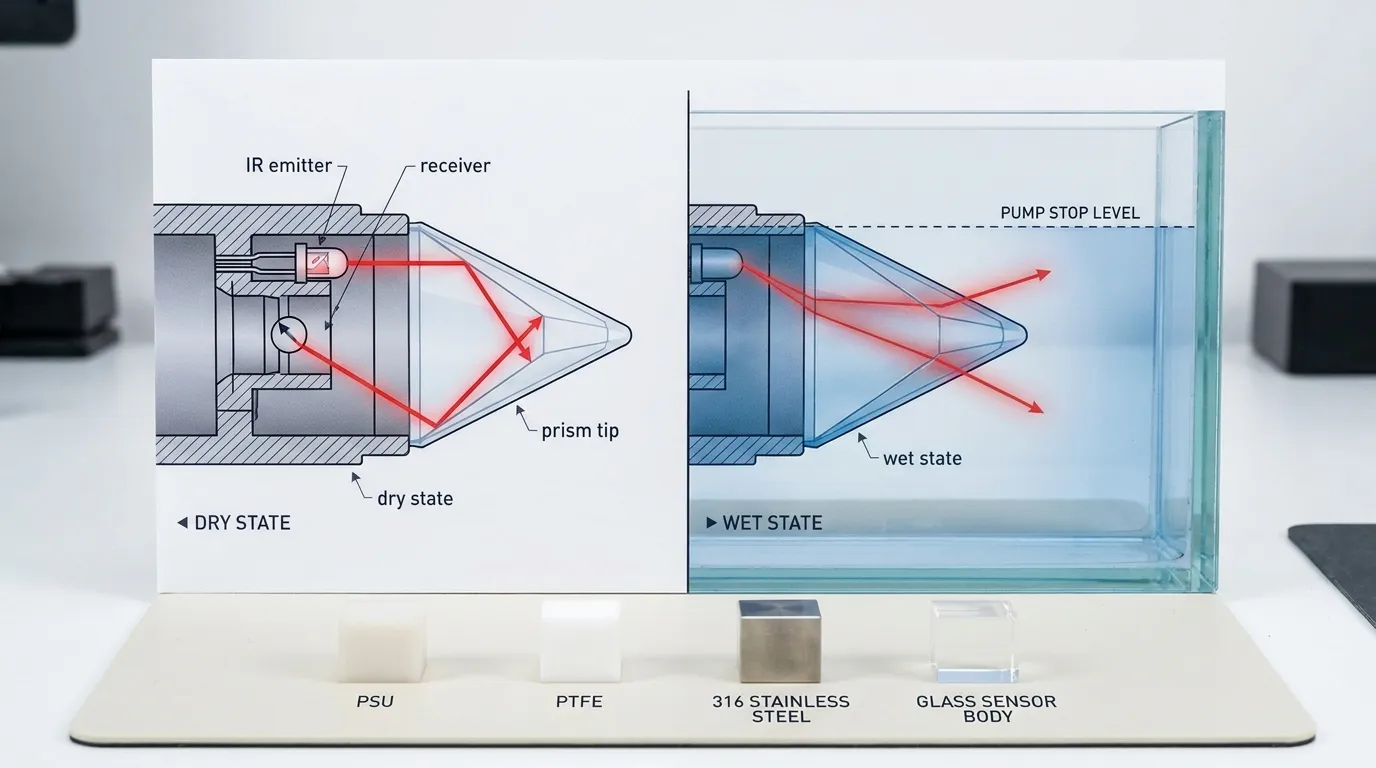
Úsáideann braiteoir leibhéal fótaileictreach LED infridhearg, fóta-trasraitheoir, agus priosma optúil múnlaithe ag an rinn braite. San aer, Frithchaitear solas infridhearg go hinmheánach taobh istigh den phriosma agus sroicheann sé an glacadóir. Nuair a bhíonn an priosma clúdaithe le leacht, Athraíonn an coinníoll athraonta agus filleann níos lú solais ar an nglacadóir. Déanann an leictreonaic an t-athrú optúil seo a thiontú ina aschur digiteach.
Níl aon lámh snámhphointe ag an dearadh seo, maighnéad, inse, nó cuid mheicniúil ag gluaiseacht taobh istigh den leacht. Tá sé sin tábhachtach d'iarratais scoite caidéil nuair a bhíonn mall, greamaithe, nó is féidir le snámhphointe tilted moill a chur ar an gcomhartha stad. Tá braiteadh optúil úsáideach go háirithe do thaiscumair dhlúth, seomraí caol, Trealamh OEM, umair cuisnithe, córais dosing, coimeádáin uisce, agus modúil caidéil séalaithe ina bhféadfadh lasca meicniúla a bheith ró-mhór.
De ghnáth úsáideann ciorcad tirim-rith an braiteoir mar lasc pointe-leibhéal. Le haghaidh feidhmchlár braite pointí gaolmhara, féach ar ár Athraigh leibhéal pointe Leathanach.
Sreangú Gearrtha Ísealleibhéil le haghaidh Rialú Caidéil
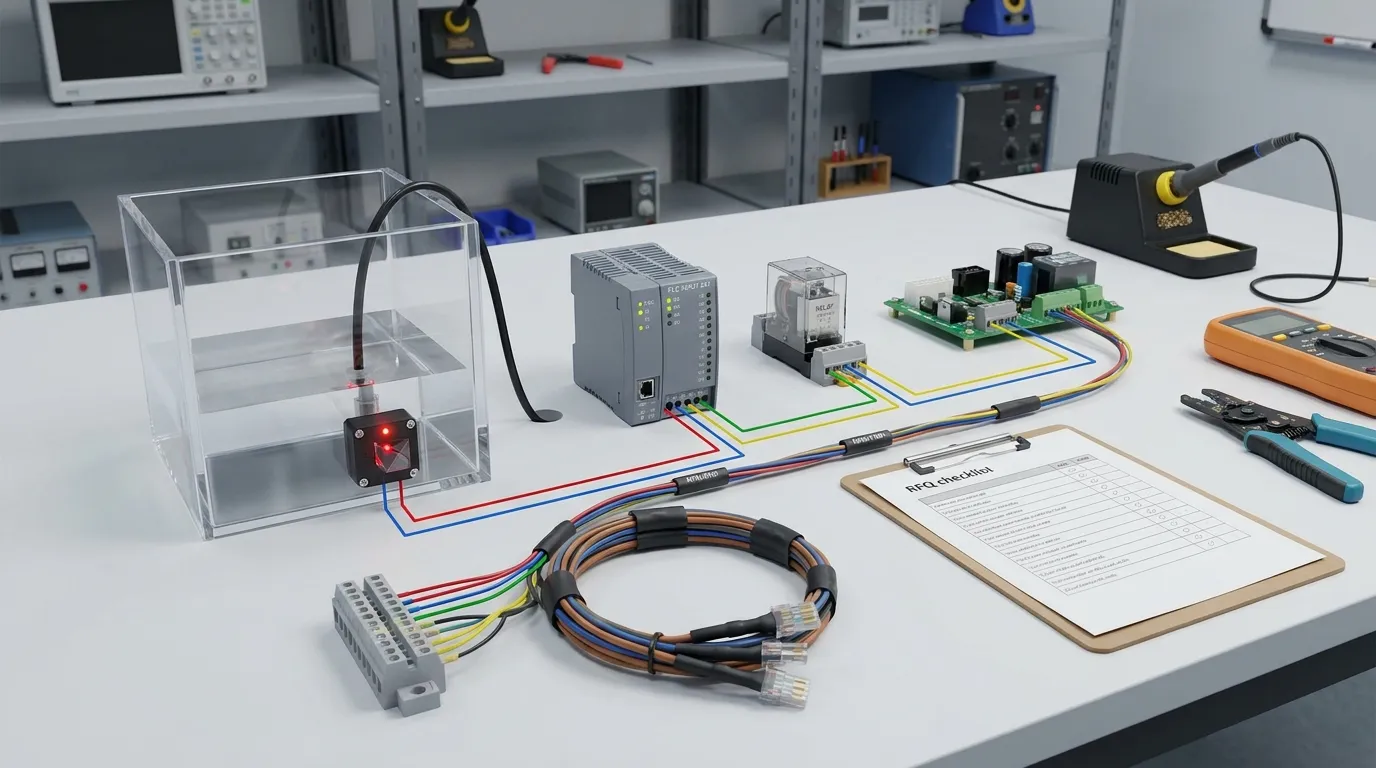
Ba chóir an t-aschur braiteora a mheaitseáil leis an ionchur rialaithe, Ní roghnaítear ach de réir cruth braiteora. Sula n-ordaítear, Deimhnigh an n-úsáideann do chóras caidéil corna sealaíochta, Ionchur digiteach PLC, Ionchur teagmhála tirim VFD, ionchur trasraitheoir, nó PCB saincheaptha.
I measc na gcomhshocruithe rialaithe tá:
- Braiteoir go hionchur PLC: léann an PLC staid fliuch / tirim agus rialaíonn sé an teagmhálaí caidéil nó VFD.
- Braiteoir go modúl sealaíochta: Tiomáineann an braiteoir sealaíocht a osclaíonn an ciorcad cumasaithe caidéil.
- Braiteoir go rialtóir caidéil: faigheann an rialtóir aláram ísealleibhéil nó comhartha cead reáchtáil.
- Braiteoir go hionchur VFD: Díchumasaíonn an comhartha tirim-rith oibriú tiomána nó spreagann sé ionchur locht.
- Braiteoir go OEM PCB: Léann an bord rialaithe táirge an comhartha go díreach.
Is é an dearadh is sábháilte de ghnáth loighic "cead reáchtáil". Ní cheadaítear an caidéal a reáchtáil ach amháin nuair a dheimhníonn an braiteoir go bhfuil leacht ann. Nuair a éiríonn an braiteoir tirim, baintear an cead reáchtáil.
Tábla Loighic Sreangú le haghaidh Cosaint Tirim-Rith
| Stát leachtach ag barr braiteora | Loighic aschuir braiteora | Léirmhíniú an rialaitheora | Gníomh caidéil | An cás úsáide is fearr |
|---|---|---|---|---|
| Fliuch / leachtach i láthair | Comhartha cead rith gníomhach | Leibhéal leachtach sábháilte ar fáil | Caidéal ceadaithe a reáchtáil | Cosaint chaighdeánach ísealleibhéil |
| Tirim / leacht thíos an leid | Baineadh comhartha cead rith | Braitheadh riosca tirim | Stopann an caidéal nó ní féidir é a thosú | Gearradh caidéil sábháilte teip |
| Fliuch tar éis athlíonadh | Comhartha gníomhach arís | Leacht athchóirithe | Auto-athshocrú nó athshocrú láimhe ag brath ar loighic | Taiscumair shimplí nó córais athlíonta rialaithe |
| Tirim le latch cumasaithe | Tá an turas fós gníomhach | Caithfear an locht a admháil | Fanann an caidéal OFF | Caidéil ardluacha, Dáileog cheimiceach, Córais gan freastal |
| Fliuch / tirim éagobhsaí in aice le líne na dtonn | D'fhéadfadh comhartha athrú arís agus arís eile | Riosca cainte | Úsáid moill, hysteresis, nó feadán stilling | Umair chorraithe nó seomraí beaga |
| Locht braiteora / cábla | Braitheann comhartha ar dhearadh sreangaithe | Locht nó gan cead rith | Ba chóir go stopfadh an caidéal i ndearadh teip-shábháilte | Ciorcaid chosanta caidéil chriticiúla |
Don chuid is mó d'fheidhmchlár tirim-rith, Sonraigh go soiléir an staid aschuir fliuch/tirim atá ag teastáil. Is féidir leis an mhonarcha cabhrú le NPN a mheaitseáil, PNP, NÍL/NC, nó aschur analógach do dhearadh rialaitheoir.
Freagra Optúil Tapa vs Lasca Snámhphointe Mall
Tá lasca snámhphointe coitianta, Ach ní bhíonn siad oiriúnach i gcónaí le haghaidh cosaint tirim-reáchtáil caidéil. Teastaíonn gluaiseacht fhisiciúil ó shnámhphointe, Spás le luascadh, agus treoshuíomh ceart. In umair bheaga, leacht olach, seomraí caidéil caol, nó trealamh le tonnchrith, d'fhéadfadh an snámhphointe freagairt go mall nó bata.
Freagraíonn braiteoir optúil go díreach ag an rinn braite. Nuair a nochtann an leacht an priosma, Athraíonn an staid optúil gan fanacht le lámh snámhphointe a thitim. Déanann sé seo an scoithphointe níos in-athláimhe agus níos dlúithe.
Tá braiteadh tirim-rith optúil úsáideach nuair a bhíonn gá leis an gceannaitheoir:
- Airde scoite beacht ísealleibhéil
- Gléasta dlúth taobh istigh de thaiscumar beag
- Aistriú tapa ag an leibhéal íosta sábháilte
- Níl aon chodanna ag gluaiseacht sa leacht
- Tithíocht agus saincheaptha cábla atá cairdiúil do OEM
- Comhtháthú comhartha níos glaine le PCB, PLC, nó rialtóir caidéil
Cén dóigh faoin spéir a ...?, Ní mór an braiteoir a roghnú i gceart fós. Leacht cúr, sciath trom, criostalú, nó d'fhéadfadh go mbeadh roghnú ábhair ag teastáil ó iarmhar tiubh, socrúchán leideanna, Rochtain a ghlanadh, nó modh cosanta breise.
Latch, Moill, agus Loighic Auto-Athshocraigh
Níl san aschur braiteora ach cuid amháin den chóras cosanta. Cinneann an loighic rialaithe cad a tharlaíonn tar éis riocht tirim a bhrath.
Loighic athshocraithe uathoibríoch Ligeann an caidéal a atosú tar éis leacht filleadh os cionn an rinn braiteora. Is féidir leis seo oibriú le haghaidh umair uisce simplí, taiscumair athlíonta, nó córais ina bhfuil atosú sábháilte agus a bhfuiltear ag súil leo.
Loighic latch Coinníonn an caidéal OFF tar éis turas tirim-rith go dtí go ndéanann oibreoir nó rialtóir an locht a athshocrú. Tá sé seo níos fearr le haghaidh caidéil daor, córais cheimiceacha, Dosing tionsclaíoch, trealamh gan freastal, nó córais ina bhféadfadh tosaithe tirim arís agus arís eile damáiste a dhéanamh.
Loighic moille cosc a chur ar thurais núis ó thonnta, splancscáileán, boilgeoga, nó gluaiseacht leachtach momentary timpeall an braiteora. Is féidir le moill ghearr rialaitheora a dhearbhú go bhfuil an braiteoir fíor-tirim sula stopann sé an caidéal. Is féidir le moill atosaithe cosc a chur ar rothaíocht ghearr tar éis athlíonadh.
Ní cothabháil caidéil é ábhar an leathanaigh; Is é an príomhphointe ná dearadh rialaithe: sainmhínigh cé acu ba chóir don aschur tirim stop a chur leis an gcaidéal láithreach, Stop tar éis moill fhíoraithe, latch go dtí athshocrú láimhe, nó athshocrú go huathoibríoch tar éis don chomhartha fliuch filleadh.
An braiteoir a gléasadh ag an scoithphointe
Ba chóir an braiteoir a shuiteáil ag an leibhéal íosta leachtach sábháilte, ní hamháin in aice le bun an umair. Braitheann an airde ceart ar an gcalafort súchán, geoiméadracht iontógáil caidéil, Riosca vortex, Toirt cúltaca riachtanach, agus cibé an mbogann dromchla an umar le linn na hoibríochta.
Treoir gléasta:
- Cuir an barr priosma ag an airde leachtach áit a gcaithfidh an caidéal stopadh.
- Coinnigh an barr glan ó bhallaí umar, coirnéil, criosanna dríodair, agus limistéir mharbha.
- Seachain suíomhanna ina nochtann boilgeoga nó splancscáileán arís agus arís eile an barr.
- Le haghaidh umair chorraithe, Smaoinigh ar fheadán stilling nó seomra braite cosanta.
- Le haghaidh suiteáil taobhbh-bhalla, Deimhnigh cineál snáithe, Modh séalaithe, agus treo cábla.
- Le haghaidh leachtanna ionsaitheacha ceimiceacha, Roghnaigh ábhair fhliucha comhoiriúnacha.
- Le haghaidh feidhmchlár ola nó breosla, Freagra optúil agus comhoiriúnacht ábhair a dhearbhú roimh olltáirgeadh.
Le haghaidh ró-shreabhadh agus cosaint ardleibhéil ag baint úsáide as prionsabail braite optúla comhchosúla, féach ar ár Braiteoir cosanta ró-shreabhadh Leathanach.
Seicliosta Cosanta Tirim-Rith Roimh RFQ
| Mír le deimhniú | Cén fáth go bhfuil sé tábhachtach don chiorcad scoite |
|---|---|
| Cineál leachtach | Uisce, cuisnithe, ola, breosla, ceimiceach, nó bíonn tionchar ag leacht measctha ar iompar ábhair agus optúil |
| Íosleibhéal sábháilte | Cinneann sé an airde gléasta braiteora cruinn |
| Ábhar umar nó seomra | Bíonn tionchar aige ar an snáithe, Séalaithe, agus modh gléasta |
| Cineál ionchuir rialaithe | PLC, sealaíocht, VFD, rialaitheoir caidéil, nó PCB éilíonn meaitseáil aschuir difriúil |
| Rogha aschuir | NPN, PNP, NÍL/NC, nó caithfidh aschur analógach an ciorcad a mheaitseáil |
| Athshocraigh loighic | Athraíonn athshocrú uathoibríoch nó athshocrú latch iompar atosaigh caidéil |
| Ceanglas moille | Cosc ar thurais bhréagacha ó thonnta, tonnchrith, boilgeoga, nó splancscáileán |
| Ábhar fliuch | PSU, PTFE, 316 cruach dhosmálta, nó ba chóir go mbeadh gloine ag teacht le leacht agus an timpeallacht |
| Cábla agus cónascaire | Tábhachtach do thionól OEM, Rochtain ar an tSeirbhís, agus ródú uiscedhíonach |
| Treoshuíomh suiteála | Taobh mount, gléas ingearach, gléas seomra, nó tionchar a bhíonn ag sealbhóir saincheaptha ar iontaofacht |
5-Próiseas Seirbhíse Céim
1. Fiosrúchán
Seol do chineál caidéil, líníocht umar, cineál leachtach, Ionchur rialaithe, agus an leibhéal scoite riachtanach trí WhatsApp nó ríomhphost. Grianghraif, léaráidí sreangaithe, nó cuidíonn sonraí ionchuir PCB lenár n-innealtóirí freagairt níos tapúla.
2. Sonraíocht agus Saincheaptha
Deimhníonn ár bhfoireann an cineál braiteoir optúil, Ábhar fliuch, loighic aschuir, snáthaid, cábla, cónascaire, agus treo gléasta. Do thionscadail OEM / ODM, Is féidir sonraí tithíochta agus úim a choigeartú chun dearadh an trealaimh a oiriúnú.
3. Sampla
Is féidir sampla a ullmhú le haghaidh tástála comhartha fliuch / tirim i do chiorcad leachtach agus rialaitheora iarbhír. Tá an chéim seo tábhachtach chun iompar athshocraithe a sheiceáil, uainiú stad ísealleibhéil, agus suíomh gléasta.
4. Táirgeadh agus QC
Tar éis ceadú samplach, leanann an táirgeadh an tsonraíocht dheimhnithe. Díríonn QC ar fheidhm lasctha optúil, Iompar Aschuir, sreangú, Séalaithe, agus cuma bunaithe ar an gcumraíocht chomhaontaithe.
5. Loingseoireacht
Onnmhairíonn HojellyTek táirgí braiteoir leibhéal leachtach optúla ó Shenzhen chuig custaiméirí sna Stáit Aontaithe, TÁIMID, An India, agus margaí eile. Déantar pacáistiú agus doiciméadú a eagrú de réir riachtanais an tionscadail.
Riachtanais agus Specs le Deimhniú
Brazzers físeán catagóir Inexperienced, Déagóirí, Seapáinis, Aziatochki, Téalainnis, Físeán HD ar a dtugtar Téalainnis Cailín Kim watch gan chlárú sa HD, Deimhnigh na sonraí seo sula n-ordaíonn tú:
- Ainm agus tiúchan leachtach
- Gnáthleibhéal leachtach agus íosleibhéal leachtach
- Tiús balla umar agus spás gléasta
- Snáithe riachtanach nó struchtúr suiteála
- Ábhar comhlacht braiteoir agus ábhar priosma / tip
- Voltas soláthair a theastaíonn ón mbord rialaithe
- Cineál aschuir: NPN, PNP, 4-20 mA, nó comhéadan eile
- Rogha aschuir fliuch-stáit agus tirim-stáit
- Fad cábla, cónascaire, agus riachtanas dath sreinge
- Cibé acu ba chóir an caidéal a athshocrú go huathoibríoch nó fanacht latched OFF
- Cibé an bhfuil comhtháthú Tuya / Smart Life ag teastáil ón bhfeidhmchlár le haghaidh monatóireacht umar iargúlta
Ná buille faoi thuairim an loighic sreangaithe ag am suiteála. Ba chóir an ciorcad scoite a shonrú roimh an táirgeadh ionas go mbeidh an t-aschur braiteora agus an t-ionchur rialaitheora comhoiriúnach i gceart.
Braiteoir Optúil vs Modhanna Cosanta Tirim-Rith Eile
| Modh | Neart | Teorainn | Is fearr a oireann |
|---|---|---|---|
| Braiteoir leibhéil optúil | Freagra tapa ar leibhéal an phointe, dlúth, gan aon snámhphointe ag gluaiseacht | Teastaíonn ábhar ceart agus leid braite glan uaidh | Umair OEM, taiscumair, córais caidéil dhlúth |
| Lasc snámhphointe | Simplí agus eolach | Is féidir a bheith mall, toirtiúil, claonta, nó greamaithe | Umair níos mó le go leor spáis gluaiseachta snámhphointe |
| Lasc brú | Is féidir tátal a bhaint as riocht súchán nó urscaoilte íseal | B'fhéidir nach mbraitheann leibhéal an umar iarbhír go díreach | Córais caidéil a dteastaíonn cúltaca brú-bhunaithe uathu |
| Lasc sreafa | Brath caillteanas sreafa iarbhír | May react after flow has already failed | Cosaint píblíne agus dearbhú tánaisteach |
| Braite reatha | Aimsíonn ualach mótair neamhghnácha | Éilíonn tiúnadh agus d'fhéadfadh sé a bheith éagsúil de réir caidéil | Ciseal cosanta mótair, Gearradh leibhéal beacht |
Do go leor córais dhlúth, Is é an braiteoir optúil an gléas scoite ísealleibhéil is dírí. Do chórais thionsclaíocha chasta, is féidir é a chomhcheangal le brú freisin, sreabhadh, nó monatóireacht reatha ar chosaint srathaithe.
Cén fáth a n-oibríonn sé le HojellyTek
Is monaróir agus onnmhaireoir Shenzhen é HojellyTek atá dírithe ar bhrath optúil fótaileictreach agus forbairt braiteoir leibhéal leachtach. Le R inmheánach&Cumas D agus OEM / ODM, Cabhraímid le ceannaitheoirí an comhlacht braiteora a mheaitseáil, ciorcad aschuir, cábla, agus dearadh gléasta leis an bhfeidhmchlár cosanta caidéil.
Tacaíonn ár bhfoireann le ceisteanna innealtóireachta praiticiúla: loighic fliuch/tirim, Roghnú NPN/PNP, Roghanna Snáithe, Comhoiriúnacht ábhair, agus tástáil samplach. In ionad lasc cineálach amháin a thairiscint do gach caidéal, Cabhraímid leis an scoithphointe a shainiú agus iompar a rialú roimh tháirgeadh.
Ceisteanna CCanna
An féidir le braiteoir leibhéal optúil cosc a chur ar rith tirim caidéil?
Tá. Nuair a bheidh sé suite ag an leibhéal íosta leachtach sábháilte, braitheann an braiteoir nuair a thiteann leacht faoi bhun an rinn priosma agus seolann sé comhartha tirim-stáit chun an caidéal a stopadh trí PLC, sealaíocht, VFD, nó rialtóir caidéil.
Cad a chiallaíonn cosaint rith tirim caidéil braiteoir leibhéal optúil?
Ciallaíonn sé braiteoir optúil pointe-leibhéal a úsáid mar an gléas scoite ísealleibhéil sa chiorcad rialaithe caidéil. Ní ritheann an caidéal ach amháin nuair a dhearbhaíonn an braiteoir go bhfuil leacht ann agus stopann sé nuair a bhraitheann an braiteoir riocht tirim.
Ba chóir an caidéal a atosú go huathoibríoch tar éis an umar a athlíonadh?
Braitheann sé ar riosca. Tá Auto-athshocrú oiriúnach d'umair athlíonta simplí. Tá Latch / athshocrú láimhe níos sábháilte do chaidéil daor, ceimiceáin, Córais gan freastal, nó iarratais ina bhféadfadh tosaithe tirim arís agus arís eile damáiste a dhéanamh don trealamh.
An bhfuil braiteoir optúil níos tapúla ná lasc snámhphointe?
I go leor umair dhlúth, Tá. Athraíonn braiteoir optúil staid ag barr an phriosma gan fanacht le lámh snámhphointe a bhogadh. Tugann sé seo comhartha scoite níos dírí ag an leibhéal leachtach roghnaithe.
Cá háit ar chóir an braiteoir a shuiteáil le haghaidh cosaint tirim-rith?
Suiteáil é ag an airde scoite íosta sábháilte os cionn an phointe riosca súchán caidéil. Seachain boilgeoga, dríodar, suaitheadh, agus suíomhanna inar féidir an barr braiteora a splancscáileán arís agus arís eile seachas a fhliuchadh go seasta.
Cén t-aschur ba chóir dom a roghnú le haghaidh rialtóir caidéil?
Roghnaigh an t-aschur bunaithe ar an ionchur rialaithe. Is minic a úsáideann PLCanna ionchuir digiteacha NPN nó PNP, D'fhéadfadh go mbeadh loighic NO / NC ag teastáil ó mhodúil sealaíochta, agus éilíonn roinnt córais ionchur PCB analógach nó saincheaptha. Deimhnigh é seo le linn RFQ.
Iarratas ar luachan le haghaidh Caidéal Dry-Run Braiteoir Cosaint
Seol do líníocht umar, cineál leachtach, Modh rialaithe caidéil, ionchur sreangaithe, agus an leibhéal scoite riachtanach chuig HojellyTek trí WhatsApp nó ríomhphost. Molaimid cumraíocht braiteoir leibhéal optúil do do chiorcad cosanta tirim-reáchtáil, loighic aschuir a áireamh, ábhar, snáthaid, cábla, agus roghanna tástála samplacha.


