
Braiteoir Leibhéal Uisce Optúil do Mheaisíní Caife
Cuidíonn braiteoir leibhéal uisce optúil do OEManna meaisín caife le déantóirí fearas uisce íseal a bhrath, uisce ard, ró-shreabhadh, agus riosca tirim-rith gan a bheith ag brath ar tóireadóirí seoltaí a d'fhéadfadh fionnaidh suas ó scála. Le haghaidh meaisíní espresso, meaisíní díola, grúdlanna caife, agus trealamh dí cliste, Soláthraíonn HojellyTek braiteoirí leibhéal fótaileictreach dlúth atá deartha le haghaidh taiscumar, coire-in aice láimhe, tráidire drip, agus comhtháthú umar inmheánach.
Ní hé ár bhfócas úsáid barista. Tá sé OEM dearadh-i: fachtóir foirme beag, aschur loighic cobhsaí, Ábhair fhliuchaithe oiriúnacha, athrú in-athdhéanta, Roghanna Sreangaithe, agus tacaíocht tithíochta saincheaptha do mhonaróirí fearas.
Cumas Braiteoir Leibhéal Uisce Optúil do OEManna Fearas
Forbraíonn agus onnmhairíonn HojellyTek réitigh braite leibhéal leachtach fótaileictreach ó Shenzhen do mhonaróirí a dteastaíonn dlúth uathu, Braite uisce iontaofa taobh istigh d'fhearais chríochnaithe. Le haghaidh trealamh caife agus díola, Is féidir an braiteoir a chumrú mar lasc ísealleibhéil, lasc ardleibhéil, Brathadóir ró-shreabhadh, Braiteoir umar inbhainte, nó ionchur cosanta caidéil.
Cuimsíonn tacaíocht OEM tipiciúil:
- Struchtúr braiteoir priosma optúil dlúth le haghaidh spásanna fearas daingean
- 5Dearadh aschuir loighic V nó 12V chun boird rialaithe fearas a mheaitseáil
- NPN, PNP, Ní hea, NC, agus roghanna loighic comhartha saincheaptha
- Roghnú ábhar bia-teagmhála bunaithe ar umar, Conair Uisce, agus coinníollacha glantacháin
- Taiscumar, coire-in aice láimhe, tráidire drip, agus tacaíocht socrúcháin umar díola
- Cábla, cónascaire, snáthaid, tithíocht, agus saincheaptha gléasta
- Forbairt OEM / ODM do bhrandaí fearas agus comhtháthóirí córais
- Meastóireacht shamplach roimh dheimhniú táirgeachta
Le haghaidh cúlra ginearálta táirge, féach ar ár Braiteoir Leibhéal Optúil Raon. Le haghaidh dearaí teagmhála uisce fearais, ár Braiteoir optúil de ghrád bia Tá an leathanach ábhartha freisin.
Cén fáth go n-athsholáthraíonn Déantóirí Meaisín Caife Tóireadóirí Seoltaí
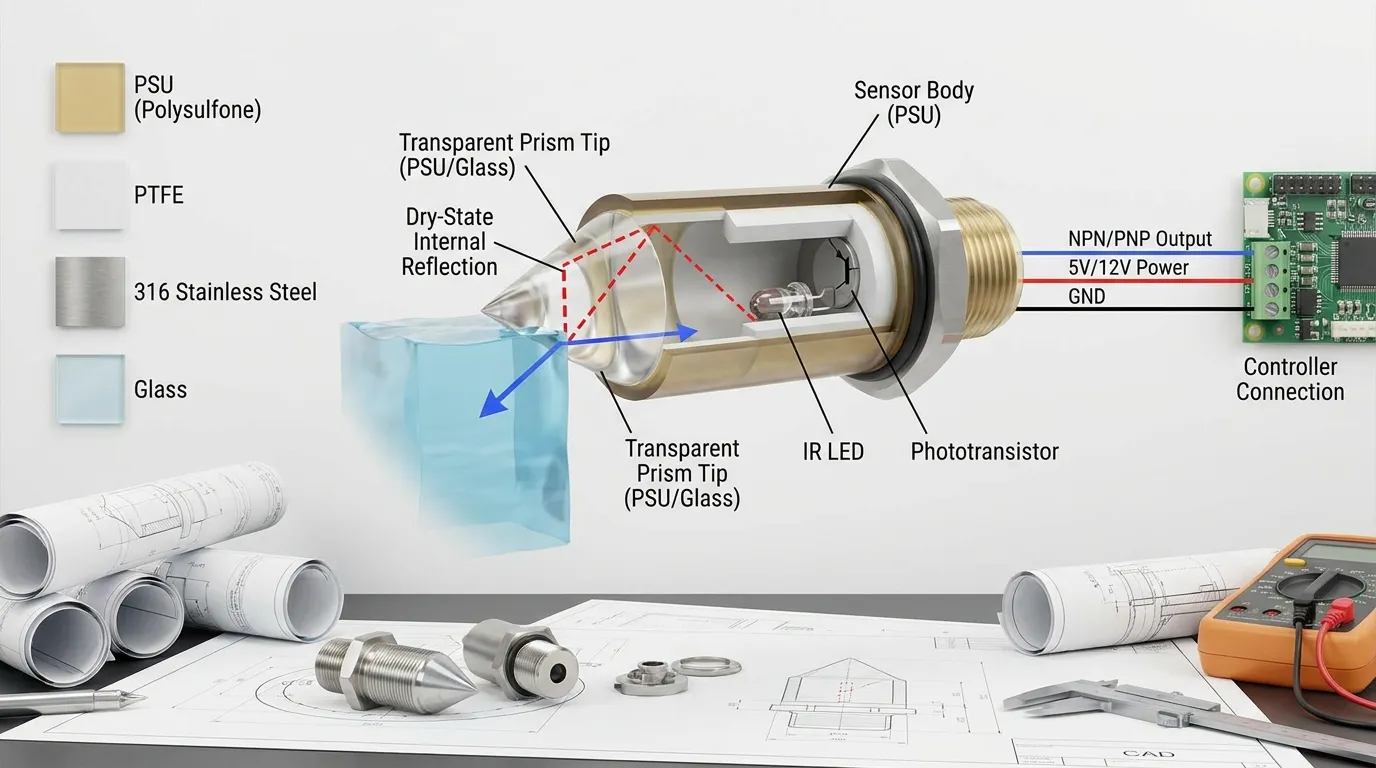
Tá tóireadóirí seoltaí coitianta in umair uisce toisc go bhfuil siad simplí, ach braitheann siad ar theagmháil leictreach leis an leacht. I dtrealamh caife agus díola, gur féidir leis an limistéar teagmhála sin a bheith níos lú iontaofa nuair a bhíonn mianraí uisce, scála, iarmhar caife, scannán gníomhaire glantacháin, nó comhdhlúthú gaile a thógáil suas timpeall an leictreoid.
Úsáideann braiteoir optúil braite fótaileictreach ina ionad sin. Taobh istigh den braiteoir, seolann LED infridhearg solas i dtreo barr priosma trédhearcach. Faigheann fóta-trasraitheoir an solas frithchaite. Nuair a bhíonn an priosma tirim, Léiríonn solas go hinmheánach ar bhealach intuartha. Nuair a théann uisce i dteagmháil leis an dromchla priosma, Athraíonn an cosán optúil toisc go n-athraíonn an coinníoll athraonta. Déanann an leictreonaic an t-athrú sin a thiontú ina chomhartha lasctha.
Do dhéantóirí fearas, Cruthaíonn sé seo roinnt buntáistí dearaidh:
- Níl aon phéire leictreoid seoltaí nochta ag teastáil le haghaidh braite.
- Is féidir leis an braiteoir comhartha glan ard / íseal a sholáthar don rialtóir.
- Is féidir an pointe braite a dhéanamh an-bheag le haghaidh taiscumair dhlúth.
- Féadann sé láithreacht uisce a bhrath ag pointe seasta gan lámh snámhphointe.
- Laghdaíonn sé teip cuid ghluaiseachta i gcomparáid le lasca snámhphointe.
- Tá sé níos oiriúnaí do leagan amach fearas séalaithe nó leath-shéalaithe.
Ní chiallaíonn sé seo go ndéanann an braiteoir neamhaird ar gach éilliú. Tá timpeallacht dearaidh réalaíoch fós ag teastáil ón aghaidh priosma. Sciath ar scála trom, boilgeoga aeir gafa, iarmhar teimhneach, nó droch-uillinn gléasta is féidir tionchar a imirt ar aon braiteoir pointe-leibhéal. Is é an difríocht ná go seachnaíonn an modh optúil an fhadhb choitianta de theagmháil leictreach a bheith éagobhsaí toisc go bhfuil an dromchla probe furred suas.
Caife, Espresso, agus Pointí Comhtháthaithe Meaisín Díola
Tagann an luach dearaidh is láidre as an suíomh braite ceart a roghnú. D'fhéadfadh braiteoir amháin a bheith ag teastáil ó mheaisín caife, ach d'fhéadfadh go mbeadh roinnt braiteoirí pointe ag teastáil ó ardán dí OEM le stáit loighic éagsúla.
Brath Ísealleibhéil Taiscumar Uisce
Is féidir lasc optúil ísealleibhéil a shuiteáil in aice le líne uisce sábháilte íochtarach an taiscumair. Nuair a thiteann leibhéal an uisce faoi bhun an phriosma, Is féidir leis an rialtóir stop a chur leis an gcaidéal, Taispeáin foláireamh athlíonta, nó oibriú téitheoir a chosc. Tá sé seo úsáideach do mheaisíní espresso dlúth, déantóirí caife countertop, agus meaisíní díola inar féidir le rith tirim damáiste a dhéanamh do chaidéil nó iontaofacht custaiméirí a laghdú.
Brath Ardleibhéil agus Ró-Shreabhadh
Is féidir braiteoir optúil ardleibhéil a shuíomh in aice leis an líne líonta uachtarach. Féadann sé tacú le córais líonta uathoibríocha, umair díola, dáileoirí uisce, nó meaisíní atá ceangailte le comhla inlet uisce. Nuair a bhraitheann an braiteoir uisce ag an bpointe uachtarach, Is féidir leis an rialtóir stop a chur le gnáthamh cosanta ró-shreabhadh a líonadh nó a spreagadh.
Cosaint Coire-Adjacent
I socrúchán a bhaineann le coire, Caithfear athbhreithniú níos cúramach a dhéanamh ar dhearadh an braiteora. Ba chóir do OEManna teocht an uisce a dhearbhú, Nochtadh gaile, Aonrú brú, Comhoiriúnacht ábhair, agus cibé an bhfuil an braiteoir fliuch go díreach nó suiteáilte i seomra in aice láimhe. Le haghaidh go leor fearais, Is fearr an braiteoir a chur sa taiscumar nó sa chonair uisce cúnta seachas taobh istigh de chorp coire ard-struis.
Tráidire Drip agus Brath Fuíolluisce
Is féidir braiteoir pointe optúil a úsáid freisin i dtráidire drip nó i gcoimeádán fuíolluisce. Anseo athraíonn an fócas dearaidh ó uisce inólta go caoinfhulaingt iarmhar, Rochtain a ghlanadh, agus cosc bréagach. Ba chóir go seachnódh suíomh gléasta criosanna splancscáileáin dhíreacha nuair is féidir.
Brath Umar Inmheánach Meaisín Díola
Le haghaidh dáileoirí díola agus dí, Is féidir le braiteoirí optúla tacú le rialú athlíonta, Brath umar folamh, Gearradh Ardleibhéil, agus aláraim chothabhála. Nuair a bhíonn feidhmeanna IoT nó app ag an meaisín díola, Is féidir leis an aschur braiteora an príomhbhord rialaithe a bheathú, agus is féidir leis an gcóras foláirimh stádais a chur ar aghaidh tríd an ardán fearais. I gcás inarb ábhartha, is féidir lenár bhfoireann riachtanais táirge ceangailte Tuya nó Smart Life a phlé ag leibhéal an chórais feiste.
Tábla Comhtháthaithe Fearas
| Limistéar an fhearais | Ról an braiteora | Fócas dearaidh molta | Riachtanas aschuir |
|---|---|---|---|
| Taiscumar uisce inbhainte | Rabhadh uisce íseal, Cosaint caidéil | Gléasadh taobh nó bun dlúth, nochtadh priosma glan, Timthriall athlíonta úsáideora | 5Aschur loighic V nó 12V |
| Pointe taiscumar uachtarach | Gearradh ardleibhéil, Cosc ar Ró-shreabhadh | Suíomh líne líonta cobhsaí, rialú splancscáileáin, Loighic lasctha sainithe | NÍL/NC, NPN/PNP |
| Conair uisce meaisín espresso | Idirghlasáil ísealleibhéil nó sábháilteachta | Comhoiriúnacht ábhair, Athbhreithniú gaile / teasa, Sreang Séalaithe Amach | Loighic saincheaptha deimhnithe ag RFQ |
| Seomra in aice le coire | Tacaíocht um chosc tirim | Seachain ró-strus díreach; teocht a dhearbhú, Gléasta, agus coinníoll fliuch | Aschur meaitseáilte le rialaitheoir |
| Umar díola | Stádas folamh/iomlán, Rialú athlíonta | Ródú cábla fada, Glasáil cónascaire, Rochtain ar an tSeirbhís | NPN / PNP nó comhartha saincheaptha |
| Tráidire driping / umar dramhaíola | Foláireamh tráidire iomlán | Lamháltas iarmhar, Rochtain a ghlanadh, socrúchán frith-splancscáileáin | Aschur lasc digiteach |
Fachtóir Foirm Dlúth agus Roghanna Gléasta
Is minic a bhíonn spás teoranta ag meaisíní caife taobh thiar de bhalla an taiscumair, faoin umar, nó in aice le fráma an fhearais. Is féidir le lasc snámhphointe toirtiúil cur isteach ar chodanna plaisteacha múnlaithe, Baint umar, nó rochtain ar sheirbhís. Ligeann dearadh optúil dlúth an pointe braite a chur ag leibhéal seasta le barr priosma beag.
Le haghaidh leagan amach daingean, ár Braiteoir Micrimhilseogra Optúil Is pointí tosaigh oiriúnacha iad na roghanna le haghaidh plé. Is féidir leis an dearadh deiridh gléasta snáithithe a úsáid, corp séalaithe, suiteáil taobhbhalla, nó lúibín saincheaptha ag brath ar struchtúr an fhearais.
I measc na gcinntí atá le daingniú tá:
- Taobhbhalla, bun, nó suiteáil uilleach
- Tiús balla umar agus dromchla séalaithe atá ar fáil
- Ceanglas gléasta snáithe nó neamh-snáithe
- O-fáinne, gasket, nó coincheap comhtháthaithe táthaithe / séalaithe
- Treo imeachta cábla agus faoiseamh brú
- Cineál cónascaire agus fad úim
- Cibé an bhfuil an umar seasta nó inbhainte
- An féidir le húsáideoirí glanadh timpeall an limistéir bhraite
Do thionscadail OEM, Níor chóir an braiteoir a roghnú ach de réir méid seachtrach. Is í an cheist dearaidh fíor ná an bhfanann an barr priosma nochta i gceart don uisce ag an bpointe lasctha riachtanach trí thimthriall úsáide iomlán an fhearais.
Ábhair le haghaidh Uisce, Gaile, Scála, agus Coinníollacha Glantacháin
Braitheann rogha ábhair ar an áit a dtéann an braiteoir i dteagmháil le huisce agus cad a bhfuil súil ag an déantóir fearas le linn glantacháin agus oibríochta. I measc na roghanna coitianta tá plaisteach innealtóireachta, PSU, PTFE, 316 cruach dhosmálta, agus struchtúir ghloine. Tá cothromaíocht chostais difriúil ag gach ceann acu, friotaíocht ceimiceach, iompar teochta, agus neart meicniúil.
Le haghaidh feidhmchlár caife agus díola, Ba chóir do cheannaitheoirí seiceáil:
- An dtéann an chuid fhliucha i dteagmháil le huisce inólta
- Cibé an bhfeiceann an braiteoir uisce te, gaile, nó ach uisce taiscumar teocht an tseomra
- Cibé an dtéann leacht descaling nó gníomhairí glantacháin i dteagmháil leis an bpriosma
- Cibé an bhfuil an t-ábhar umar trédhearcach, tréshoilseach, nó teimhneach
- Cibé an bhfuiltear ag súil le buildup mianraí ó mhargaí uisce crua
- Cibé an bhfuil an pointe braite inrochtana le haghaidh glanadh tréimhsiúil
Níor chóir aon ábhar a roghnú ach ó ghrianghraf catalóige. Is é an bealach is sábháilte ná líníocht an fhearais a sholáthar, Suíomh cosán uisce, Modh glantacháin, agus coinníoll oibriúcháin ionchasach ionas gur féidir leis an mhonarcha struchtúr oiriúnach ábhar fliuch a mholadh.
Aschur Leictreach: 5V, 12V, NPN, PNP, agus 4-20 mA
Is minic gur fearr le boird rialaithe meaisín caife stádas digiteach simplí: uisce i láthair nó uisce as láthair. Ar an gcúis seo, úsáideann go leor tionscadal fearas aschur loighic 5V nó 12V. Léann an rialtóir an comhartha agus socraíonn sé an stopfaidh sé an caidéal, Taispeáin foláireamh, Comhla a oscailt, nó téamh a cheadú.
Is féidir le plé leictreachais atá ar fáil a bheith san áireamh:
- 5Aschur loighic V do bhoird fearas ísealvoltais
- 12Aschur loighic V do chórais díola nó rialaithe inmheánaigh
- Aschur NPN nó PNP ag brath ar dhearadh ionchuir rialaitheora
- Loighic oscailte de ghnáth nó dúnta de ghnáth le haghaidh rogha teip-shábháilte
- Saincheaptha cábla agus cónascaire le haghaidh úim fearas
- 4-Aschur 20 mA áit a dteastaíonn comharthaíocht leibhéal lúb reatha ó chóras seachas lasc pointe simplí
Don chuid is mó de bhrath uisce íseal / ard meaisín caife, is leor lasc optúil pointe-leibhéal. Maidir le feidhmchláir a éilíonn treocht leibhéal nó monatóireacht thionsclaíoch iargúlta, Ba chóir athbhreithniú a dhéanamh ar an gcineál aschuir ag an gcéim RFQ.
OEM Saincheaptha agus Dearadh Tacaíocht
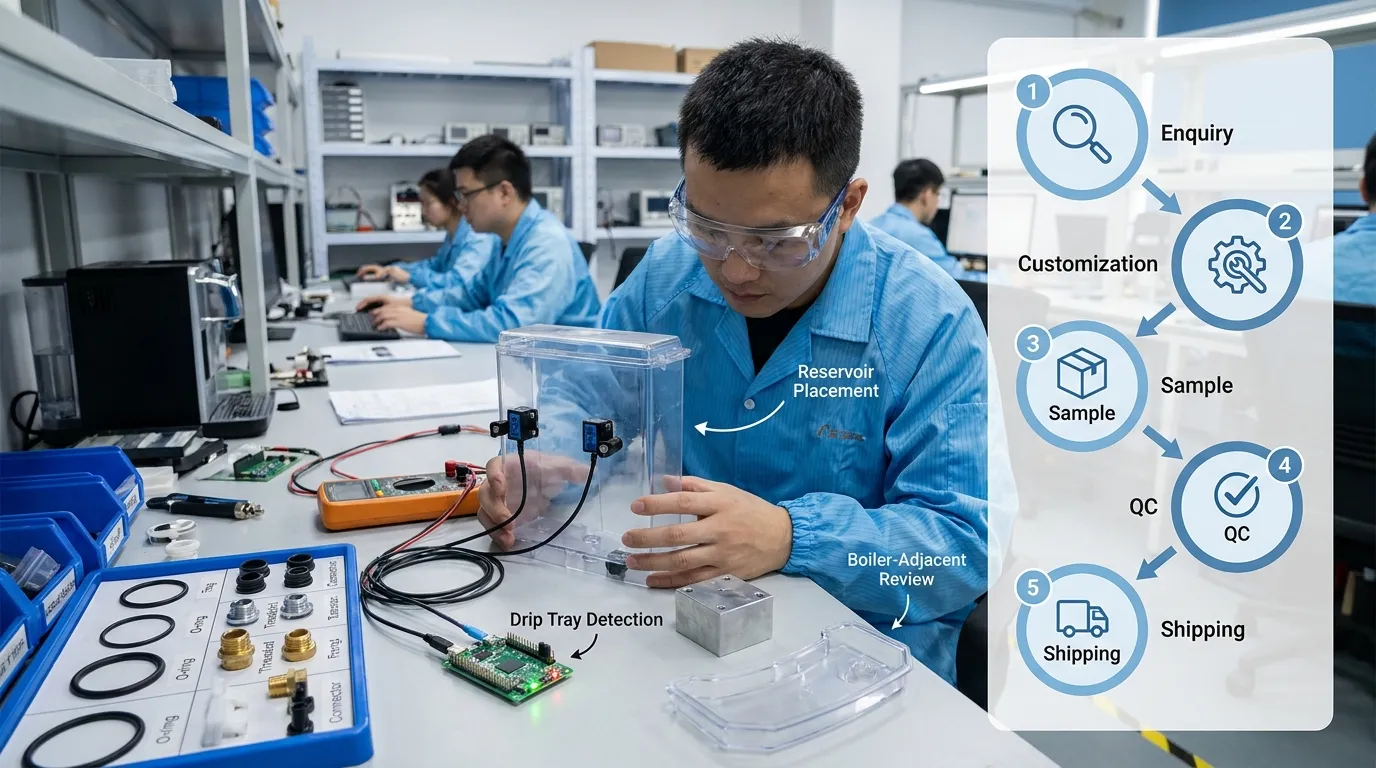
Mar mhonaróir / onnmhaireoir Shenzhen le R intí&D, Tacaíonn HojellyTek le tionscadail OEM / ODM nuair nach n-oireann braiteoirí catalóige caighdeánacha do dhearadh an fhearais. Ár Athraigh leibhéal optúil OEM Is féidir leis an tseirbhís tacú le hathruithe tithíochta, tionóil cábla, Meaitseáil cónascaire, ceanglais lógó nó phacáistithe, agus loighic leictreach a bhaineann go sonrach leis an tionscadal.
D'fhéadfadh dearadh OEM a bheith san áireamh:
- Athbhreithniú ar chruth priosma agus ar phointe braite
- Roghnú ábhar comhlacht braiteora
- Saincheaptha snáithe agus struchtúr gléasta
- Fad sreinge agus cónascaire teirminéil a mheaitseáil
- Coigeartú loighic aschuir
- Ullmhúchán samplach le haghaidh tástála fearais
- Plean QC Táirgeadh tar éis ceadú samplach
Onnmhairímid táirgí braiteoir do chustaiméirí sna Stáit Aontaithe, TÁIMID, An India, agus margaí eile, le cumarsáid innealtóireachta dírithe ar líníochtaí, Samplaí, agus comhtháthú fearas praiticiúil.
5-Próiseas OEM Céim
- Fiosrúchán
Seol an cineál fearais, Suíomh braiteora, riocht uisce, Feidhm sprioc, voltas, Cineál Aschuir, agus líníocht má tá sé ar fáil. - Athbhreithniú Spec agus Saincheaptha
Seiceálann ár bhfoireann ábhar, tithíocht, cábla, cónascaire, Gléasta, agus riachtanais aschuir loighic. - Dearbhú Samplach
Ullmhaítear samplaí le haghaidh taiscumar, coire-in aice láimhe, tráidire drip, nó tástáil umar díola. - Táirgeadh agus QC
Tar éis ceadú samplach, leanann an táirgeadh an tsonraíocht dheimhnithe, sreangú, agus ceanglais iniúchta. - Loingseoireacht agus Tacaíocht
Ullmhaímid loingsiú onnmhairithe agus tacaímid le ceisteanna leantacha le haghaidh suiteála, sreangú, agus orduithe a athdhéanamh.
Seicliosta Dearaidh Isteach Sula n-Ordaítear
Sula n-iarrann tú luachan, na sonraí seo a ullmhú:
- Cineál fearais: déantóir caife, Meaisín espresso, meaisín díola, dáileoir uisce, nó córas dí
- Feidhm braiteora: uisce íseal, uisce ard, ró-shreabhadh, cosaint tirim-rith, Tráidire Drip Lán, nó láithreacht umar
- Pointe suiteála: balla taiscumar, umar bun, limistéar in aice le coire, umar díola, nó coimeádán dramhaíola
- Riocht uisce: glanuisce, uisce te, Nochtadh gaile, Riosca scála, nochtadh leachtach a ghlanadh
- Voltas soláthair: 5V, 12V, nó ceanglas rialaitheora eile a dhearbhú
- Cineál aschuir: NPN, PNP, Ní hea, NC, 4-20 mA, nó loighic saincheaptha
- Riachtanas ábhartha: PSU, PTFE, 316 dhosmálta, gloine, nó rogha eile d'ábhar fliuch
- Gléasta: snáthaid, gasket, O-fáinne, lúibín, comhéadan umar múnlaithe, nó tithíocht saincheaptha
- Cábla agus cónascaire: fad, teirminéal, uiscedhíonta, faoiseamh brú, agus treo ródaithe
- Loighic sábháilte teip: cad ba chóir don rialaitheoir a dhéanamh nuair a bhíonn uisce as láthair, i láthair, nó teipeann ar shreangú braiteora
- Cainníocht shamplach agus plean tástála le haghaidh bailíochtú fearas
Optúil vs Seoltaí vs Brath Snámhphointe
| Rogha | Neart | Teorannú i meaisíní caife/díola | An úsáid is fearr |
|---|---|---|---|
| Braiteoir pointe optúil | Dlúth, gan aon snámhphointe ag gluaiseacht, gan aon phéire probe seoltaí nochta, comhartha láithreacht uisce digiteach cobhsaí | Ní mór aghaidh priosma a shuíomh agus a choinneáil oiriúnach le haghaidh braite optúil | OEM braite uisce íseal / ard |
| Probe seoltaí | Simplí agus ar chostas íseal | An féidir fionnaidh suas le scála, gá seoltacht leachtach, D'fhéadfadh tionchar a bheith ag scannán mianraí | Brath bunúsach teagmhála uisce |
| Lasc snámhphointe meicniúil | Éasca le tuiscint, Athrú pointe díreach | Cuid ag gluaiseacht, spás níos mó, greamú féideartha nó caitheamh meicniúil | Umair níos mó le go leor imréitigh |
| Braiteadh brú-bhunaithe | Is féidir tacú le meastachán leibhéil | Níos mó castachta dearaidh an chórais | Umair níos mó nó tomhas neamhphointe |
| 4-Aschur leibhéal -20 mA | Maith le haghaidh tarchur comhartha ar leibhéal an chórais | De ghnáth níos mó ná mar is gá le haghaidh braite pointe taiscumar caife bunúsach | Córais thionsclaíocha nó nasctha |
Cén fáth a n-oibríonn sé le HojellyTek
Comhcheanglaíonn HojellyTek taithí braite optúil fótaileictreach le tacaíocht déantúsaíochta OEM d'iarratais ar leibhéal leachtach. Do dhéantóirí fearas, Ciallaíonn sé seo gur féidir leat an fhadhb suiteála iarbhír a phlé seachas uimhir pháirte a roghnú ó liosta amháin.
I measc na bpríomhchomharthaí iontaobhais tá:
- Shenzhen-bhunaithe monaróir agus onnmhaireoir
- Intí R&D le haghaidh braite leibhéal leachtach fótaileictreach
- Saincheaptha OEM / ODM do bhrandaí fearas agus trealaimh
- Tacaíocht do dhearadh lasc leibhéal optúil dlúth
- Sreangú, cónascaire, Aschur, agus díospóireachtaí a mhéadú
- Taithí easpórtála le SAM, TÁIMID, An India, agus margaí eile
- Luan agus cumarsáid shamplach trí WhatsApp nó ríomhphost
Ceisteanna CCanna
An féidir braiteoir leibhéal uisce optúil do thionscadail meaisín caife tóireadóirí seoltaí a athsholáthar?
Tá. Is féidir le braiteoir leibhéal uisce optúil do dhearaí meaisín caife tóireadóirí seoltaí a athsholáthar nuair a bhíonn braite láithreacht uisce dlúth ag teastáil ón bhfearas gan a bheith ag brath ar seoltacht leachtach. Tá sé úsáideach go háirithe nuair a d'fhéadfadh buildup mianraí nó fionnadh probe iontaofacht probe seoltaí a laghdú.
An féidir leis an braiteoir céanna leibhéal uisce íseal agus ard a bhrath?
Braitheann braiteoir pointe amháin leibhéal seasta amháin. Maidir le cosaint caidéil ísealleibhéil agus rialú ró-shreabhadh ardleibhéil araon, De ghnáth suiteálann OEManna dhá phointe braite nó dearann siad tionól saincheaptha le suíomhanna braite iolracha.
An bhfuil braiteoir optúil oiriúnach le haghaidh socrúchán uisce te nó coire?
Braitheann sé ar an suíomh cruinn. Is gnách go mbíonn úsáid taiscumar níos simplí. Éilíonn socrúchán coire nó uisce te athbhreithniú ar ábhar, nochtadh teochta, gaile, Séalaithe, Aonrú brú, agus coinníollacha glantacháin roimh dheimhniú samplach.
Cén voltas ba chóir dúinn a roghnú: 5V nó 12V?
Roghnaigh an voltas a mheaitseálann do bhord rialaithe fearais. Pléann go leor tionscadail meaisín caife aschur loighic 5V, cé go bhféadfadh córais díola nó rialaithe inmheánaigh 12V a úsáid. Ba chóir an loighic soláthair agus aschuir deiridh a dhearbhú le linn athbhreithniú RFQ.
An mbeidh scála nó boilgeoga ina chúis le triggering bréagach?
Sciath ar scála trom, boilgeoga gafa, splancscáileán díreach, nó is féidir le hiarmhar tionchar a imirt ar bhrath. Socrúchán priosma ceart, Rogha ábhair, Rochtain a ghlanadh, agus cuidíonn uillinn suiteála le comharthaí bréagacha a laghdú in úsáid fearas fíor.
An féidir le HojellyTek an cábla a shaincheapadh, cónascaire, snáthaid, nó tithíocht?
Tá. Do thionscadail OEM / ODM, Is féidir le HojellyTek athbhreithniú a dhéanamh ar fhad cábla, cineál cónascaire, snáithe nó struchtúr gléasta, ábhar tithíochta, loighic aschuir, agus riachtanais shamplacha bunaithe ar líníocht do fhearais.
Iarratas ar luachan le haghaidh Dearadh Braiteoir Meaisín Caife
Seol do mheaisín caife, Meaisín espresso, nó riachtanas leibhéal uisce meaisín díola chuig HojellyTek trí WhatsApp nó ríomhphost. Comhroinn suíomh an braiteora, voltas, Cineál Aschuir, rogha ábhartha, líníocht gléasta, agus riocht uisce ionchasach, agus molfaidh ár bhfoireann dearadh braiteoir leibhéal optúil oiriúnach le haghaidh tástála samplach.


