
How Often to Test Propane Tanks and Replace Gauges: The Complete Guide
It's a frustrating scenario I've seen play out dozens of times. A homeowner is set for a backyard BBQ, but the refill station attendant rejects their 20lb cylinder, pointing to a date on the collar. Or, a rural homeowner gets a notice that their propane supplier refuses to fill their main 500-gallon tank due to "visible rust." What do those dates mean? Is the tank really unsafe? And what about the gauge? You've looked at it for years, but can you even trust it anymore?
Here’s the problem: the rules are wildly confusing because they are completely different for the portable tank on your grill versus the large stationary tank at your home.
In this guide, we'll clear up all that confusion. I'm going to walk you through the exact inspection schedules for both types of tanks and, just as importantly, how to know when that unreliable gauge is a problem waiting to happen. With over 15 years of experience in industrial and residential gas systems, I've seen the costly—and dangerous—mistakes people make. Let's make sure you're not one of them.
The Quick Answer: Tank Testing vs. Gauge Replacement
To get right to the point, here's the bottom line you need to know.
- Tank Testing: There is no single answer. It depends entirely on your tank type:
- DOT Portable Tanks (BBQ, RV, Forklift): Must be recertified 12 years from their manufacture date. After that, they require recertification every 5, 7, or 10 years, depending on the method.
- ASME Stationary Tanks (Home, Commercial): These tanks do not have a time-based recertification schedule. Instead, they require a visual inspection by your propane supplier every time they are filled.
- Gauge Replacement: There is no mandated replacement schedule for a propane gauge. It is a mechanical part that should be replaced when it fails. In my experience, the average reliable lifespan is about 7-10 years.
Propane Tank Testing Explained: The Critical DOT vs. ASME Difference
This is the single most important concept you need to understand. Forget everything else for a second. The "universe" of propane tanks is split in two, and the rules are not interchangeable.
DOT Portable Cylinders (Grills, RVs, Forklifts)
These are the tanks you transport. Think of your 20lb grill tank, the 30lb cylinders on the front of your travel trailer, or even the 100lb tanks you might use for a mobile food truck.
Because they are moved, they are governed by the Department of Transportation (DOT).
A brand-new DOT cylinder is good for 12 years from the date stamped on its collar. This is its "born-on" date. This rule is part of the DOT's regulations (specifically 49 CFR 180.209(e)) designed to ensure that tanks subjected to the bumps, dings, and weather of transport are regularly taken out of service for inspection. This is a key part of overall propane tank safety and maintenance.
How to Read Your DOT Tank’s Manufacture Date
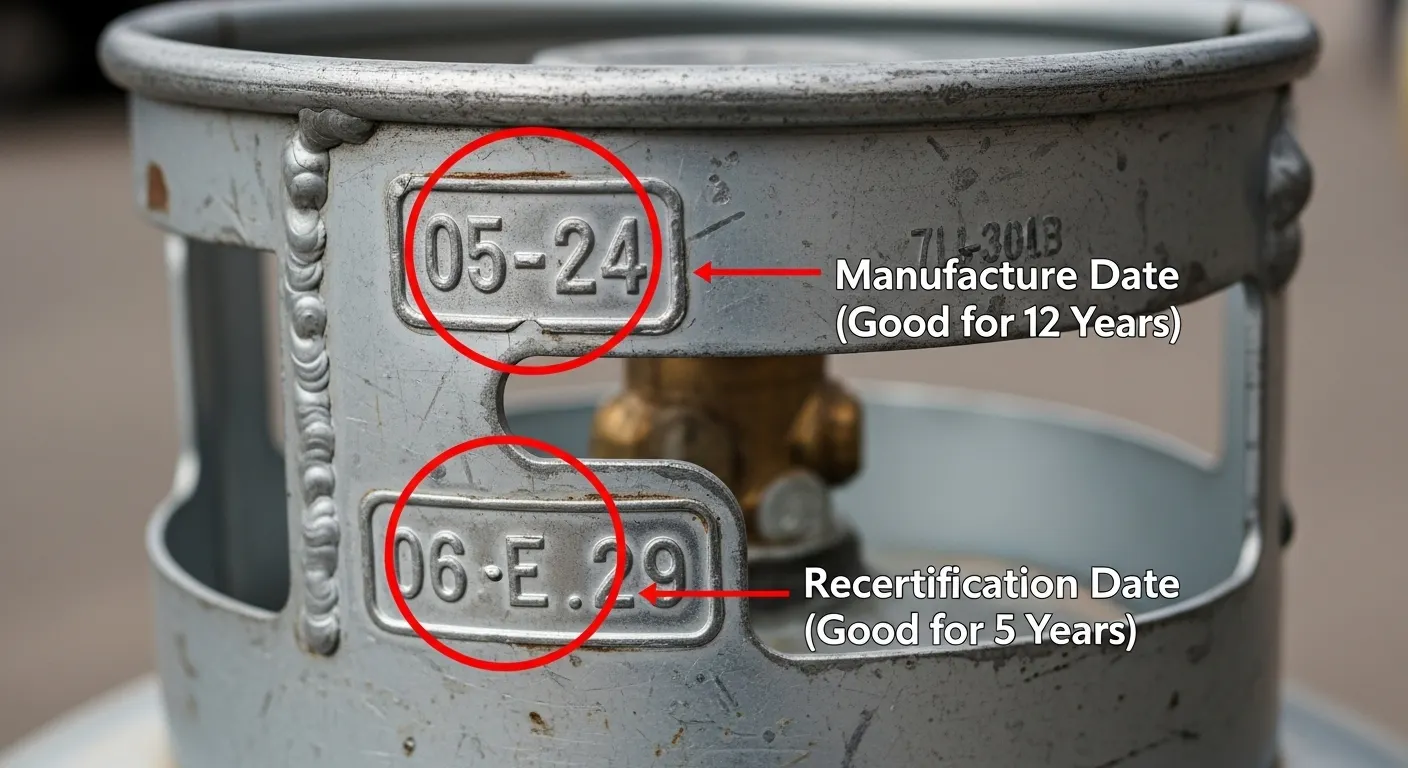
This is easy. You just need to know where to look.
- Look at the metal collar (the handle) of your tank.
- Find the date stamp, which is typically in a two-digit Month-Dash-Year format (e.g., "05-24" means May 2024).
- This is the tank's original manufacture date. Your 12-year clock starts here.
The Recertification Timeline (After 12 Years)
Once those 12 years are up, the tank is "expired." It cannot be legally refilled. But it's not useless—it just needs to be "requalified" or "recertified."
You take it to a qualified propane refiller or tank certifier. They will perform an inspection and, if it passes, stamp it with a new date and a letter.
- "E" or "S" Stamp: This means it passed a standard Visual Inspection. Your tank is now recertified for 5 years. (Example: "06 E 24" means it was visually inspected in June 2024 and is good until June 2029).
- "H" or "P" Stamp: This indicates a Hydrostatic Test, a more complex test where the tank is filled with water to check for leaks or expansion. This certification is good for 10 years. (Some older hydrostatic tests were good for 12 or 7 years, but 10 is the modern standard).
Here's a dose of real-world trustworthiness: for a standard 20lb BBQ tank, it is almost never cost-effective to pay for recertification. The inspection fee ($20-$40) is often more than the cost of simply swapping your "expired" tank at a tank exchange cage (like Blue Rhino or AmeriGas). They take your old tank and deal with the recertification; you get a certified tank.
ASME Stationary Tanks (Home & Commercial)
These are the big tanks. The 120-gallon, 500-gallon, or 1,000-gallon tanks that are permanently installed at a home or business. They are built to the ASME (American Society of Mechanical Engineers) "Boiler and Pressure Vessel Code."
Because they are built to a much more robust standard and are not transported, the rules are completely different.
The "No Expiration Date" Rule
Let's be perfectly clear: ASME tanks do not expire. They do not have a 12-year rule or any time-based recertification schedule.
The Inspection Requirement
Instead, their safety is ensured through ongoing visual inspection by a qualified propane technician (i.e., your supplier's delivery driver) every single time they are filled.
Your driver is trained—and legally obligated by the NFPA 58 (Liquefied Petroleum Gas Code)—to perform this check.
What They Look For:
- Corrosion: Any deep rust or pitting, especially on the "feet" or on the underside where moisture collects.
- Integrity: The valves, fittings, and data plate must be legible and in good condition.
- Foundation: The tank must be on a stable, level, non-combustible base (usually concrete blocks or a pad). A propane tank that is not level can cause gauge inaccuracies and safety issues.
- Damage: Any significant dents, gouges, or signs of heat/fire damage.
In my experience, your supplier has the right—and legal obligation—to "red-tag" and refuse to fill any tank they deem unsafe. The most common reason I've seen for this is excessive, flaking rust on the bottom of the tank, which could compromise its structural integrity.
When (and Why) to Replace Your Propane Gauge
Okay, we've covered the tank. But what about the gauge? This is the most-ignored part of the query, but it's critical.
First, let's understand how they work.
How Propane Gauges Work (It's a Simple Float)
It’s not high-tech. That gauge on your tank is not electronic. Inside the tank, a metal float (just like the one in your toilet's tank) is attached to a rod. As the liquid propane level drops, the float drops. This rod connects to a set of gears or a magnet that turns the needle on the external dial.
It's simple and mechanical, which is exactly why it eventually fails. It's a moving part sitting in a pressurized environment.
5 Signs Your Propane Gauge is Failing
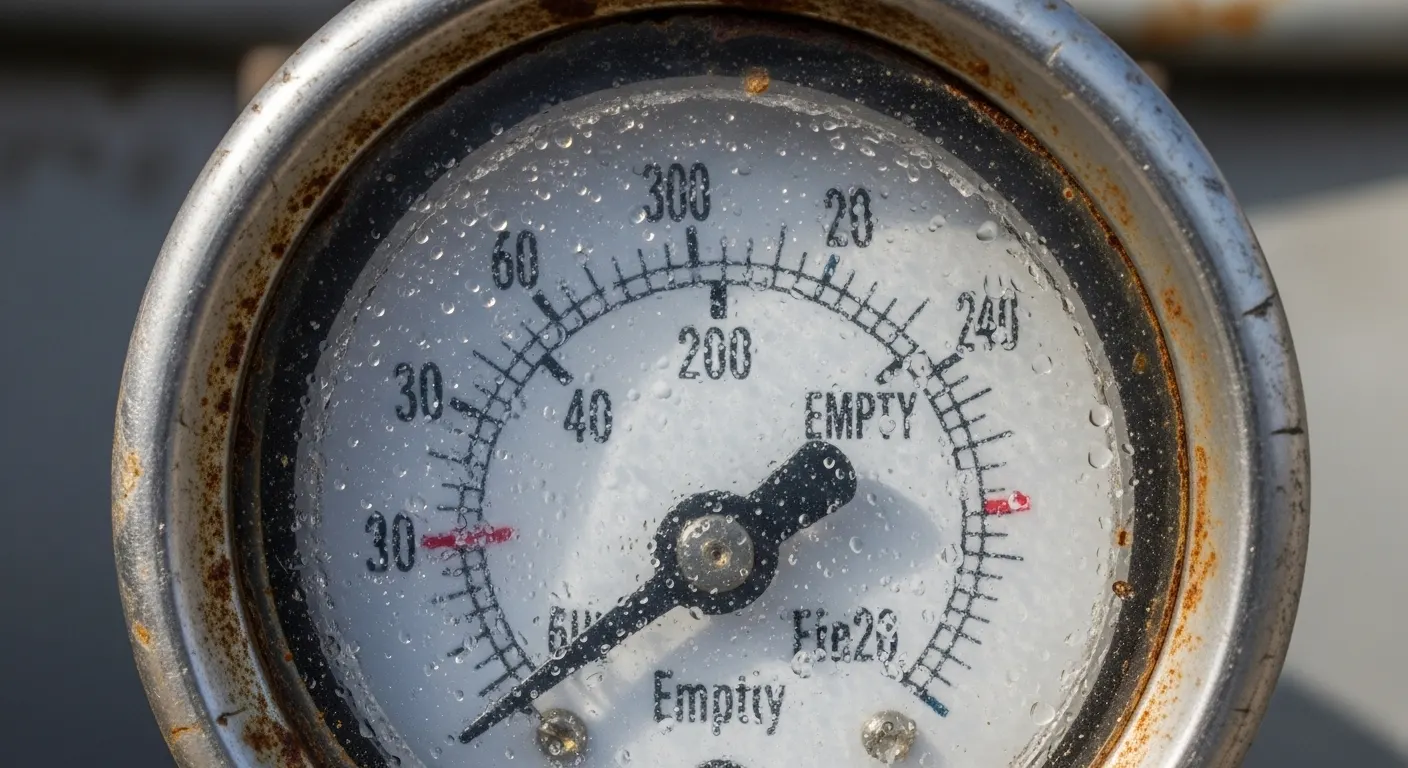
There is no fixed replacement schedule. You replace it when it's broken. Here are the tell-tale signs I look for.
- It's Stuck on "Full." The float is likely rusted or jammed at the top.
- It's Stuck on "Empty" (or any number). The float is stuck, or the dial mechanism itself has corroded and frozen.
- The Reading is "Sticky." You know you used gas, but the needle doesn't move. Then, after your next fill, it suddenly drops to 30%. This means the float or gears are binding and moving in "jumps" instead of smoothly.
- The Dial is Foggy or Unreadable. The seal on the dial face has failed, letting in moisture. If moisture got in, the dial mechanism is next to fail.
- The Gauge Reads 80% and Never Moves. Now, wait. This one is often correct... and it builds a ton of trust to explain why. Propane tanks are only filled to 80% capacity to leave room for the liquid to expand into a gas (vapor). This is a common point of confusion when you check your propane tank level. If your supplier fills your tank and the gauge reads 80-85%, it's working perfectly!
Is There a Fixed Replacement Schedule? (The 7-10 Year "Guideline")
While there is no mandated rule, in my professional experience, a good quality gauge has a reliable service life of 7-10 years. After a decade, the moving parts are simply subject to wear, rust, and sticking.
I recommend replacing it proactively if it's over 10 years old or shows any of the signs above. A faulty gauge isn't just an inconvenience; it's a critical safety issue. Not knowing your fuel level can lead to run-outs (which can be dangerous if it extinguishes pilot lights) or prevent you from knowing if you have a leak. This is why it's so important to know how to check your propane tank level manually or trust your gauge.
The Recertification & Replacement Process: What to Expect
Let's say your tank is expired or your gauge is broken. What happens next?
Who Can Recertify a DOT Tank?
Only DOT-licensed and registered facilities. This is not a DIY job. Look for:
- Propane suppliers (many larger ones have this capability)
- Welding supply companies
- Specialty hydrostatic testing centers
What Inspectors Actually Look For (The DOT Visual Exam)
They aren't just looking at the date. When you bring in a 100lb tank for recertification, they are performing a detailed visual inspection. They're trained to spot:
- Deep rust pits (especially under the collar or on the foot-ring)
- Evidence of fire or heat damage (scorched or blistered paint)
- Cuts, gouges, or dents in the metal body
- A bent or damaged collar (handle) or foot-ring (base)
- The integrity and legibility of the valve and fittings
Who Can Replace a Gauge?
This is absolutely not a DIY job. Replacing a gauge requires specialized tools, thread sealant, and, most importantly, fully and safely depressurizing the tank first. This is a job that must be done by a qualified propane technician.
Cost vs. Benefit Analysis
- DOT Tanks: Recertification can cost anywhere from $20 to $50, depending on the facility. As I mentioned, for a 20lb tank, it's cheaper to just swap it at an exchange cage for ~$25. But for your 30lb, 40lb, or 100lb tanks, paying $40 for a 5-year recertification is a no-brainer.
- Gauges: The gauge part itself is relatively cheap ($20-$50). The main cost will be the service call and labor from the technician ($75-$150) to safely empty the tank, make the swap, and perform a leak test.
Conclusion: Your Path to Propane Safety and Compliance
I know this is a lot of information, but it really boils down to a few simple, actionable steps. If you want to stay safe and ensure you're never refused a fill, here's your checklist.
- Check Your Tank: First, identify if you have a portable DOT tank or a stationary ASME tank.
- Check the Date (DOT): If it's a DOT tank, go look at the collar right now. If it's over 12 years old (or past its last recertification date), it's time to get it inspected or, if it's a 20lb tank, just swap it.
- Inspect Your Tank (ASME): If you have a large home tank, trust your supplier's visual inspection. To help, keep the area around the tank clear of weeds and debris, and make sure the tank itself is clean and painted to prevent surface rust.
- Trust, But Verify Your Gauge: Don't rely 100% on that gauge, especially if it's over 10 years old. If it's sticky, foggy, or stuck, it's lying to you. Call a professional to have it replaced immediately.
Don't wait for a supplier to refuse your fill on a cold day. Go take 30 seconds right now to check the date on your portable tank's collar. It's the simplest and most important step you can take for safety and uninterrupted service.
Frequently Asked Questions (FAQ)
How much does it cost to recertify a propane tank?
For a standard DOT tank (like a 30lb or 100lb cylinder), a 5-year visual recertification typically costs between $20 and $50. It is almost always more cost-effective to swap a 20lb BBQ tank at an exchange service.
Can I recertify a propane tank myself?
No. Absolutely not. Tank recertification must be performed by a facility and technicians registered with the Department of Transportation (DOT) to handle and inspect pressurized vessels.
What's the difference between recertification and inspection?
"Recertification" applies to DOT portable tanks and is a formal process that happens at set time intervals (12 years, then every 5). "Inspection" applies to ASME stationary tanks and is a visual check for safety and integrity performed by your supplier every time they deliver fuel.
Do 1lb "disposable" propane canisters expire?
While they don't have a recertification schedule (they are non-refillable), 1lb canisters are DOT cylinders and should be inspected for rust, dents, or valve damage before each use. Most manufacturers recommend using them within 7 years of manufacture.
How long is a brand new propane tank good for?
A brand new DOT portable tank (like for a grill) is good for 12 years from the manufacture date stamped on its collar. A brand new ASME stationary tank (like for a home) does not have an expiration date.
Why does my propane gauge only read 80% full?
This is a critical safety feature! Propane is delivered as a liquid, but it needs space in the tank to expand into a gas (vapor). The 20% empty space (ullage) ensures the tank doesn't become over-pressurized. If your gauge reads 80-85% after a fill, it's working perfectly.
My propane tank is expired. What do I do?
If it's a 20lb BBQ tank, the easiest solution is to take it to a tank exchange cage (at a gas station or hardware store) and swap it. If it's a larger 30lb, 40lb, or 100lb DOT tank, take it to a local propane supplier to have it recertified.


