
Omega Optical Level Sensor Alternative
omega optical level sensor buyers often know Omega for its broad catalog, distributor network, and convenient product documentation. For OEMs, machine builders, tank equipment suppliers, and repeat buyers, HojellyTek offers a factory-direct alternative when the goal is to match the function of an optical level switch while improving cost control, customization, and bulk purchasing flexibility.
This page is for buyers who need a compatible equivalent, not a cloned Omega part number or an endorsed replacement. Our team helps you compare the real engineering points: wetted material, thread, output type, cable or connector, mounting position, liquid type, and production quantity.
Factory-Direct Optical Level Sensor Capabilities
As a Shenzhen manufacturer and exporter, HojellyTek designs and supplies photoelectric liquid level sensors for OEM/ODM projects, equipment factories, distributors, and industrial buyers. Our optical sensing products are used in tanks, reservoirs, dosing equipment, water systems, oil systems, coolant containers, appliances, and smart monitoring devices.
Typical project capabilities include:
- Photoelectric point level detection using infrared optical sensing
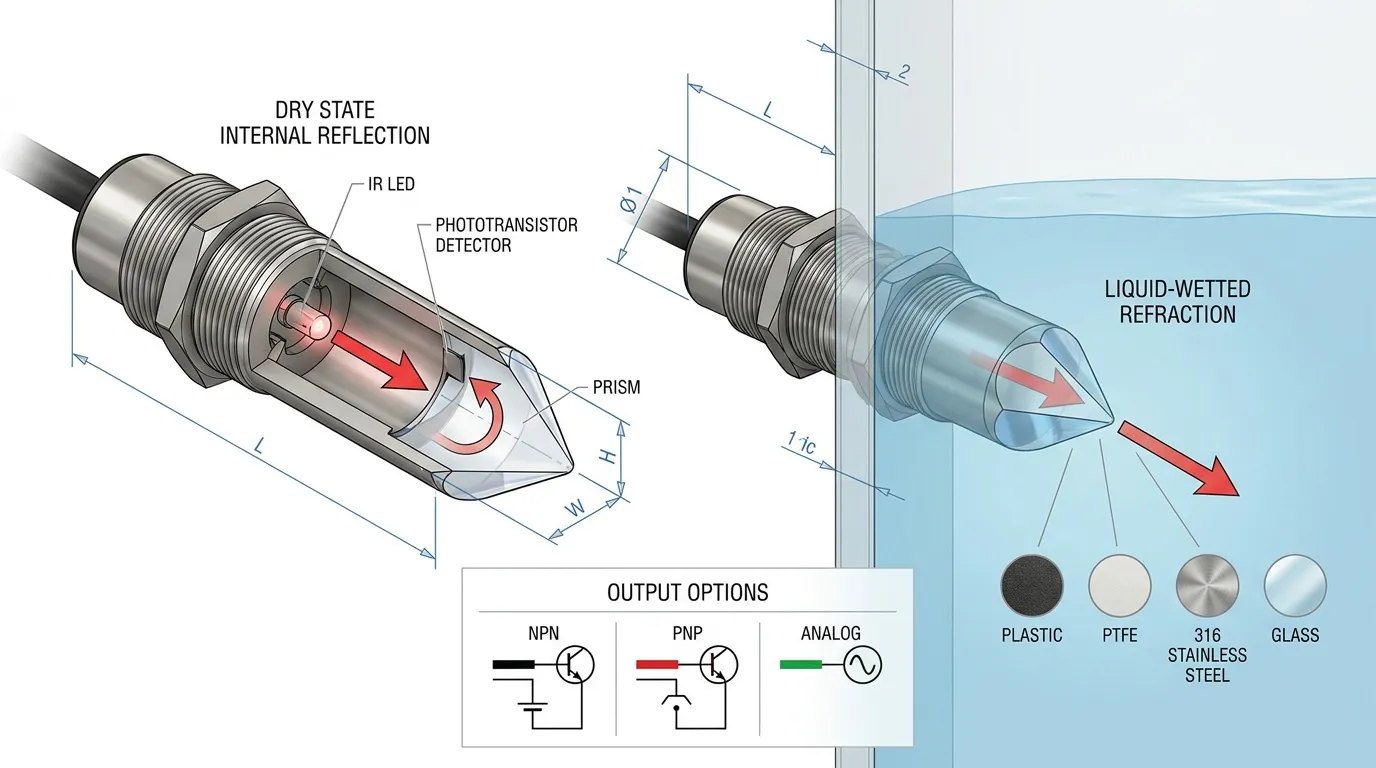
- Custom plastic, PTFE, 316 stainless steel, or glass sensing structures depending on liquid compatibility
- Threaded and panel-mounted designs for compact tanks and industrial reservoirs
- NPN, PNP, digital switching, and project-specific output configuration
- Cable length, connector, wire color, and output logic customization
- OEM/ODM support for housing, label, packaging, and repeat production
- Export support for buyers in the US, EU, India, and other markets
For standard and custom sensor options, see our optical level sensor overview or review our optical level sensor product page.
Omega Optical Level Sensor Alternative: Where Factory-Direct Buying Helps
Omega has a strong position for buyers who want a recognized catalog brand, published model families, and distributor-based ordering. That is valuable when a maintenance team wants a standard catalog item and does not need mechanical or electrical customization.
The challenge appears when the buyer is not only replacing one sensor. OEM and bulk buyers often need a sensor that fits their own tank wall, wiring harness, controller input, liquid compatibility, and target cost. In that situation, a factory-direct equivalent can be more practical than ordering a standard catalog part and adapting the machine around it.
An optical level sensor works by using an infrared LED, a phototransistor or receiver, and a prism-style sensing tip. In air, the IR light reflects internally through the prism and returns to the receiver. When liquid covers the tip, the optical path changes because the liquid alters refraction at the prism surface. The circuit then changes output state, allowing the controller to detect dry or wetted conditions.
That simple principle is why optical level switches are attractive for compact tanks: there are no floats, magnets, hinges, or moving parts to jam. But it also means the details matter. A buyer comparing Omega-style optical level sensors with a factory-direct alternative should not only ask, “Does it detect liquid?” The better question is, “Will the sensor body, prism, thread, output, and cable match my real installation?”
Material Matching: Plastic, PTFE, 316 Stainless Steel, and Glass
Material choice is one of the most important differences between a standard catalog purchase and a custom-compatible alternative.
Plastic optical sensors can work well for clean water, low-pressure reservoirs, small appliances, dosing tanks, and compact equipment. They are cost-effective and suitable when the liquid is compatible with the selected polymer. For more demanding chemical or temperature environments, PTFE or glass may be considered because the wetted surface needs stronger chemical resistance.
For industrial oils, coolants, metal tanks, and harsher factory environments, a 316 stainless optical sensor may be a better option. 316 stainless steel offers a more rugged housing choice for buyers who do not want a plastic body exposed to mechanical stress, metal fittings, or industrial cleaning conditions. The final material should still be checked against the liquid, concentration, pressure, temperature, and cleaning method before ordering.
Thread, Mounting, and Mechanical Fit
Omega-style catalog sensors may offer common threaded configurations depending on the series. When sourcing a compatible equivalent, the thread and mounting style must be confirmed carefully, not guessed from a product image.
Buyers should provide the required process connection, such as NPT thread, metric thread, panel mount, flange mount, or a custom boss. The sensor length, tip position, sealing method, O-ring material, and tightening space can affect whether the switch point aligns with the actual tank level.
A common failure mode is not sensor electronics but installation mismatch. If the prism tip is too far inside the tank, too close to a wall, trapped in foam, or positioned where liquid drains slowly, the output may switch late or remain wet after the tank is nearly empty. Factory-direct customization helps because the housing, thread, and cable direction can be adjusted for the actual tank design rather than forcing a standard sensor into a non-standard space.
Output Options: NPN, PNP, Switching Logic, and Analog Projects
Electrical output is another area where buyers need a true engineering comparison. Some optical level sensors use NPN output, some use PNP output, and some systems require normally open or normally closed behavior. For a replacement project, the output must match the controller input, PLC wiring, relay module, alarm board, or pump protection circuit.
For point level detection, the usual requirement is a digital wet/dry signal. For projects requiring continuous level measurement, an analog output such as 4–20 mA may be discussed as a separate sensor solution, not as a direct substitute for every point-level switch. Our team confirms the required signal type at the RFQ stage so the supplied sensor matches your electrical design instead of only matching the physical appearance.
Cost, Bulk Pricing, and Lead-Time Planning
A catalog brand can be convenient for small-quantity maintenance purchasing. Factory-direct sourcing becomes more attractive when the buyer needs repeated batches, private-label supply, a stable BOM, or multiple sensor variations for different machines.
HojellyTek can support bulk quotation, sample confirmation, and production planning based on your specification. We do not publish fake universal savings or fixed lead times because price and schedule depend on material, machining, cable, connector, quantity, testing requirements, and packaging. For serious buyers, that is the advantage: the quote is built around the actual project, not only a one-size catalog listing.
5-Step Factory-Direct Replacement Process
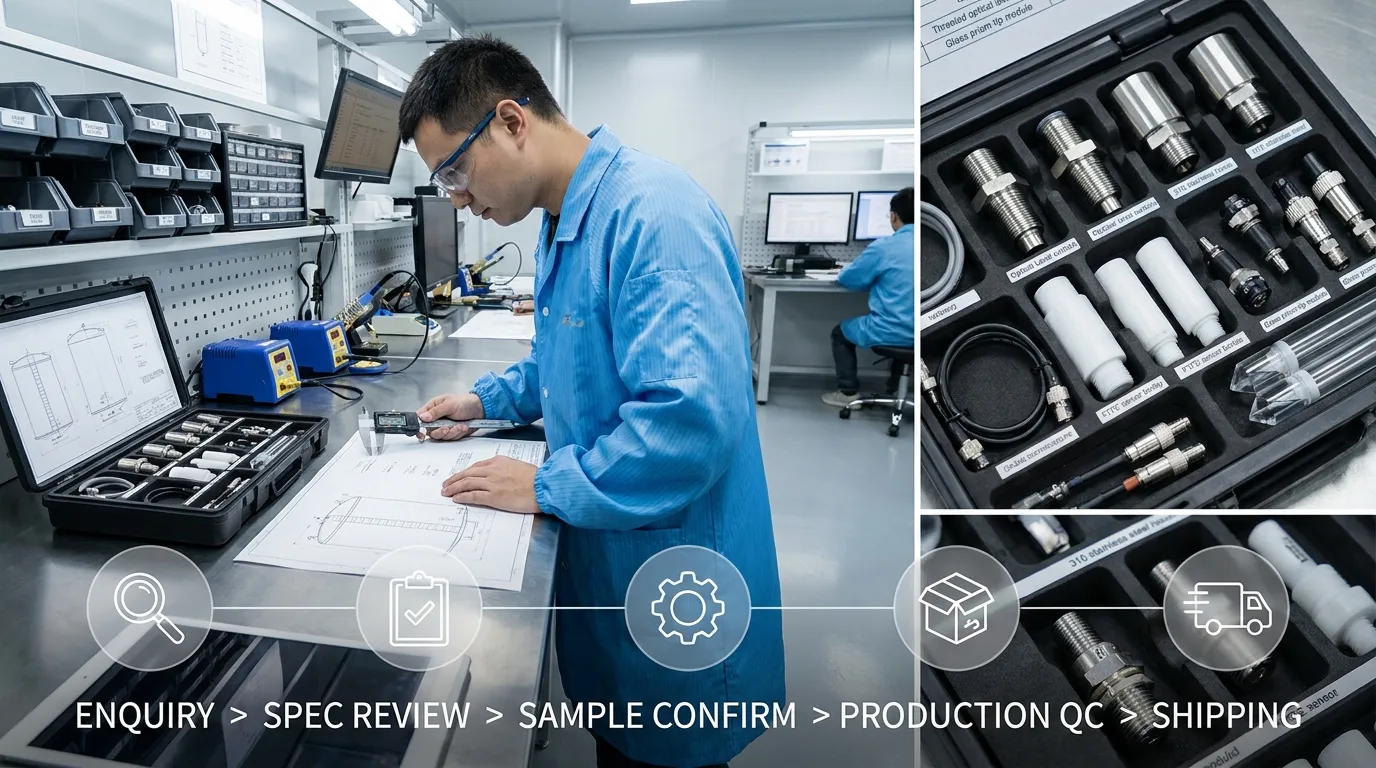
- Enquiry
Send your current sensor requirements, photos, drawing, liquid type, tank material, expected quantity, and target application. If you are comparing against an Omega optical level sensor, describe the function you need rather than asking for a copied part number. - Spec and customization review
Our engineering team checks wetted material, thread, voltage, output, cable, connector, sealing, and installation direction. We confirm whether a standard item fits or whether a custom equivalent is more appropriate. - Sample confirmation
Samples can be arranged for electrical testing, fit checking, liquid compatibility review, and controller verification before bulk production. - Production and QC
After sample approval, production follows the confirmed drawing and specification. QC focuses on optical switching response, wiring, appearance, sealing structure, and batch consistency according to the agreed requirements. - Shipping and repeat supply
For OEM and distributor buyers, we can support repeat orders, packaging requirements, and export shipment coordination.
Requirements to Confirm Before Ordering
Before replacing or cross-referencing a sensor, prepare these details:
- Liquid type, concentration, viscosity, foam level, and whether residue can coat the prism
- Tank material, wall thickness, mounting angle, and switch point position
- Required wetted material: plastic, PTFE, 316 stainless steel, glass, or another project-specific option
- Thread or mounting type, sealing method, and available installation space
- Supply voltage and controller input requirements
- Output type: NPN, PNP, normally open, normally closed, or analog requirement for a separate level solution
- Cable length, connector, wire color, and environmental protection needs
- Quantity plan: sample, pilot batch, and bulk production
Residue, bubbles, foam, crystallization, and incorrect material selection can cause unstable switching. A good equivalent sensor is selected around the liquid and installation, not only around the catalog category.
Omega vs HojellyTek Compatible Equivalent Comparison
| Comparison Point | Omega Optical Level Sensor Buying Route | HojellyTek Factory-Direct Alternative | Buyer Takeaway |
|---|---|---|---|
| Best use case | Standard catalog buying, distributor sourcing, maintenance replacement | OEM/ODM projects, bulk purchasing, customized equivalents | Choose based on whether you need convenience or customization |
| Brand position | Strong catalog and recognized distribution channel | Shenzhen manufacturer with in-house R&D and export supply | Factory-direct support can reduce extra sourcing layers |
| Part number approach | Uses Omega catalog model families | No cloned Omega part numbers; compatible equivalent by specification | Match function, not brand code |
| Materials | Catalog-dependent material options | Plastic, PTFE, 316 stainless steel, glass, and project-specific options | Confirm wetted material against the liquid |
| Output | Depends on selected catalog model | NPN, PNP, switching logic, and project-specific output review | Electrical compatibility must be checked before ordering |
| Thread and mounting | Standard catalog configurations | Thread, cable exit, housing, and mounting customization where feasible | Useful for tank manufacturers and machine builders |
| Cost structure | Convenient for standard purchases | Better suited to bulk pricing and OEM cost targets | Final quote depends on spec and quantity |
| Lead-time planning | Depends on distributor and stock status | Sample and production schedule confirmed by RFQ | Plan around approval, production, and shipment |
| Where Omega wins | Catalog depth, documentation, distribution familiarity | Custom engineering, factory-direct communication, repeat OEM supply | Omega may be better for urgent single-unit catalog replacement |
Why Buyers Work With HojellyTek
HojellyTek focuses on photoelectric optical sensing and liquid level detection. As an optical sensor manufacturer, we support buyers who need more than a ready-made catalog item: material selection, custom wiring, mechanical adjustment, private-label production, and bulk purchasing support.
Our in-house R&D team can review application details and recommend a practical sensor structure for water, oil, coolant, chemical, appliance, and industrial tank projects. Where relevant, our broader liquid monitoring experience also supports smart tank projects, including Tuya and Smart Life connected monitoring systems.
FAQ
Is an omega optical level sensor replacement available from HojellyTek?
Yes. We can offer a compatible equivalent based on your required function, material, thread, output, and installation. It is not an Omega-endorsed product and does not copy Omega part numbers.
Can you match 316 stainless steel optical level sensor requirements?
Yes, 316 stainless steel options can be discussed for industrial liquids, metal tanks, oils, coolants, and harsher installations. The liquid compatibility and sealing requirements should be confirmed before ordering.
Can I choose NPN or PNP output?
Yes. Output type is confirmed during the RFQ stage. Buyers should provide the controller input type, wiring diagram, voltage requirement, and desired wet/dry switching logic.
Do optical level sensors work with dirty or sticky liquids?
They can be affected by coating, residue, foam, bubbles, or crystallization on the prism tip. For dirty liquids, the application should be reviewed carefully before selecting an optical sensing method.
Is factory-direct sourcing cheaper than buying from a catalog brand?
For bulk, OEM, or customized projects, factory-direct sourcing can help reduce cost and improve specification control. The final price depends on material, quantity, cable, connector, testing, and packaging requirements.
When should I still buy from Omega?
Omega may be the better choice when you need an exact catalog product, distributor purchasing, existing internal approval, or a fast single-unit replacement already listed in your maintenance system.
Request a Compatible Optical Level Sensor Quote
Send your current sensor photos, drawing, liquid type, thread, output, cable requirement, and estimated quantity. Our team will review the specification and recommend a compatible optical level sensor option for sample testing or bulk production.
Contact HojellyTek by WhatsApp or email to request a quote, datasheet, or OEM/ODM consultation.


