
Optical Level Sensor Datasheet (PDF Download)
If you searched for an optical level sensor pdf, this resource page helps you request the genuine HojellyTek datasheet with dimensions, wiring, output options, material choices, and model selection details. Instead of publishing a fake download button, we provide the datasheet through a real request form so our team can send the correct file for your liquid, tank, wiring, and installation requirements.
Use this page to check what the datasheet contains, compare optical level sensor variants, and prepare your RFQ before requesting the PDF, drawing, or sample.
Request the Genuine Optical Level Sensor Datasheet PDF
The datasheet is intended for engineers, OEM buyers, equipment manufacturers, automation integrators, and purchasing teams who need more than a product photo. A useful optical level sensor datasheet should help you answer practical questions before ordering:
- Will the sensor fit the tank wall, pipe, reservoir, or small chamber?
- Which wetted material is suitable for the liquid?
- Is the output compatible with your PLC, MCU, relay board, alarm controller, or IoT device?
- Is the switching logic dry-on or wet-on for your control system?
- Can the sensor be customized for cable length, thread, connector, or private-label production?
To request the PDF, submit your project information by email or WhatsApp. Our team can send the correct datasheet, confirm the recommended variant, and provide a quotation or sample plan if needed.
For a broader product overview, see our optical level sensor guide. For specification planning, you can also review the optical level sensor specifications page.
What the Datasheet Should Include
A serious optical level sensor PDF should not only say “liquid detection sensor.” It should give enough technical information for design review and procurement approval.
The HojellyTek datasheet package can include mechanical dimensions, sensing principle, wiring information, output options, body material, thread and mounting options, cable or connector choices, and model selection guidance. For OEM/ODM projects, the final file may also include a customized drawing or version-specific table.
Dimensions and Mechanical Drawing
The dimensional drawing helps buyers confirm whether the sensor can be installed in a tank wall, narrow reservoir, pipe adapter, dispensing system, coolant tank, pump chamber, or custom plastic housing. Important checks include thread size, probe length, body diameter, sealing position, cable exit direction, and whether there is enough clearance inside the tank.
For compact devices, even a few millimeters of sensor body length or cable bend space can affect the assembly. That is why datasheet seekers often need a real drawing before they can approve a sample.
Wiring and Output Details
Optical liquid level sensors are often integrated with PLC inputs, microcontroller boards, relay circuits, alarm modules, pump control panels, or industrial controllers. The datasheet should clearly show the wiring relationship between power, ground, signal output, and load.
Common output choices include NPN switching, PNP switching, normally open, normally closed, and analog-style output such as 4–20 mA where the application requires continuous or controller-friendly signal handling. The correct choice depends on the control board, input logic, cable distance, and whether the system should trigger when liquid is present or absent.
For NPN/PNP selection details, buyers can also review the optional NPN/PNP optical liquid level sensor resource.
Operating Principle: IR LED, Phototransistor, and Prism Tip
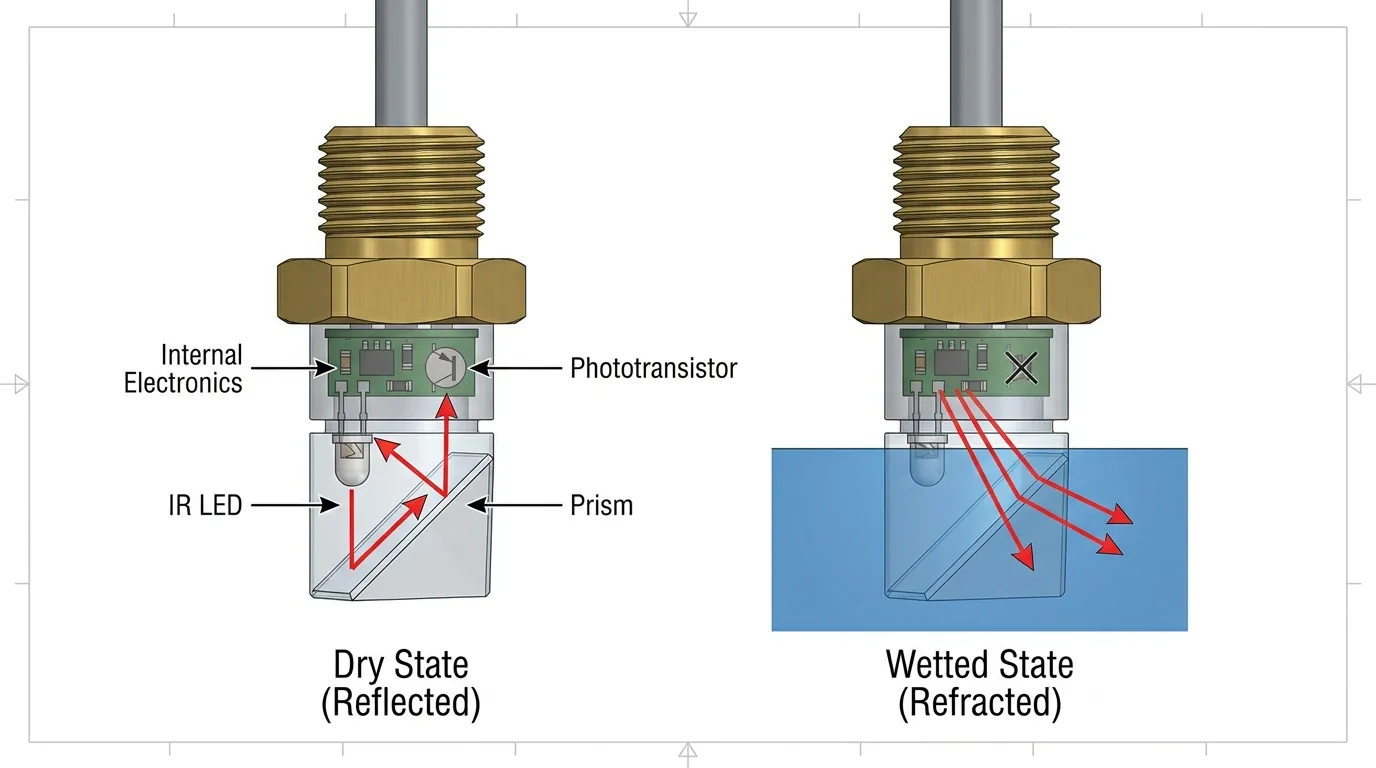
An optical level sensor uses photoelectric sensing rather than a moving float. Inside the sensor, an infrared LED sends light into a prism-shaped sensing tip. A phototransistor receives the reflected light signal.
In the dry state, the prism reflects infrared light back to the receiver. When the tip is wetted by liquid, the refractive condition changes and the reflected light pattern is reduced or redirected. The circuit detects this change and switches the output.
This design is useful when buyers want a compact, no-moving-parts level switch for water, coolant, oil, fuel, detergent, chemical liquid, or small tank detection. It is especially valuable where float sensors may stick, absorb liquid, collect debris, or require extra installation space.
For more technical background, visit our IR sensor documentation.
Optical Level Sensor Model and Variant Table

The table below shows common variant directions buyers may request. Final model selection should be confirmed through the real datasheet, drawing, and RFQ review.
| Variant / Model Direction | Typical Wetted Material Choice | Output Options | Mounting Direction | Best-Fit Applications |
|---|---|---|---|---|
| Compact optical point level sensor | PSU or engineering plastic | NPN / PNP, NO / NC | Side or bottom mounting depending on housing | Small reservoirs, appliances, dispensers, compact OEM equipment |
| Industrial stainless optical sensor | 316 stainless steel with optical prism structure | NPN / PNP or controller-compatible signal | Threaded tank or pipe mounting | Coolant tanks, industrial water systems, oil tanks, pump protection |
| Chemical-resistant optical sensor | PTFE or other fluid-compatible material | Switching or project-specific output | Threaded or customized installation | Chemical dosing, reagent tanks, aggressive fluid detection |
| Glass optical sensing tip version | Glass wetted tip with compatible body material | Switching output depending on control design | Tank-mounted installation | Applications requiring stable optical contact and clear sensing surface |
| OEM customized optical level sensor | Material, thread, cable, and connector selected by project | NPN / PNP / analog-style options where applicable | Custom bracket, thread, flange, or panel design | Equipment manufacturers, private-label products, export projects |
| Connected liquid level solution | Optical sensor plus matched control or IoT module when relevant | Digital or system-level output | Project-specific | Smart tank monitoring, remote alarms, Tuya / Smart Life related projects where suitable |
If you already have a target enclosure, tank drawing, PCB input requirement, or old sensor sample, send it with the request. It helps the factory recommend a closer match faster.
What Buyers Must Check Before Ordering
A datasheet is only useful when it matches the real operating environment. Before requesting a PDF or sample, prepare the following details.
1. Liquid Type and Optical Behavior
Optical sensors work best when the liquid reliably changes the light behavior at the prism. Clear water, coolant, light oil, fuel, and many industrial liquids can be suitable, but the final result depends on liquid clarity, bubbles, foam, coating, viscosity, color, contamination, and whether the sensing tip may become covered by residue.
Sticky liquids, crystallizing chemicals, dirty oil, or liquids that leave film on the prism can cause false switching or delayed recovery. For these cases, material choice, mounting angle, cleaning access, and test samples are important.
2. Wetted Material Compatibility
The wetted material must survive the liquid. Common choices include PSU, PTFE, 316 stainless steel, and glass depending on the liquid and installation design.
PTFE is often considered for chemically aggressive liquids. 316 stainless steel is often requested for stronger mechanical protection and industrial environments. Glass sensing tips may be selected where a stable optical prism surface is needed. Plastic materials can support compact, cost-sensitive, lightweight OEM assemblies.
Do not choose material only by price. A low-cost body material that swells, cracks, stains, or reacts with the liquid can create failure in the field.
3. Output Type and Controller Match
The sensor output must match the input side of your device. NPN and PNP are not interchangeable in every circuit. Normally open and normally closed logic also affect whether the controller sees a signal in the dry state or wetted state.
For PLC projects, confirm sinking or sourcing input requirements. For MCU projects, confirm signal voltage, pull-up or pull-down logic, input protection, and whether isolation is required. For longer cable runs, confirm noise environment and whether a different signal design is better.
4. Thread, Seal, and Mounting Position
Thread type, sealing method, and mounting direction are critical. A sensor can fail mechanically even if the electronics are correct. Buyers should check tank wall thickness, thread engagement, gasket or O-ring position, tightening method, vibration, cable strain relief, and whether the prism tip will sit at the correct level point.
Avoid installing the prism where bubbles, turbulent flow, splashing, or sediment can constantly disturb the sensing surface. For pump protection, low-level alarm, or overflow control, the exact mounting height matters.
5. Real Failure Modes to Prevent
The most common optical level sensor problems are not caused by the sensing principle alone. They often come from poor matching between the sensor and the application.
Typical risks include wrong NPN/PNP selection, reversed wet/dry logic, incompatible liquid material, coating on the prism, thread leakage, overtightening, cable damage, unstable power supply, excessive electrical noise, incorrect load wiring, and poor mounting location.
A proper datasheet request form helps prevent these issues before sample ordering.
Request-Datasheet Form: Information to Send
When contacting us, include as many of these items as possible:
- Liquid name and concentration
- Tank material and installation position
- Required thread, flange, or custom mount
- Dry-state and wet-state output logic
- NPN, PNP, 4–20 mA, or other signal requirement
- Supply voltage requirement
- Cable length, connector, or wire color preference
- Quantity estimate for sample and production
- Drawing, photo, old sample, or target product structure
- Destination market, such as US, EU, India, or other export region
You can also visit the optical level sensor product page before submitting your request.
5-Step Supply Process
1. Enquiry
Send your datasheet request by WhatsApp or email with your liquid type, installation method, and output requirement. Our team reviews whether a standard model or custom version is more suitable.
2. Specification and Customization
The factory confirms the sensing structure, wetted material, thread, wiring, cable, connector, and output logic. For OEM/ODM projects, drawings and private-label requirements can be discussed.
3. Sample
A sample can be arranged after model confirmation. Testing should be done with the real liquid, real tank position, and real controller input whenever possible.
4. Production and QC
Production follows the approved sample and specification. QC focuses on electrical function, output switching, appearance, wiring, and order-specific requirements.
5. Shipping
As a Shenzhen manufacturer and exporter, HojellyTek supports international buyers in markets including the US, EU, and India. Packing, shipping method, and export documents are confirmed during the order stage.
Requirements and Specification Checklist
| Requirement | What to Confirm Before Ordering |
|---|---|
| Liquid compatibility | Liquid type, concentration, residue, viscosity, bubbles, foam, and cleaning needs |
| Wetted materials | PSU, PTFE, 316 stainless steel, glass, or project-specific material |
| Output signal | NPN, PNP, NO/NC, 4–20 mA, or controller-specific signal requirement |
| Electrical match | Supply voltage, load type, input circuit, cable length, and electrical noise environment |
| Mounting | Thread, sealing method, tank wall thickness, orientation, and sensing height |
| Customization | Cable, connector, body material, logo, packaging, drawing, and OEM/ODM version |
| Documentation | Datasheet PDF, mechanical drawing, wiring diagram, and quotation details |
Datasheet Request vs Direct Download
| Option | Best For | Limitation |
|---|---|---|
| Public generic PDF | Fast browsing and early comparison | May not match the exact material, output, or customized version |
| Gated genuine datasheet | Buyers who need the right drawing, wiring, and model table | Requires sending project information |
| Custom drawing with RFQ | OEM equipment, new product design, replacement projects | Needs technical review before quotation |
| Sample before production | Verifying real liquid and controller compatibility | Requires testing in the actual application |
For this page, the recommended route is a genuine request form, not a fake PDF button. That protects buyers from using the wrong drawing or wiring diagram in a design file.
Why Work With HojellyTek
HojellyTek is a Shenzhen optical and liquid level sensor manufacturer with in-house R&D, photoelectric optical sensing experience, OEM/ODM support, and export service for industrial and equipment manufacturers. Our team can support standard optical level sensor requests, customized wetted materials, different output logic, cable and connector options, and project-specific documentation.
For buyers comparing suppliers, the main advantage is direct factory communication. You can discuss the sensor, datasheet, drawing, sample, and quotation with the same team instead of guessing from a generic PDF.
FAQ
Where can I get the optical level sensor pdf?
You can request the genuine datasheet by sending your application details through WhatsApp or email. We do not recommend using a fake download link because the correct PDF depends on material, output, thread, wiring, and model variant.
Does the datasheet include wiring diagrams?
Yes, the datasheet package can include wiring information for the relevant output type. Confirm whether your controller needs NPN, PNP, normally open, normally closed, 4–20 mA, or another signal format.
Can I request dimensions before ordering a sample?
Yes. Mechanical dimensions and installation drawings are usually needed before sample approval, especially for OEM equipment, compact tanks, custom housings, and replacement projects.
Which material should I choose for the wetted part?
It depends on the liquid. PSU, PTFE, 316 stainless steel, and glass may be considered depending on chemical compatibility, temperature, cleaning method, and mechanical strength requirements.
Can the sensor detect oil, fuel, coolant, or chemical liquid?
Many optical level sensors can be used for water, oil, fuel, coolant, and selected chemical liquids, but the real liquid must be checked. Foam, bubbles, coating, residue, and chemical compatibility can affect performance.
Can HojellyTek customize the sensor for OEM projects?
Yes. HojellyTek can discuss OEM/ODM requirements such as material, thread, cable length, connector, output logic, labeling, packaging, and project-specific drawings.
Request the Datasheet and Quote
Send your liquid type, tank drawing, output requirement, thread preference, and quantity estimate by WhatsApp or email. Our team will confirm the suitable optical level sensor variant, provide the correct datasheet PDF or drawing, and prepare a quote for samples or production.


