
Optical Level Sensor Market Guide & Trends
The optical level sensor market is moving from a narrow point-level switch category into a broader design choice for automotive systems, appliances, medical devices, process equipment, and connected smart-home products. Instead of treating level detection as a simple float switch decision, more OEM buyers now compare footprint, response time, liquid compatibility, control-board interface, and long-term maintenance risk before choosing a sensing technology.
This guide gives a practical market overview for buyers, engineers, and sourcing teams. It explains where optical level sensing is gaining attention, how it compares with float, ultrasonic, and capacitive sensors, why published market-size figures vary, and what to check before sourcing from China OEM manufacturers.
Where Optical Level Sensing Is Growing
Optical level sensing is strongest where a buyer needs reliable point-level detection in a compact space. The sensor does not measure the full height of a tank like a continuous ultrasonic or radar transmitter. Instead, it detects whether liquid is present or absent at a fixed point: low level, high level, overflow, leak, empty tank, or dry-run protection.
Growth is especially visible in five application groups:
Automotive and EV systems use level sensing for coolant reservoirs, washer fluid, oil-related tanks, fuel-adjacent systems, and battery thermal management auxiliaries. These applications favor compact sensors with stable electrical output and vibration-resistant mounting.
Appliances and consumer equipment use small level switches in coffee machines, water dispensers, humidifiers, steam appliances, floor-cleaning equipment, and small water tanks. Here, the buyer usually cares about low profile, repeatable switching, plastic compatibility, and per-unit cost at volume.
Medical and laboratory devices need compact liquid detection for reagent bottles, waste tanks, diagnostic equipment, sterilization systems, and dosing modules. These buyers look closely at wetted materials, cleaning method, contamination risk, and failure behavior.
Process and industrial equipment use optical liquid level sensors for leak detection, overflow prevention, pump protection, and small tank automation. Chemical compatibility becomes more important, so PTFE, 316 stainless steel, and glass options are often part of the discussion.
IoT and smart-home systems are expanding demand for small sensor modules that can connect to controller boards, smart pumps, water leak alarms, aquarium auto top-off systems, and Tuya / Smart Life connected devices.
For buyers comparing designs, a compact optical level sensor is usually considered when mechanical movement, large sensor size, or long-term sticking risk is a concern.
Market Estimates: Useful, But Not Exact
Published level sensor market numbers should be treated as third-party estimates, not exact industry facts. The biggest reason is scope: some reports cover all level sensors, some include level switches, some focus only on optical liquid level sensors, and some include broader optical sensing categories.
For the broad level sensor market, recent third-party estimates range roughly from USD 6.48 billion in 2026 to USD 9.27 billion in 2026 depending on report methodology. Mordor Intelligence estimates the level sensor market at USD 6.48 billion in 2026 and USD 8.68 billion by 2031, while Fortune Business Insights estimates USD 9.27 billion in 2026 and USD 12.85 billion by 2034. Coherent Market Insights gives another 2026 estimate of USD 8.46 billion. These are not directly interchangeable because each firm defines market coverage differently.
Optical-specific estimates vary even more. Future Market Insights estimates the optical liquid level sensor market at USD 41.6 billion in 2025 and USD 74.5 billion by 2035, while Lucintel states that the global optical liquid level sensor market may reach an estimated USD 46.4 billion by 2031. A China-focused estimate from IndexBox places China’s optical liquid level sensor market around USD 180–220 million in 2026. These wide ranges show why buyers should use market figures for direction, not for procurement decisions.
How Optical Level Sensors Work
A typical optical liquid level sensor uses an infrared LED, a phototransistor or photodiode receiver, and a transparent prism tip. When the prism is dry and surrounded by air, infrared light reflects inside the prism and returns to the receiver. When liquid covers the prism, the refractive condition changes; much of the light escapes into the liquid, so less light returns to the receiver. The internal electronics convert that dry/wet state into an output signal.
This principle explains both the appeal and the limits of the technology. The sensor is fast, compact, and solid-state. It has no float arm, magnet, hinge, or reed movement. But it is still a contact sensor, so the prism and housing must match the liquid, cleaning method, pressure condition, mounting angle, and expected contamination level.
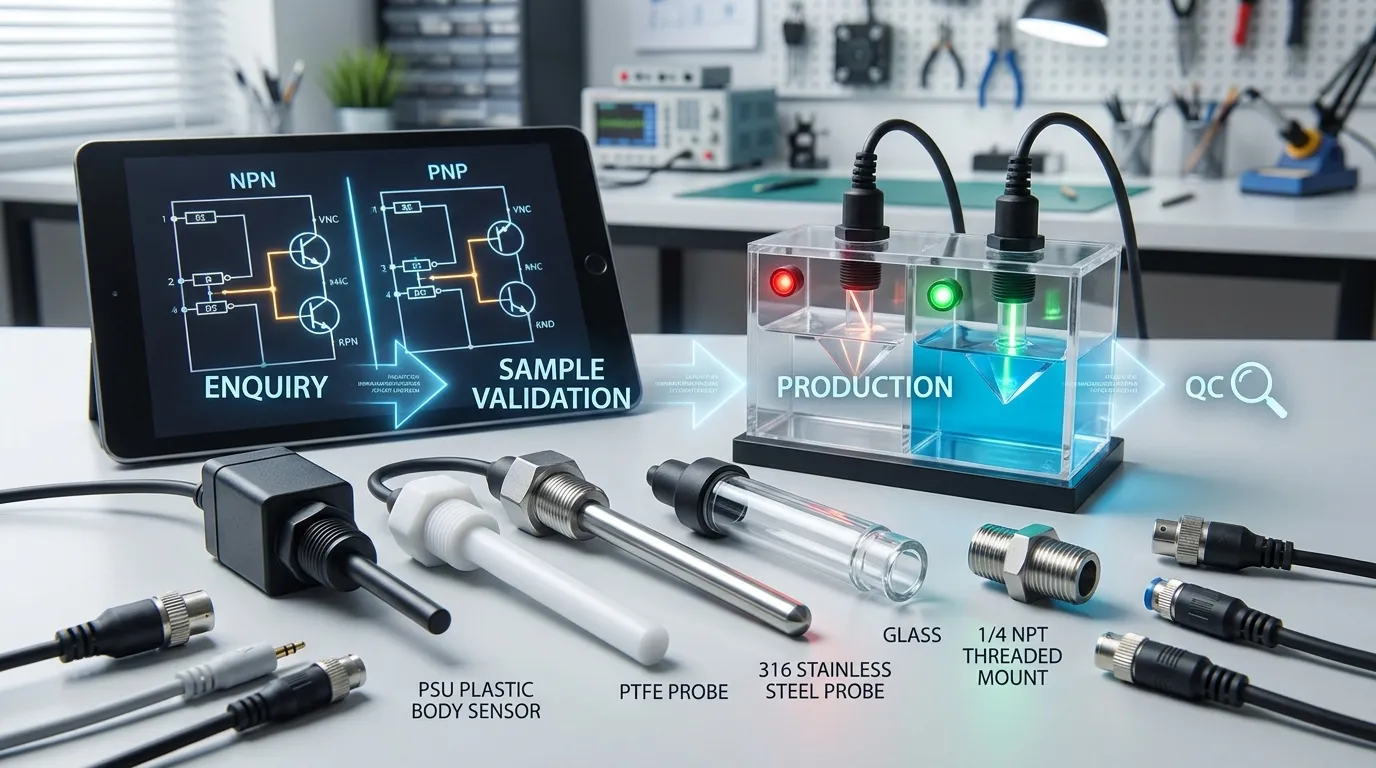
Common wetted-material choices include PSU or similar engineering plastics for water-based appliances, PTFE for aggressive chemicals, 316 stainless steel for industrial strength and corrosion resistance, and glass for selected chemical or high-cleanliness applications. The best material depends on the liquid, temperature, cleaning process, installation location, and whether the sensor touches water, oil, coolant, detergent, reagent, or mixed media.
Optical vs Float, Ultrasonic, and Capacitive Sensors
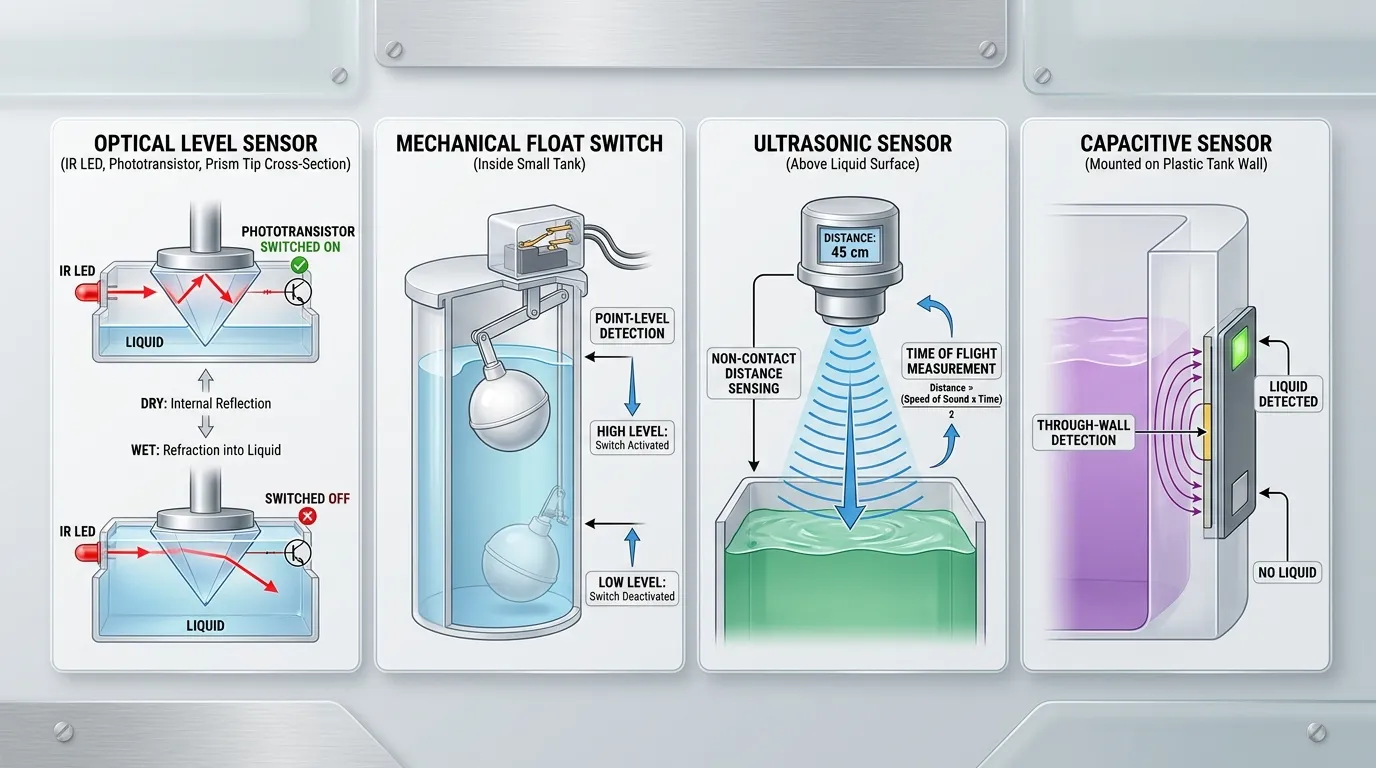
Optical level sensors are not replacing every other level technology. They are gaining share in applications where compact, no-moving-parts point detection is more valuable than continuous level measurement.
| Technology | Strongest fit | Where it keeps share | Where optical may win |
|---|---|---|---|
| Float switch | Simple low-cost tanks, basic high/low alarm | Mature designs, low electronics cost, easy understanding | When floats stick, jam, wear, need more space, or fail in small tanks |
| Ultrasonic sensor | Non-contact distance measurement in open tanks | Continuous level monitoring, waste bins, water tanks, remote measurement | When the tank is small, foamy, confined, or only needs point detection |
| Capacitive sensor | Plastic tanks, non-metal wall detection, some non-contact setups | Low-cost water and liquid detection through thin walls | When liquid properties, buildup, or calibration drift create instability |
| Optical sensor | Compact point-level detection, leak detection, overflow, dry-run protection | Appliances, medical, automotive, small process tanks, smart devices | When fast switching, small size, and no moving parts matter most |
In broad level sensor reports, ultrasonic often appears as a leading technology segment; Future Market Insights, for example, estimates ultrasonic at 18.6% share within its 2025 level sensor market segmentation. Optical is usually a smaller category in total level measurement because large process tanks often use radar, pressure, hydrostatic, or ultrasonic technologies. But inside compact liquid point-level detection, optical sensors compete much more directly with float and capacitive switches.
Market Segment Table
| Segment | Growth signal | Typical liquid | Optical sensor requirement | Buyer concern |
|---|---|---|---|---|
| Automotive / EV auxiliary tanks | More electronics, compact reservoirs, thermal systems | Coolant, washer fluid, oil-related media | Stable logic output, vibration-resistant mount, material compatibility | Long-term reliability under vibration and temperature change |
| Appliances | More water-handling devices and smart dispensers | Water, detergent, steam-system liquid | Small prism tip, plastic body, low power, fast switching | Cost, leakage prevention, compact installation |
| Medical and lab equipment | Growth in diagnostics, dosing, reagent systems | Reagent, waste fluid, purified water | Cleanable housing, reliable dry/wet detection, suitable wetted material | Contamination risk and false switching |
| Process equipment | Automation and pump protection | Water, chemical, oil, coolant | PTFE / 316 stainless / glass options, threaded or flange mounting | Chemical resistance and maintenance |
| IoT / smart home | Connected tanks, leak alarms, smart pumps | Water, aquarium fluid, small tanks | Module-ready output, controller compatibility, low-voltage design | Easy integration with control boards and apps |
Key Regions and Sourcing Trends
North America and Europe remain important demand regions because of automation, equipment replacement, medical devices, industrial process control, and regulatory pressure around safety and leakage prevention. Buyers in these regions often focus on documentation, repeatability, material traceability, and stable supply.
Asia-Pacific is important for two reasons: end-use demand and manufacturing supply. China, India, and Southeast Asia continue to expand appliance manufacturing, automotive electronics, smart-home devices, water equipment, and industrial automation. Several market reports identify North America, Europe, and Asia-Pacific as key growth regions for optical or general level sensor demand.
China OEM sourcing is becoming more relevant because many buyers do not only need a catalog sensor. They need a modified body length, custom thread, connector, cable length, output logic, plastic housing, stainless probe, or private-label supply. For buyers comparing an optical sensor manufacturer, the sourcing discussion often includes engineering support, sample validation, export experience, and whether the factory can keep the same design stable across repeat batches.
HojellyTek is a Shenzhen manufacturer and exporter focused on photoelectric optical sensing, liquid level detection, OEM/ODM projects, and sensor modules for customers in the US, EU, India, and other markets.
What Buyers Must Check Before Ordering
The biggest sourcing mistakes usually happen when buyers only ask for a “water level sensor” without defining the operating conditions. Before ordering, confirm these points:
- Liquid type: water, oil, coolant, detergent, chemical, reagent, or mixed liquid
- Optical behavior: transparent, colored, reflective, foaming, sticky, or prone to bubbles
- Wetted material: PSU, PTFE, 316 stainless steel, glass, or another confirmed material
- Output type: NPN, PNP, relay-style logic, voltage output, or 4–20 mA for compatible systems
- Logic state: dry-on, wet-on, normally open, normally closed, or custom control logic
- Mounting: side mount, bottom mount, 1/4 NPT, metric thread, flange, gasket, or custom housing
- Electrical interface: supply voltage, current limit, pull-up requirement, connector, and cable length
- Installation environment: splash, vibration, condensation, cleaning, pressure, and temperature exposure
For early cost planning, compare materials, body design, electronics, cable, and customization level rather than only asking for a generic optical level sensor price.
Real Failure Modes to Design Around
Optical sensors are reliable when specified correctly, but they are not magic. A buyer should design around real-world failure modes.
Prism contamination can occur when liquid leaves scale, oil film, detergent residue, biological growth, or sticky deposits on the tip. This may make the sensor “think” the prism is still wet or reduce switching margin.
Foam and bubbles can cause unstable detection if the prism alternates between liquid, foam, and air. In these cases, mounting position and software filtering may matter.
Wrong material selection can cause swelling, cracking, corrosion, or leakage. A sensor that works in clean water may not survive chemical cleaning or oil exposure.
Electrical mismatch can damage the control board or create false signals. NPN and PNP outputs are not interchangeable without checking the input circuit. 4–20 mA is more common for industrial analog systems, while many compact switches use digital logic outputs.
Poor mounting geometry can trap air, collect residue, or expose the prism to turbulence. The best installation position depends on whether the goal is leak detection, low-level alarm, overflow prevention, or pump dry-run protection.
FAQ
Is the optical level sensor market growing?
Yes, the optical level sensor market is growing in compact liquid-detection applications such as appliances, medical equipment, automotive auxiliary tanks, process equipment, and smart-home devices. However, published market-size figures vary by scope, so buyers should treat them as estimates rather than exact values.
Are optical sensors better than float switches?
They are better when small size, fast switching, no moving parts, and reduced sticking risk are important. Float switches can still be the simplest low-cost choice for basic tanks with enough space and clean liquid.
Can optical level sensors measure continuous tank level?
Most compact optical level sensors are point-level switches. They detect wet or dry at one position. For continuous tank measurement, ultrasonic, pressure, radar, or multi-point sensing may be more suitable.
Which output should I choose: NPN, PNP, or 4–20 mA?
Choose based on your controller input. NPN and PNP are common for digital switching. 4–20 mA is used when the control system expects an industrial analog signal. The output should be confirmed at the RFQ stage.
Why do market reports show different optical level sensor values?
Reports use different definitions. Some count only optical liquid level switches, while others include broader optical sensing, industrial transmitters, or multiple level sensor categories. That is why estimates can vary widely.
Why source optical level sensors from a China OEM?
China OEM sourcing can help when the buyer needs custom housing, cable, connector, output logic, wetted material, or private-label supply at volume. The key is to validate samples and confirm specifications before production.
Soft CTA
For buyers studying the market and preparing a new design, HojellyTek offers compact optical liquid level sensors, micro photoelectric level switches, stainless steel and glass probe options, and OEM/ODM customization for appliance, automotive, medical, industrial, and smart-water applications. Explore our optical level sensor range, or request a quote by WhatsApp or email with your liquid, mounting, output, material, and volume requirements.


