
Optical Level Sensor Price
HojellyTek is a Shenzhen manufacturer and exporter of photoelectric optical liquid level sensors for OEM/ODM projects, industrial tanks, small appliances, water systems, oil detection, and smart monitoring applications. We support sample evaluation, bulk production, and factory-direct quotation via WhatsApp or email.
Optical Level Sensor Pricing: What Is Included in a Quote?
A proper quotation for an optical level sensor should not only list a unit cost. It should confirm the full configuration that affects performance, reliability, and repeat ordering.
A buyer-ready quote usually includes:
- Sensor type: point level switch or continuous level sensing
- Wetted material: PSU, PTFE, 316 stainless steel, glass, or other compatible housing
- Optical structure: IR LED, phototransistor, and prism sensing tip
- Output type: NPN, PNP, switch logic, or analog signal such as 4–20 mA where required
- Electrical interface: voltage, wiring, cable length, connector, and pin definition
- Mounting method: threaded, panel mount, tank wall mount, flange, or custom OEM housing
- Liquid compatibility: water, oil, coolant, chemical liquid, foam risk, or residue risk
- Quantity: sample order, pilot batch, or bulk production
- Testing and documentation requirements
- Packaging, labeling, and export requirements
This is why two sensors that look similar in a product photo may have very different prices. A compact plastic water-level switch for a small appliance is not priced the same as a 316 stainless steel optical sensor for oil, high-temperature liquid, or industrial tank integration.
The Main Factors That Drive Optical Level Sensor Cost
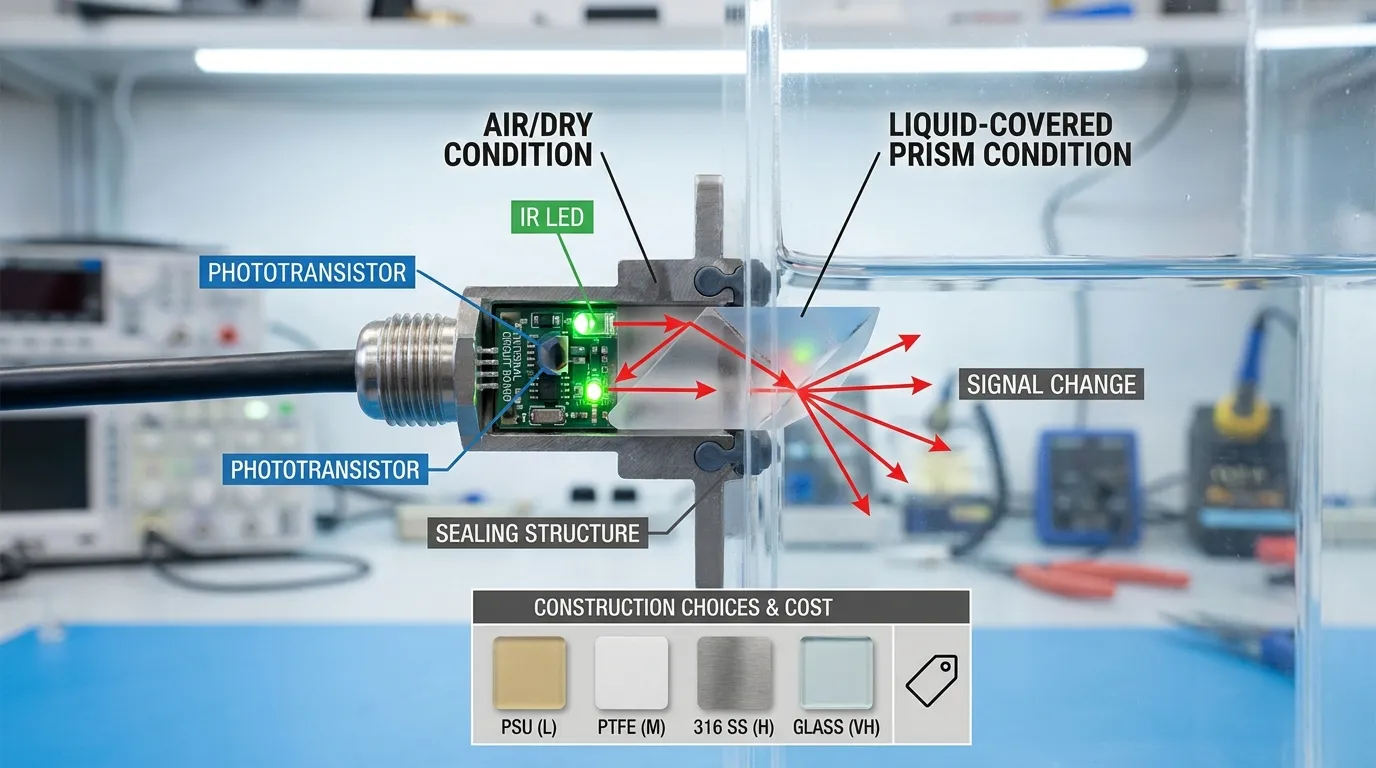
The largest price difference usually comes from the technology and material choice. Optical sensors work by sending infrared light from an IR LED into a prism tip. In air, the light reflects internally and reaches the phototransistor. When liquid covers the prism, the refractive condition changes, less light returns, and the circuit switches state. This solid-state design gives fast response and avoids a moving float, but the final cost depends on how robust the package must be.
Point Level Switch vs Continuous Level Sensor
A point optical level switch detects one liquid position: empty/full, high level, low level, leak present, or no liquid. It is usually the lower-cost option because the design is simpler and the output is often a digital switch signal.
A continuous level sensor measures level over a range. It requires more sensing structure, signal processing, calibration, and output control. If your application only needs pump dry-run protection, overflow detection, or a low-level alarm, a point optical level switch is normally the more cost-efficient choice. If your system needs real-time tank level percentage, remote monitoring, or process trend data, continuous sensing may justify the higher cost.
Wetted Material: PSU, PTFE, 316SS, and Glass
Wetted material is one of the clearest price drivers because it controls chemical resistance, temperature suitability, mechanical strength, and machining complexity.
PSU or engineered plastic is often suitable for clean water, appliance tanks, humidifiers, dispensers, small reservoirs, and general non-aggressive liquids. It is usually more economical and works well when the liquid is compatible.
PTFE is selected when chemical resistance is more important. It is commonly considered for corrosive liquids, special cleaning fluids, or applications where plastic swelling, staining, or attack is a concern. PTFE can increase cost because of material and manufacturing requirements.
316 stainless steel is used when buyers need stronger mechanical protection, industrial durability, oil/fuel compatibility, or a premium metal body. Stainless housings usually cost more than plastic versions because of machining, sealing, and assembly requirements.
Glass sensing tips may be chosen for special chemical or optical compatibility needs. They require careful sealing and handling, so the quote must confirm the liquid, pressure, cleaning method, and installation environment.
Output Type and Control Interface
Basic switch outputs such as NPN or PNP are common for equipment builders because they connect easily to PLCs, control boards, alarms, and relay circuits. Output logic, normally open/normally closed behavior, and pull-up requirements should be confirmed before ordering.
A 4–20 mA output is more relevant where the buyer needs continuous level data, longer cable runs, or industrial signal compatibility. It can increase cost because it requires a different electronic design and calibration approach. Custom connector pinouts, special cable jackets, molded connectors, or waterproof plugs can also affect the final price.
Certification, Documentation, and Export Requirements
Certification requirements can change the cost because they affect materials, testing, documentation, and production control. Do not assume every sensor requires the same compliance package. A small appliance water-level switch, an industrial oil-level sensor, and a drinking-water-contact application may need different material declarations or test documents.
HojellyTek exports sensors to the US, EU, India, and other markets, so the quotation stage can include the documentation your buyer, importer, or engineering team needs to review. Final certification needs should always be confirmed before mass production.
Order Volume: Sample, Pilot Batch, and Bulk Pricing
Sample pricing is usually higher per unit because it includes small-batch handling, engineering confirmation, setup, packing, and export preparation. Bulk pricing becomes more competitive when the design is fixed, the materials are confirmed, and production can be planned efficiently.
For OEM projects, the best approach is:
- Confirm the technical specification.
- Test samples in the real tank and liquid.
- Approve the mounting, wiring, and logic.
- Lock the production drawing.
- Request bulk pricing based on forecast quantity.
Optical Level Sensor Price Factor Table
| Price Factor | Lower-Cost Direction | Higher-Cost Direction | Buyer Note |
|---|---|---|---|
| Sensor technology | Point level switch | Continuous level sensor | Do not pay for continuous measurement if a high/low alarm is enough |
| Wetted material | PSU / plastic | PTFE, 316SS, glass | Choose based on liquid compatibility, not only price |
| Output type | NPN / PNP switch output | 4–20 mA or custom signal | Match the PLC or control board before ordering |
| Mounting | Standard thread or simple tank mount | Custom thread, flange, compact OEM body | Custom mechanical design can affect tooling and unit cost |
| Cable / connector | Standard cable | Molded plug, special jacket, long cable | Useful for waterproofing and field installation |
| Certification | Standard factory test | Application-specific documentation | Confirm market and industry requirements early |
| Order volume | Bulk production | Samples or small trial orders | Unit cost usually improves after specification approval |
All price ranges should be confirmed by quotation. Material market changes, custom structure, testing level, and shipping method can change the final commercial offer.
Factory-Direct Price vs Distributor Markup
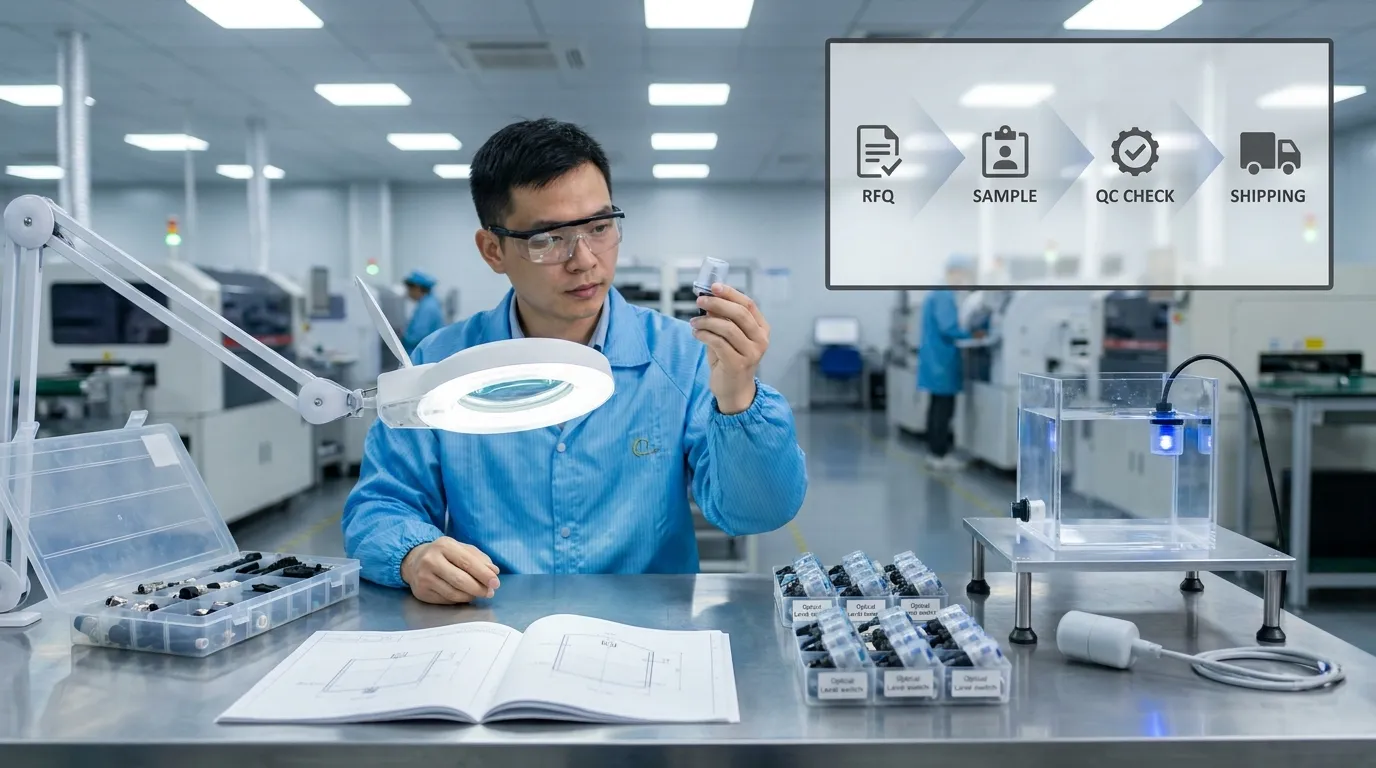
Buying from a distributor can be convenient when you need a standard item quickly, but the unit cost may include stocking margin, local service margin, and limited configuration flexibility. Buying factory-direct from an optical sensor manufacturer is usually more suitable when you need custom wire length, private label packaging, different output logic, a special thread, or stable pricing for repeat production.
Factory-direct sourcing is especially useful for:
- Appliance manufacturers integrating sensors into their own product
- Pump and water system builders needing fixed wiring and mounting
- Oil/fuel equipment suppliers choosing stainless steel bodies
- IoT tank monitoring brands pairing sensors with LoRa, WiFi, Tuya, or Smart Life modules
- Distributors who need repeatable specifications under their own part numbers
The tradeoff is that factory-direct orders require clearer technical input. The more complete your specification, the faster the factory can quote accurately.
Total Cost of Ownership vs Float Switches
A float switch may look cheaper at first, but purchase price is not the full cost. In many compact tanks, dirty liquids, narrow chambers, or high-cycle applications, mechanical float switches can fail from sticking, contamination, float wear, mounting angle problems, or limited installation space.
Optical level sensors use a solid-state optical principle with no moving float. This can reduce maintenance in applications where float movement is unreliable. They are also compact, fast-switching, and easier to integrate into small equipment housings.
However, optical sensors are not automatically the best choice for every liquid. Buyers should check coating, foam, bubbles, condensation, strong residue, and prism cleaning conditions. If the liquid leaves a film on the sensing tip, the sensor may need a different material, installation angle, cleaning plan, or alternative sensing method. The lowest purchase price is not a good deal if the sensor is mismatched to the liquid.
For market context and sourcing trends, see the optical level sensor market guide.
5-Step Quotation and Supply Process
1. Enquiry
Send your application details by WhatsApp or email. Share the liquid type, tank material, mounting position, supply voltage, output signal, and estimated order quantity.
2. Specification and Customization
Our engineering team reviews the wetted material, circuit output, cable, connector, thread, sealing method, and installation structure. OEM/ODM customization can be discussed at this stage.
3. Sample Confirmation
Samples are used to test real liquid behavior, dry/wet switching, wiring logic, tank fit, and controller compatibility. This step helps prevent costly changes after tooling or bulk production.
4. Production and QC
After sample approval, production follows the confirmed configuration. QC focuses on optical response, wiring, sealing, appearance, and output behavior based on the approved requirement.
5. Shipping and Repeat Orders
The final order can be packed for export shipment. For repeat orders, keeping the same drawing, cable, connector, and test requirement helps stabilize future pricing.
Requirements to Prepare Before Requesting Price
To receive a practical quotation for an optical level sensor product, prepare the following details:
- Liquid name and whether it is water, oil, chemical, coolant, detergent, or mixed liquid
- Required function: low-level alarm, high-level alarm, leak detection, pump protection, or continuous measurement
- Tank material and wall thickness
- Mounting direction: side, bottom, top, internal chamber, or external fitting
- Preferred wetted material: PSU, PTFE, 316SS, glass, or open to recommendation
- Output type: NPN, PNP, 4–20 mA, or custom logic
- Supply voltage and controller type
- Cable length and connector preference
- Expected sample quantity and annual or batch quantity
- Export market and documentation needs
Optical Sensor vs Float Switch Cost Comparison
| Item | Optical Level Sensor | Float Switch |
|---|---|---|
| Initial purchase cost | Often higher than a basic float switch | Often lower for simple models |
| Moving parts | No moving float | Mechanical float movement |
| Space requirement | Compact prism tip, good for small tanks | Needs room for float travel |
| Response | Fast dry/wet optical switching | Depends on float movement |
| Failure risk | Residue, coating, foam, or wrong material can affect sensing | Sticking, wear, contamination, and mounting angle issues |
| Best use | OEM equipment, compact tanks, leak detection, water/oil point level | Simple tanks where mechanical movement is acceptable |
| Cost decision | Better when reliability and compact integration matter | Better when the application is simple and low-risk |
Why Buyers Choose HojellyTek
HojellyTek is a Shenzhen-based manufacturer and exporter focused on photoelectric optical sensing and liquid level detection. We support in-house R&D, OEM/ODM development, material selection, output matching, and sample-to-bulk supply for international buyers.
Buyers work with us when they need:
- Factory-direct communication with engineering support
- Optical liquid level sensor customization
- PSU, PTFE, 316 stainless steel, and glass material options
- NPN, PNP, and application-specific output discussion
- Support for water, oil, appliance, industrial, and smart tank monitoring projects
- Export experience for US, EU, India, and other markets
FAQ
What affects optical level sensor price the most?
The biggest factors are sensor type, wetted material, output signal, mounting design, certification requirements, and order volume. A plastic point level switch for water usually prices differently from a stainless steel, PTFE, or continuous level design.
Can you give an exact optical level sensor price?
We do not publish invented exact prices because the final cost depends on configuration and quantity. Send your liquid, material, output, mounting, cable, and volume requirements, and we will confirm a current quotation range.
Is sample pricing higher than bulk pricing?
Yes, sample unit cost is usually higher because small orders include setup, handling, testing, and export preparation. Bulk pricing can improve after the specification is approved and production quantity is confirmed.
Is PTFE or 316 stainless steel more expensive than PSU?
In most projects, PTFE and 316 stainless steel increase cost compared with common plastic materials because of material cost, processing, sealing, and application requirements. The right choice depends on chemical compatibility and durability needs.
Is an optical level sensor cheaper than a float switch?
The initial cost may be higher than a basic float switch, but total cost can be lower if the optical sensor reduces sticking, mechanical wear, space problems, or maintenance in your equipment.
How do I get the most accurate quote?
Send the liquid type, tank drawing or photo, mounting method, output requirement, supply voltage, cable or connector need, sample quantity, and target bulk quantity. The more complete the RFQ, the more accurate the quotation.
Request an Optical Level Sensor Quote
To compare the real cost of your sensor options, send your application details to HojellyTek by WhatsApp or email. Our team can help confirm the right optical structure, wetted material, output type, mounting design, and sample-to-bulk pricing range before you place an order.


