
Buyer Beware: The 5 Most Common Pain Points in the Wireless Level Monitor Market
Target Audience: Property Managers, Maintenance Personnel, End Users
Market Status: High Demand, Uneven Quality
With the rapid development of smart cities and smart water management, the market demand for wireless level monitors continues to grow. According to QYResearch data, the LoRaWAN ultrasonic level sensor market is expanding rapidly, with major players including Tekelek, Decentlab, Honeywell, and StarWav. However, behind the market prosperity, product pain points revealed in user feedback cannot be ignored.
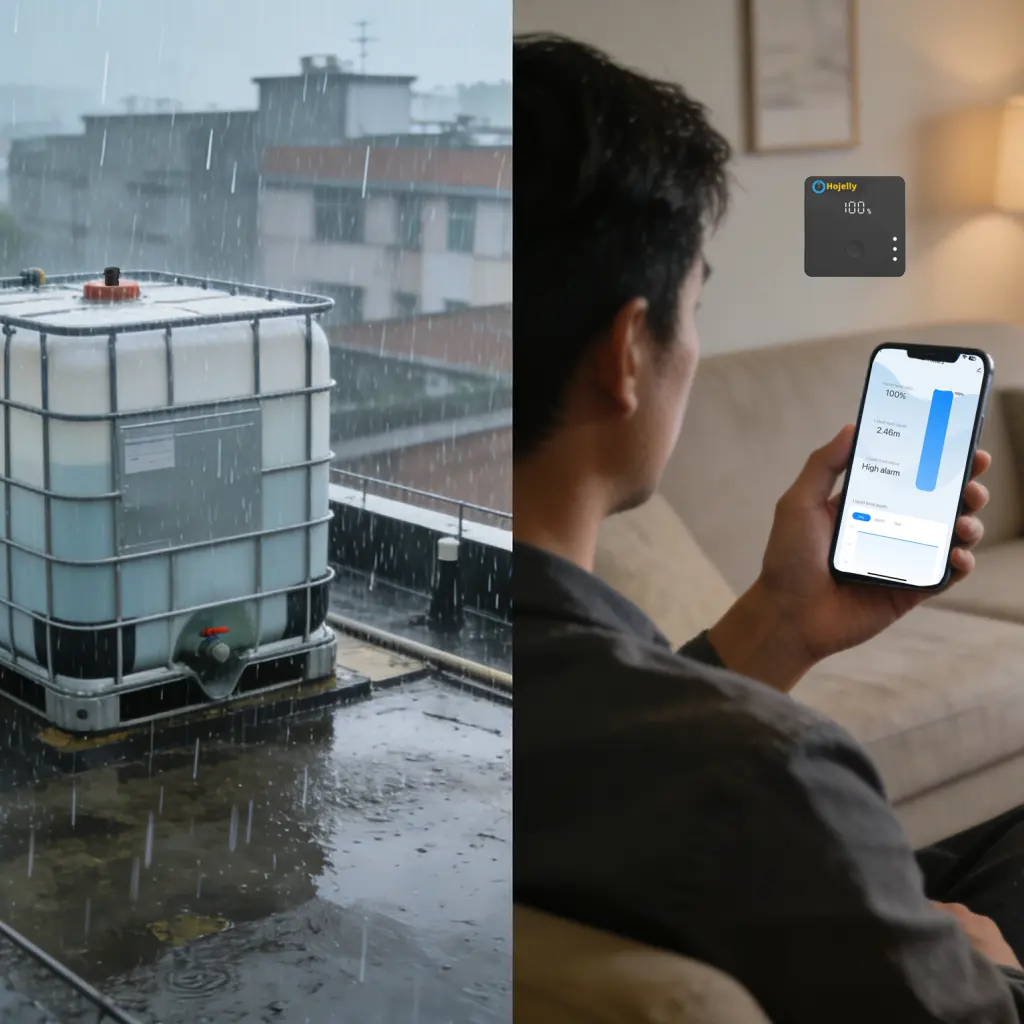
Below are the five most common pain points reported by users of similar products on the market:
Pain Point #1: Inflated Battery Life Claims – "6 Months" Actually Means 1 Month
The Problem: Many wireless level meters boast "low power consumption" and "long battery life," but users find that actual battery life falls far short of claims. While some products use low-power designs, the WiFi module's inherent power consumption makes long-term battery operation impossible. Even devices claiming battery power often only last 1-2 months at normal data reporting frequencies.
Real-World Impact: For equipment deployed in remote areas, elevated water tanks, deep wells, or other hard-to-reach locations, frequent battery changes not only increase maintenance costs but may also create monitoring gaps. User feedback indicates that some products cannot automatically recover after battery depletion, requiring on-site manual reset.
HojellyTek Solution: 8 months of true battery life, based on LoRa low-power technology and intelligent sleep mechanisms, fundamentally solving the hassle of frequent battery changes.
Pain Point #2: Signal Coverage "Dead Zones" – WiFi Disappears Through Walls
The Problem: This is the most flaw of WiFi level meters. 2.4GHz WiFi signals work reasonably well in open areas, but when encountering concrete walls, metal tanks, or underground spaces, signals rapidly attenuate or completely drop. One user reported: "The water tank is in the basement, the router is on the first floor—the device couldn't connect at all."
Real-World Impact: Device offline means monitoring failure. For critical facilities like fire water tanks and underground water tanks, signal dead zones can have serious consequences. One user complained: "I spent hundreds on this device, but signal issues made it useless."
HojellyTek Solution: LoRa technology offers 10x the penetration capability of WiFi, able to penetrate multiple concrete floors without relying on on-site WiFi coverage.
Pain Point #3: Complex Installation and Debugging – Difficult for Non-Professionals
The Problem: Some wireless level meters require complex network configuration processes, specific gateway devices, or even professional tools for installation and debugging. Selection guides point out that installation methods vary by scenario (suspended, submersible, etc.) and must consider multiple factors including protection ratings and communication methods.
Real-World Impact: For ordinary users without professional knowledge, self-installation is nearly impossible, requiring additional technical personnel and increasing costs. One user reported: "The manual was incomprehensible, customer service couldn't explain it clearly—it took a week of struggling to barely get it working."
HojellyTek Solution: Simplified installation process, detailed illustrated guidance, and professional technical support enable most users to complete installation themselves.
Pain Point #4: Inaccurate Measurement and Data Drift – "Precision" in Name Only
The Problem: Industry testing shows that some low-cost level sensors suffer from severe measurement drift—"after 72 hours of continuous operation, reading deviation reached 1.2%". In level monitoring, a few centimeters of error can mean false alarms or missed alerts.
Real-World Impact: Inaccurate measurement data causes users to lose trust in the system. One user reported: "The tank was almost empty, but the App showed 50%, so the pump ran dry and got damaged." This "cry wolf" type of false alarm leads users to gradually ignore all alerts.
HojellyTek Solution: High-precision ultrasonic sensor, strictly calibrated before leaving the factory, ensuring long-term operational stability.
Pain Point #5: Insufficient Protection, Short Lifespan – Outdoor Installation "Failure to Thrive"
The Problem: Level monitoring equipment is often installed outdoors, in humid environments, or dusty conditions, but some products have insufficient protection ratings. Selection guides clearly state: Outdoor installation requires ≥IP65, underwater installation requires ≥IP68. However, many products on the market only claim IP65 or lower and quickly fail in actual outdoor environments.
Real-World Impact: Water ingress, corrosion, and aging lead to premature equipment failure. User feedback: "After less than six months, the housing cracked and it was full of water." For users who invested in purchasing the equipment, this is the most frustrating experience.
HojellyTek Solution: IP67 highest protection rating, stainless steel probe + ABS housing, truly designed for long-term outdoor service.
Pain Point Summary
| Pain Point | Typical User Feedback | HojellyTek LoRa Solution |
|---|---|---|
| Short Battery Life | "Claimed 6 months, died in 1 month" | 8 months true battery life |
| Poor Signal Coverage | "Basement tank can't connect to WiFi" | LoRa long-range penetration |
| Complex Installation | "Took a week of struggling to get it working" | Simplified installation + tech support |
| Inaccurate Measurement | "Shows 50% but tank is actually empty" | High precision + strict calibration |
| Insufficient Protection | "Housing cracked and filled with water after 6 months" | IP67 + stainless steel probe |
Conclusion: Understanding these industry pain points helps users make more informed purchasing decisions. HojellyTek LoRa Wireless Tank Level Monitor is designed specifically to address these issues, providing users with a truly reliable and worry-free level monitoring solution.


