
Wireless Level Monitor Buying Guide: 7 Key Questions to Help You Make the Right Choice
Target Audience: Procurement Personnel, Engineering Technicians, End Users
Why Do You Need a Buying Guide?
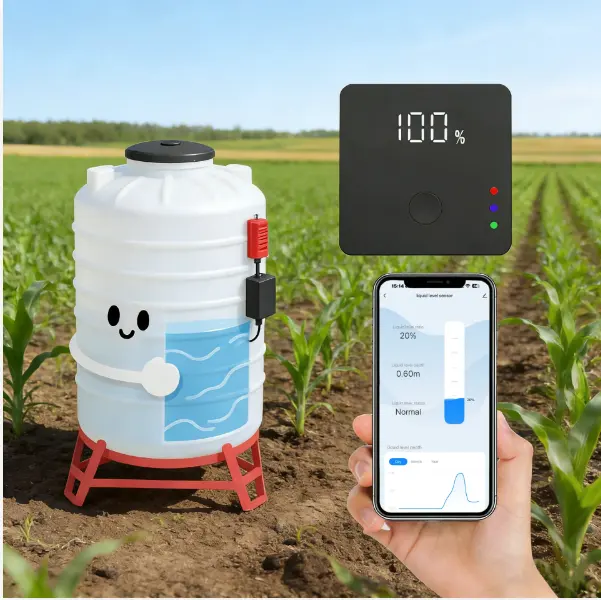
The wireless level monitor market offers a wide variety of products with complex specifications, making it difficult for ordinary users to distinguish quality from inferiority. A systematic buying guide helps users avoid pitfalls and purchase products that truly meet their needs.
Below are key selection considerations organized across multiple dimensions, covering communication methods, sensor types, power solutions, protection ratings, and other critical factors.
Question 1: What is the Application Scenario?
This is the primary prerequisite for selection, directly determining the measurement principle and product material.
Factors to Consider:
- Medium Type: Clean water (fire water tanks, domestic water tanks) can use submersible or ultrasonic; sewage/corrosive media require anti-corrosion or non-contact types; media with大量 impurities/foam should prioritize ultrasonic or radar types
- Installation Location: Indoor/outdoor, above ground/underground, accessibility
- Environmental Conditions: Temperature range, humidity, presence of corrosive gases
Recommendation: First clarify your application scenario, then filter suitable product types based on the scenario.
Question 2: Which Communication Method Should You Choose?
The communication method determines data transmission reliability, coverage range, and power consumption.
| Communication Method | Transmission Distance | Power Consumption | Penetration Capability | Suitable Scenarios |
|---|---|---|---|---|
| LoRa | 3-5 km | Extremely low | Excellent | Long distance, many obstacles, no power source |
| NB-IoT | Cellular coverage | Low | Good | Urban areas with cellular coverage |
| 4G | Cellular coverage | High | Good | High real-time requirements |
| WiFi | <100 m | High | Poor | Indoor with WiFi coverage |
| Bluetooth | <30 m | Low | Poor | Short distance, on-site viewing |
Recommendation: For water tanks in basements, deep wells, remote locations, or sites without WiFi coverage, LoRa is the best choice. For wide-coverage scenarios like urban waterlogging monitoring, LoRa also has advantages.
Question 4: How to Choose the Power Solution?
The power method directly affects deployment flexibility and maintenance costs.
| Power Method | Advantages | Disadvantages | Suitable Scenarios |
|---|---|---|---|
| Battery (LoRa) | No wiring, flexible deployment | Requires periodic battery changes | Remote/elevated locations without power |
| Solar + Battery | Long-term maintenance-free | Higher initial cost, needs sunlight | Long-term outdoor deployment |
| Mains Power | Continuous power | Requires wiring, fails during outages | Indoor with power available |
Recommendation: For water tanks, towers, deep wells, and other locations without power access, choose low-power LoRa + battery power. HojellyTek's 8-month battery life significantly reduces battery change frequency.
Question 5: What Protection Rating is Needed?
The protection rating (IP code) indicates the degree of dust and water resistance.
- IP65: Dustproof + water jet resistant, suitable for outdoor non-submersion environments
- IP67: Dustproof + temporary submersion (1m for 30 minutes)
- IP68: Dustproof + continuous submersion, suitable for underwater installation
Recommendation:
Underwater installation
Indoor dry environments: IP54 is sufficient
Outdoor rain exposure: At least IP65
Locations with possible submersion: IP67


