
Carlo Gavazzi Optical Level Sensor Alternative
A Carlo Gavazzi optical level sensor is often considered by buyers who value an established industrial automation brand, distributor access, and familiar control-panel components. For OEMs, machine builders, and volume buyers, HojellyTek offers a factory-direct optical liquid level sensor alternative focused on cost control, specification matching, and customization for tank, pump, coolant, oil, water, and equipment-level detection projects.
Factory-Direct Alternative for Optical Level Sensing Projects
Carlo Gavazzi is known for its broad industrial automation pedigree: sensors, switching devices, relays, monitoring products, and control components used in factory and machine environments. That brand position is valuable when a maintenance team wants a known industrial component from a distributor channel.
The purchasing question is different for OEMs and volume buyers. If you are building a product, integrating level detection into equipment, or sourcing hundreds or thousands of sensors for repeated production, the key issue is not only brand recognition. You need a sensor that matches the control logic, liquid type, mounting space, wiring method, and target cost.
That is where a factory-direct supplier can help. HojellyTek manufactures photoelectric liquid level sensors in Shenzhen with in-house R&D, OEM/ODM support, and export experience for US, EU, and India projects. Instead of buying only an off-the-shelf distributor part, buyers can request changes to thread, cable, housing, output, connector, and sensing structure before sample testing.
For buyers comparing a Carlo Gavazzi model with a direct factory equivalent, start with our optical level sensor range, then confirm the electrical and mechanical details before ordering samples.
What Is Included in a HojellyTek Alternative Review?
A fair comparison should not assume that every optical level sensor is interchangeable. Optical point-level sensors are compact, fast, and reliable when selected correctly, but the final choice depends on the liquid, tank wall, mounting position, output logic, and controller input.
Our comparison support can include:
- Review of your existing sensor model, machine drawing, wiring diagram, or application photo
- Matching of output logic such as NPN, PNP, normally open, or normally closed
- Housing and wetted material discussion for water, oil, coolant, detergent, chemical, or mixed liquid
- Thread and mounting check for tank-wall, side-mounted, vertical, or compact equipment installation
- Cable length, connector, and wire-color customization for OEM assembly
- Sample production before batch purchasing
- Production inspection and packing support for export orders
The goal is not to claim a universal drop-in replacement. The goal is to help buyers identify a compatible alternative that can be validated in their real tank or machine.
How Optical Level Sensors Work in Real Equipment
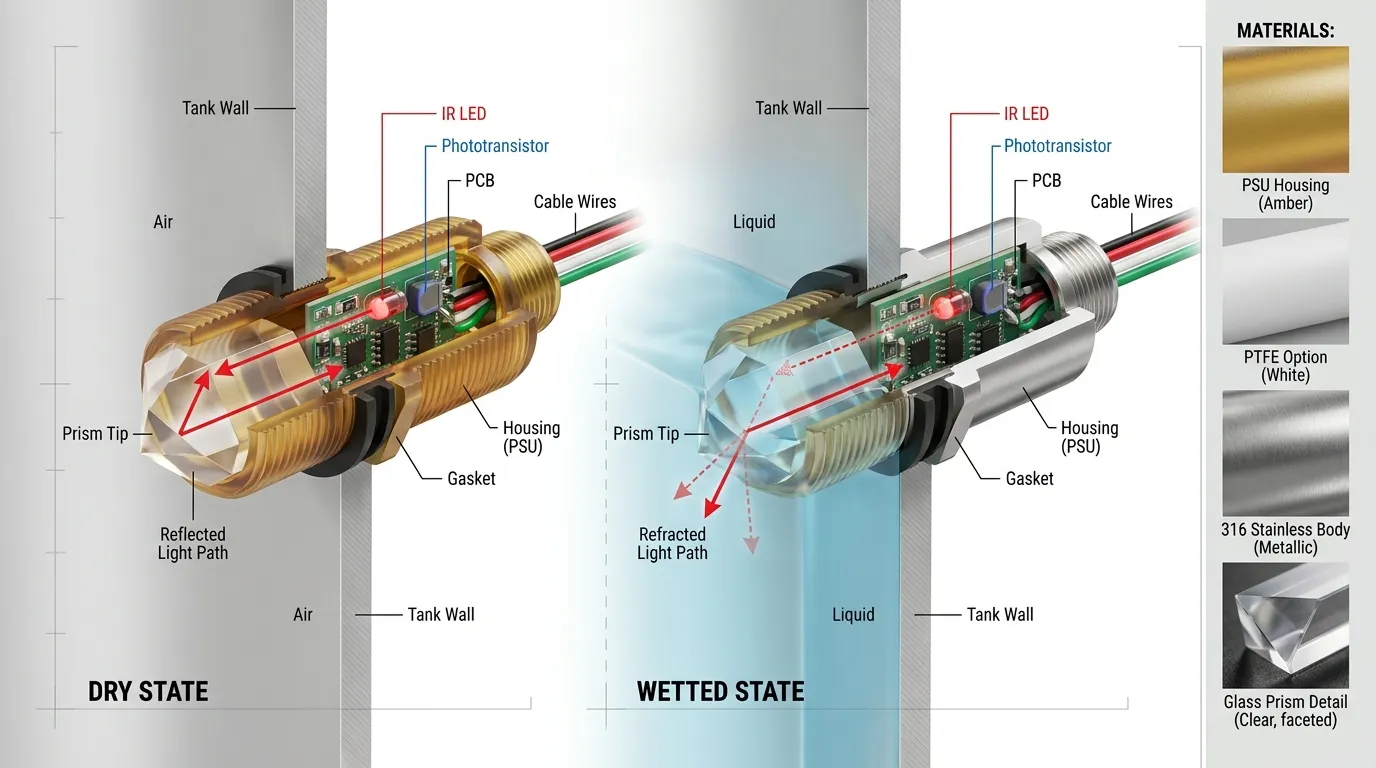
Most optical liquid level switches use a simple photoelectric principle. Inside the sensor body, an IR LED sends light toward a small prism tip. A phototransistor or optical receiver monitors how that light returns.
When the prism tip is dry, light reflects internally inside the prism and returns strongly to the receiver. When the tip is covered by liquid, the optical path changes because the liquid has a different refractive behavior than air. Less light returns to the receiver, and the internal circuit changes the output state.
This dry-versus-wetted signal is why optical sensors are widely used for point-level detection. They can detect high level, low level, overflow, empty tank, pump dry-run risk, coolant presence, water presence, or oil level depending on where the sensor is installed.
For OEM buyers, the practical selection questions are:
- Does the controller need NPN or PNP output?
- Should the sensor switch ON when wet or when dry?
- Is the liquid clear, foamy, viscous, oily, or chemically aggressive?
- Will residue build up on the prism tip?
- Is the sensor mounted from the side, bottom, or top?
- Does the tank wall allow a threaded sensor, flange, compact probe, or custom body?
- Is the sensor exposed to vibration, splashing, cleaning fluid, or outdoor humidity?
These details matter more than the brand name alone. A strong alternative page should help the buyer compare the actual operating conditions, not just a product title.
Where a Factory-Direct Equivalent Saves Cost at Volume
A branded industrial automation sensor is often purchased through a distributor network. That is convenient for maintenance teams, small emergency orders, or buyers who need a familiar approved part. However, distributor purchasing can become expensive when the same sensor is used repeatedly in OEM production.
A factory-direct optical level sensor can reduce cost in several ways:
First, the buyer can avoid paying for features that are not needed. For example, a compact water tank sensor, coffee machine sensor, coolant reservoir switch, or appliance-level detector may not need the same housing style as a general industrial automation part.
Second, the factory can align the design with assembly needs. A correct cable length, connector, thread, wire sequence, or mounting shape can reduce installation time on the production line.
Third, OEM customization can prevent secondary modification. Instead of buying a standard sensor and changing the cable, bracket, seal, or housing later, buyers can request the required configuration before production.
Fourth, volume orders can be quoted directly against the project requirement. Pricing should be confirmed by RFQ because housing material, cable length, connector, packing, and test requirements all affect cost.
For buyers who need a repeatable supply plan, it is better to work with an optical sensor manufacturer than to compare only single-piece catalogue prices.
Comparable Specifications Buyers Should Check
When comparing a Carlo Gavazzi optical level sensor with a factory-direct alternative, do not compare only the product name. Compare the engineering conditions one by one.
Electrical output: Many industrial control systems require NPN or PNP output. Some buyers also need 4–20 mA for continuous or analog-level projects, although many compact optical sensors are point-level switches. Confirm whether the controller expects sinking, sourcing, wet-active, dry-active, normally open, or normally closed behavior.
Supply voltage: Confirm the sensor voltage against the PLC, control board, battery system, or equipment power supply. Do not assume the same voltage range unless the selected model is verified.
Wetted material: Plastic, PSU, PTFE, 316 stainless steel, and glass each serve different applications. PSU can suit many compact equipment applications. PTFE is useful where chemical resistance is important. 316 stainless steel is preferred for stronger mechanical structure or industrial fluid contact. Glass tips can support clean optical detection and stable prism performance.
Mounting and thread: Thread size, sealing method, and insertion depth affect whether the sensor can physically replace an existing component. Side-mounted sensors are common for tank high/low detection. Bottom or vertical mounting may be used in compact reservoirs, but residue and bubbles must be considered.
Cable and connector: OEM projects often require defined wire length, stripped ends, terminals, aviation connectors, waterproof connectors, or custom harnesses. This is one of the strongest reasons to choose a customized optical sensor instead of a fixed catalogue part.
Liquid behavior: Clear water is easier than sticky oil, foam, milk-like liquid, coolant with particles, or chemical liquid that may coat the prism. If residue covers the optical tip, the sensor may respond slowly or remain in the wrong state. Sample testing is essential.
Carlo Gavazzi vs HojellyTek: Fair Side-by-Side Comparison
| Comparison Point | Carlo Gavazzi Optical Level Sensor | HojellyTek Factory-Direct Alternative |
|---|---|---|
| Brand position | Established industrial automation brand with broad control-component portfolio | Shenzhen optical and liquid level sensor manufacturer focused on OEM/ODM sensing projects |
| Best-fit buyer | Maintenance, MRO, approved-vendor purchasing, standard distributor replacement | OEMs, machine builders, equipment manufacturers, volume buyers, custom projects |
| Sensing principle | Photoelectric optical point-level detection depending on selected model | IR LED, receiver, and prism-based photoelectric liquid detection |
| Output options | Selected by model; buyer must match controller input | NPN, PNP, switching logic, and project-specific output confirmed during RFQ |
| Analog option | Confirm by selected product family | 4–20 mA can be discussed for suitable level-sensing projects |
| Wetted materials | Confirm from selected datasheet | PSU, PTFE, 316 stainless steel, glass, and project-specific material review |
| Mounting | Standard catalogue configurations | Thread, cable, connector, body, and installation style can be customized |
| Price model | Distributor or channel pricing, often convenient for small quantities | RFQ-based factory quotation for sample, batch, and OEM volume purchasing |
| Lead-time model | Depends on distributor stock and channel availability | Confirmed by project quantity, customization, sample approval, and production schedule |
| Documentation strength | Strong brand documentation and distributor product data | Application review, drawings/spec confirmation, sample validation, and factory communication |
| Relationship | Independent comparison only; not endorsed by Carlo Gavazzi | Compatible alternative only after engineering confirmation |
Where Carlo Gavazzi Still Wins
A fair comparison should be honest. Carlo Gavazzi can still be the better choice when your company already approved that brand, when the part is written into a machine manual, when a maintenance team needs a quick distributor purchase, or when the buyer must keep the exact same brand for compliance, warranty, or internal purchasing reasons.
They also win when documentation, global industrial brand recognition, and immediate replacement through a known distributor are more important than customization or factory-direct cost.
HojellyTek is the stronger fit when the buyer needs an equivalent optical sensing function at OEM volume, wants to adjust the design, or needs direct communication with the manufacturing team before sample testing.
5-Step Replacement and Customization Process
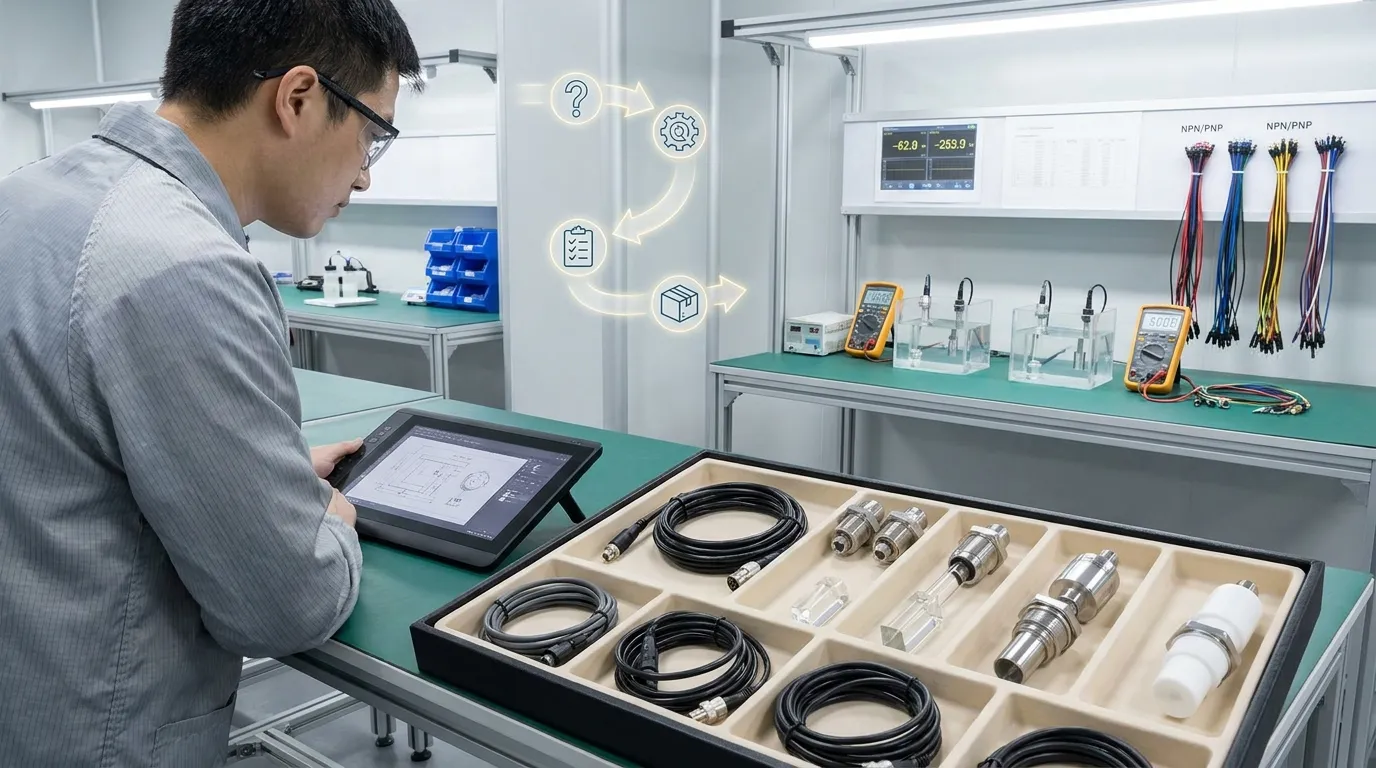
- Enquiry: Send the current sensor model, product photo, tank drawing, liquid type, wiring diagram, and annual quantity estimate. If you are not replacing an existing sensor, describe the tank, liquid, installation position, and controller input.
- Spec and customization review: Our team checks output logic, supply voltage, wetted material, cable, thread, sealing method, and required switching state. If a standard part is not suitable, we recommend a custom configuration.
- Sample confirmation: A sample is prepared for electrical and liquid testing. Buyers should test dry state, wetted state, bubbles, residue, vibration, cleaning cycle, and controller response.
- Production and QC: After sample approval, production follows the confirmed specification. Inspection can cover appearance, wiring, switching function, sealing, and packing requirements.
- Shipping: Export packing and shipment are arranged according to the buyer’s order plan. Request a quote by WhatsApp or email with your required quantity and customization details.
RFQ Requirements Before Ordering
To select our optical level sensor as an alternative, prepare the following information:
- Existing Carlo Gavazzi model or application description
- Liquid type and whether it leaves residue
- Tank material and wall thickness
- Mounting direction and thread requirement
- Supply voltage and controller input type
- NPN, PNP, NO, NC, or analog output requirement
- Cable length, connector, and wire sequence
- Operating environment, cleaning method, and sealing expectations
- Sample quantity and estimated production volume
Why Buyers Work With HojellyTek
HojellyTek is a Shenzhen manufacturer and exporter focused on optical/photoelectric liquid level sensing. With in-house R&D and OEM/ODM capability, we support buyers who need more than a standard catalogue sensor.
Projects can include compact water reservoirs, pump protection, coolant tanks, oil detection, industrial equipment, appliances, and smart liquid monitoring systems. Where relevant, the team can also discuss Tuya and Smart Life integration for connected tank monitoring projects.
The best result comes from a practical engineering discussion: match the sensor to the liquid, mounting, circuit, and production target before placing a volume order.
FAQ
Is a Carlo Gavazzi optical level sensor alternative always a drop-in replacement?
No. It may be compatible, but electrical output, switching logic, supply voltage, thread, cable, sealing, and wetted material must be checked before replacement. Sample testing is recommended before batch orders.
Can HojellyTek match NPN or PNP output requirements?
Yes, NPN and PNP output requirements can be reviewed during RFQ. Buyers should also confirm whether the controller needs normally open, normally closed, wet-active, or dry-active switching behavior.
Can I request PTFE, 316 stainless steel, PSU, or glass wetted materials?
Yes. Material choice depends on the liquid, temperature condition, cleaning method, and mechanical installation. PTFE, 316 stainless steel, PSU, and glass may be considered according to the application.
Is factory-direct pricing lower than distributor purchasing?
For volume and OEM projects, factory-direct sourcing can reduce total cost because the sensor can be configured for the project instead of purchased as a fixed distributor item. Final pricing must be confirmed by RFQ.
What failure modes should I test before replacing a branded sensor?
Test residue on the prism, foam, bubbles, vibration, false triggering, cable strain, sealing, liquid compatibility, and controller response. Optical sensors are reliable when the liquid and mounting conditions are suitable.
When should I still choose Carlo Gavazzi?
Choose Carlo Gavazzi when your project requires that exact approved brand, immediate distributor replacement, existing documentation, or internal purchasing continuity. Choose a factory-direct alternative when customization, OEM volume, and cost control are the priority.
Request a Factory-Direct Optical Level Sensor Quote
Send your current sensor model, application photos, wiring requirement, liquid type, mounting thread, cable length, and estimated quantity. HojellyTek can review the requirement and recommend a compatible optical liquid level sensor alternative for sample testing and volume production. Contact us by WhatsApp or email to request a quote.


