
Gems (ELS-1100) Optical Level Sensor Alternative
Looking for a gems electro optical level sensor alternative for an ELS-1100-style compact liquid level switch? HojellyTek supplies factory-direct optical level sensor options for OEM buyers who need similar electro-optic sensing principles, matching form/output requirements, lower MOQ discussion, and customization for tank, chemical, water, oil, and equipment-level applications.
The Gems ELS-1100 is respected because it is compact, has no moving float or mechanical parts, and works across many clean liquid applications. Our role is not to clone Gems part numbers or claim endorsement. We help buyers specify a compatible alternative honestly: same sensing concept, matched electrical logic where possible, and more flexibility in material, mounting, cable, output, and OEM configuration.
Optical Level Sensor Alternative Capabilities
As a Shenzhen manufacturer and exporter, HojellyTek develops photoelectric liquid level sensors for equipment builders, tank system suppliers, water treatment integrators, appliance manufacturers, and industrial control projects. Our optical sensors can be supplied as standard catalog parts or customized for OEM/ODM programs.
For buyers comparing Gems / ELS-1100 electro-optic sensors, we can support:
- Compact optical point level detection for water, oil, fuel, coolant, chemicals, and non-crystallizing liquids
- IR photoelectric sensing with prism-tip detection
- Dry/wet state switching for high-level, low-level, overflow, or dry-run protection
- NPN, PNP, digital switching, and application-specific output matching
- 4–20 mA options for projects requiring continuous level signal rather than simple point switching
- Plastic, PTFE, 316 stainless steel, and glass wetted-material configurations
- Threaded, tank-mounted, side-mounted, vertical-mounted, and flange-mounted variants
- OEM cable length, connector, housing, mounting, and label customization
- Export support for buyers in the US, EU, India, and other industrial markets
For standard product selection, see our our optical level sensor page. For broader sensor categories, visit our optical level sensor overview.
Why Buyers Like the Gems ELS-1100 — and What to Match Carefully
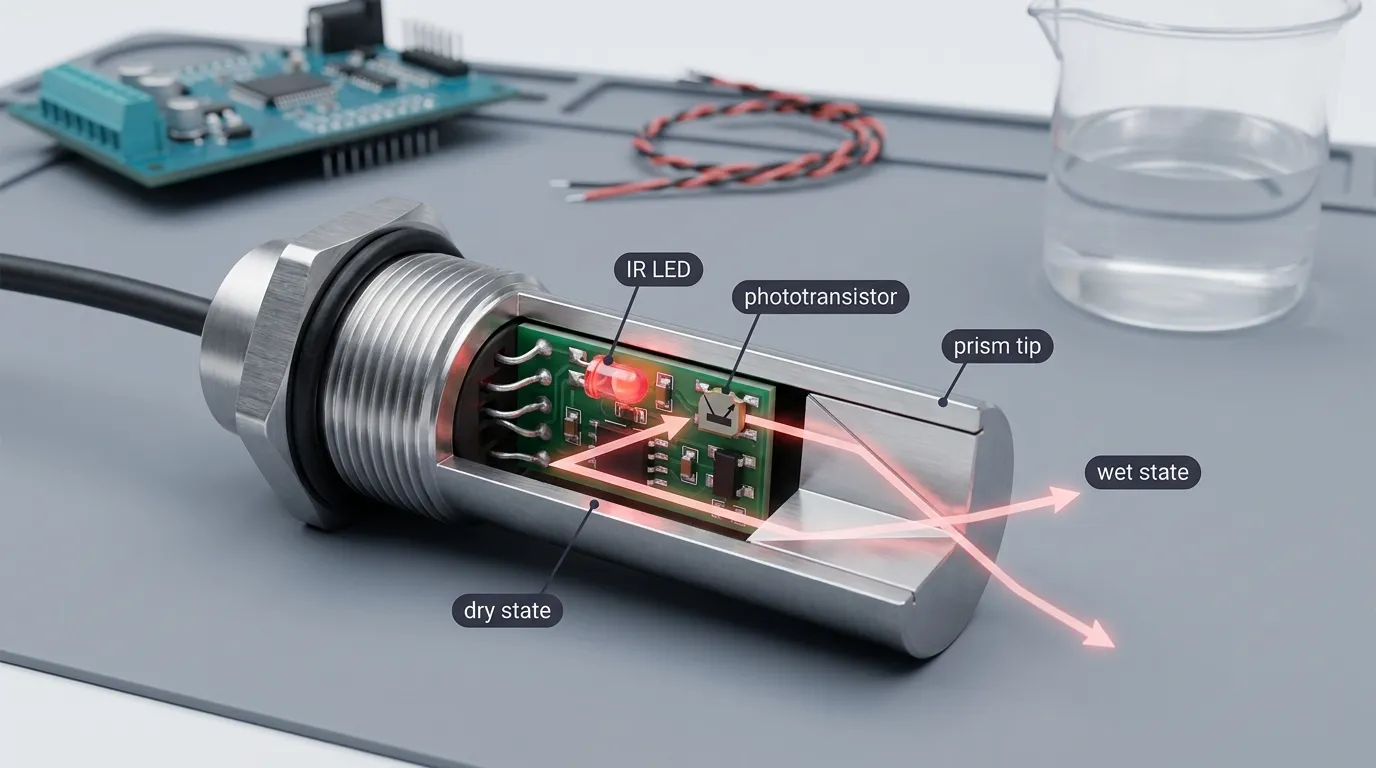
The ELS-1100 is popular because it solves a common design problem: detecting liquid presence in a very small space without a float, magnet, reed switch, or moving mechanism. In many OEM devices, there is no room for a bulky float switch. A compact electro-optic sensor can sit in the tank wall and detect whether liquid has reached the prism tip.
The working principle is simple but effective. Inside the sensor, an infrared LED sends light toward a prism tip. A phototransistor receives reflected light when the prism is dry. When liquid covers the prism, the refractive index changes, the light path changes, and the electronics switch output state. This makes the sensor useful for point level detection: liquid present or liquid absent.
When replacing or sourcing an alternative to a Gems electro-optic liquid level sensor, buyers should not only compare the outside shape. The critical checks are:
- Does the sensor match the tank wall thickness and thread?
- Is the output logic compatible with the existing PCB, PLC, or controller?
- Is the sensor normally open or normally closed in the required wet/dry state?
- Is the wetted material suitable for the liquid?
- Will residue, foam, coating, bubbles, or crystallization affect detection?
- Does the cable, connector, or conduit style fit the machine layout?
- Is the sensor used for water, oil, chemical, coolant, fuel, or cleaning fluid?
- Is point-level switching enough, or does the project need continuous level output?
A Gems-style compact sensor is often a good reference design. But for manufacturing projects, buyers may need a lower-cost, factory-direct equivalent with custom body material, custom flange, private label, smaller trial order, or wiring matched to the existing control board.
HojellyTek Equivalent: Matching Form, Output, and Application
Our alternative is specified by function, not by copying competitor part numbers. Send us your current sensor drawing, installation photo, wiring diagram, liquid type, and expected output behavior. Our engineering team checks the replacement path and recommends the closest optical sensor structure.
For form matching, we review the mounting style first. Many electro-optic point level sensors are installed through a tank wall using threaded mounting. Some designs need a side-mount sensor with a short prism tip. Others need a vertical tank-top or tank-bottom installation. For OEM tanks, we can also discuss custom body length, sealing structure, nut/gasket arrangement, or flange connection.
For output matching, we check whether your controller expects NPN, PNP, current sink, current source, high-level signal, low-level signal, or a simple dry/wet logic change. In some devices, the output is connected to a PCB input. In industrial panels, it may connect to a PLC or relay interface. A replacement must be selected around the actual input circuit, not only the liquid type.
For material matching, standard plastic bodies may be suitable for many clean water and oil applications. However, chemical tanks, cleaning fluids, and aggressive liquids may need upgraded wetted materials. That is where a PTFE optical sensor can be a better choice. PTFE helps in applications where ordinary plastic is not preferred because of chemical compatibility concerns.
For stronger industrial structures, 316 stainless steel and glass prism designs can be considered. Stainless steel housings are useful where mechanical strength, equipment-grade appearance, and industrial mounting are important. Glass prism tips are often used for stable optical sensing in compatible liquids. For non-standard vessels, we can also support flange variants instead of only threaded designs.
PTFE and Flange Variants for OEM Projects
A direct Gems-style form may not always be the best choice. Many buyers start with a Gems / ELS-1100 search because they need a compact optical liquid level switch, but their real project may require a different wetted material or mounting method.
Choose PTFE when the liquid is chemically aggressive, when plastic compatibility is uncertain, or when the sensor will contact cleaning agents, process chemicals, or corrosive liquids. PTFE variants are especially useful for chemical dosing equipment, laboratory systems, special tanks, and OEM equipment where material compatibility is more important than the lowest unit cost.
Choose a flange-mounted optical level sensor when the tank cannot accept a small threaded port, when the customer needs a larger sealing surface, or when the sensor must be installed on a custom vessel cover. Flange designs can also help when maintenance teams want easier removal and reinstallation.
Choose 316 stainless steel when the buyer wants a more rugged housing, stronger threads, or a more industrial construction. This can be useful for machinery, oil systems, coolant systems, and equipment that requires durable tank-mounted components.
Choose a standard compact plastic optical switch when the priority is cost control, small size, and clean liquid detection. This is often the closest commercial direction for buyers comparing with ELS-style sensors.
Gems vs HojellyTek Alternative Spec Comparison

| Selection Point | Gems / ELS-1100 Style Sensor | HojellyTek Compatible Alternative |
|---|---|---|
| Positioning | Established electro-optic point level sensor | Factory-direct optical point level sensor alternative |
| Sensing method | Infrared electro-optic prism detection | IR LED, phototransistor, and prism-tip detection |
| Moving parts | No moving float or mechanical switch | No moving parts |
| Typical function | Liquid present/absent point detection | High-level, low-level, overflow, dry-run, or OEM point detection |
| Form matching | Compact tank-mounted sensor format | Similar compact formats can be reviewed by drawing/sample |
| Output matching | Depends on selected configuration | NPN, PNP, digital logic, and project-specific output matching |
| Continuous output | Not the main reason buyers choose ELS-style point sensors | 4–20 mA can be discussed for continuous level projects |
| Wetted materials | Commonly selected by brand configuration | Plastic, PTFE, 316 stainless steel, glass, and custom options |
| Mounting | Threaded sensor body depending on model | Threaded, side-mounted, vertical, custom length, or flange variant |
| MOQ | Usually distributor or brand-channel dependent | Flexible MOQ discussion for sample, pilot, and OEM production |
| Price position | Brand/distributor pricing | Factory-direct quotation for cost-sensitive OEM programs |
| Customization | Limited by published configurations | Cable, connector, body, material, output, and private-label options |
| Replacement claim | Original Gems product | Compatible alternative, not endorsed or copied |
Where Gems Still Wins
Gems is a recognized brand with established distribution, public documentation, and a long track record in electro-optic level sensing. If your project requires the exact original brand, a previously approved part, existing compliance paperwork, or a maintenance team that is not allowed to change suppliers, the original Gems sensor may still be the safer purchasing route.
HojellyTek is a better fit when you are designing a new machine, building an OEM product, replacing an expensive or hard-to-source sensor, or trying to improve price, MOQ, cable design, material choice, or mounting structure. We do not recommend changing a sensor blindly in a certified or locked design. The correct approach is to compare the wiring, liquid, material, mounting, and output behavior before approving the alternative.
5-Step Supply Process
EnquirySend the current sensor model reference, photos, drawing, tank design, wiring diagram, and target quantity. If you are replacing a Gems ELS-1100-style sensor, include the liquid type and how the controller reads the wet/dry signal.
Spec and Customization ReviewOur team checks mounting, output, wetted material, cable, connector, and installation direction. We confirm whether a standard optical sensor is enough or whether a PTFE, stainless steel, glass, or flange version is more suitable.
SampleA sample can be prepared for fit and function testing. Buyers should test the sensor in the real liquid, at the real installation angle, with the real control board.
Production and QCAfter the sample is approved, production follows the confirmed specification. QC focuses on wiring, switching behavior, sealing, appearance, and consistency against the approved sample.
ShippingWe support export orders for OEM buyers, distributors, and equipment manufacturers. Request a quote by WhatsApp or email with drawings, photos, and quantity requirements.
Requirements to Confirm Before Ordering
Before selecting an alternative optical liquid level sensor, prepare these details:
- Liquid name and concentration
- Clean liquid, oil, chemical, foam, residue, or crystallizing behavior
- Tank material and wall thickness
- Mounting direction: side, top, bottom, or custom
- Thread, nut, gasket, or flange requirement
- Required wetted material: plastic, PTFE, 316 stainless steel, or glass
- Supply voltage expected by the control board
- Output type: NPN, PNP, wet signal, dry signal, or analog requirement
- Cable length and connector style
- Operating environment and cleaning process
- Sample quantity and target production quantity
If you need a sensor manufacturer that can review these details before production, see our optical sensor manufacturer page.
Why Work With HojellyTek
HojellyTek is a Shenzhen optical and liquid level sensor manufacturer focused on photoelectric sensing products. We support OEM/ODM buyers who need more than a catalog part: custom cable, material, thread, flange, signal output, housing design, and production support.
Our sensors are used in water equipment, tanks, appliances, industrial devices, oil systems, coolant monitoring, and smart liquid level projects. Where relevant, our broader sensor solutions can support smart monitoring ecosystems, including Tuya / Smart Life application requirements. For buyers in the US, EU, India, and other export markets, we can communicate by drawing, sample, or RFQ checklist to reduce replacement risk.
FAQ
Is a HojellyTek sensor the same as a Gems ELS-1100?
No. It is a compatible optical level sensor alternative, not the original Gems product and not endorsed by Gems. We match the required sensing function, mounting direction, output behavior, and material based on your project details.
Can I use your sensor as a gems electro optical level sensor alternative?
Yes, in many OEM and replacement projects, but it must be checked first. Send the existing sensor photo, wiring, thread, liquid, and control requirement so we can recommend the closest alternative.
Can you match NPN or PNP output?
Yes. We can discuss NPN, PNP, and project-specific switching logic. The important point is to confirm how your controller reads the dry and wetted states before choosing the sensor.
Do you offer PTFE optical level sensors?
Yes. PTFE variants are available for chemical and corrosive-liquid applications where standard plastic may not be the best material. Liquid compatibility should be reviewed before ordering.
Can you make a flange-mounted version?
Yes. For tanks that cannot use a standard threaded sensor, we can discuss flange-mounted optical level sensor designs based on the tank drawing, sealing requirement, and installation direction.
When should I choose the original Gems sensor instead?
Choose the original Gems sensor when your project requires the exact approved brand, existing documentation, distributor traceability, or no engineering change. Choose our alternative when price, MOQ, customization, and factory-direct support are more important.
Request a Quote
Need a Gems / ELS-1100-style optical liquid level sensor alternative for your equipment or tank system? Send your sensor photo, drawing, wiring requirement, liquid type, mounting size, and quantity target. Our team will review the specification and recommend a factory-direct optical level sensor option by WhatsApp or email.


