
Elektro-optischer Punktpegelsensor
Wenn Ihr Käufer, Ingenieur, oder das Einkaufsteam verwendet andere Begriffe, Diese Seite hilft Ihnen, den richtigen Sensortyp zu bestätigen, bevor Sie ein Angebot anfordern.
Elektro-Optik, Photoelektrisch, und optischer Punktpegelschalter: Gleiche Sensorkategorie
Im Liquiditätseinkauf, Die Terminologie ist oft gemischt. Ein Kunde kann nach einem elektro-optischen Punktpegelsensor fragen, Ein anderer kann einen Antrag stellen Fotoelektrischer Flüssigkeitsstandschalter, und ein Konstrukteur kann es als optischen Punktpegelschalter bezeichnen. In den meisten praktischen Kaufsituationen, Sie beziehen sich auf einen kompakten Sensor, der erkennt, ob die Flüssigkeit einen festen Punkt erreicht hat.
Dies unterscheidet sich von einem kontinuierlichen Pegelsender. Ein Punktsensor gibt an einer Position ein Ein-/Ausschaltsignal, während ein Optischer kontinuierlicher Pegelsensor wird ausgewählt, wenn das System eine Pegelbereichsmessung anstelle eines einzelnen Alarmpunkts benötigt.
Für Käufer, die Produkte vergleichen, Die entscheidende Frage ist nicht das Etikett. Die entscheidende Frage ist, ob der Sensor zu deiner Flüssigkeit passt, Panzermaterial, Montagefläche, Ausgangslogik, Spannung, Verdrahtung, und Alarmfunktion.
Was HojellyTek bieten kann
HojellyTek liefert elektro-optische Punkt-Level-Sensorlösungen für OEM-Gerätehersteller, Panzerhersteller, Automatisierungsintegratoren, und Lieferanten von Flüssigkeitshandhabungssystemen. Unsere Fähigkeiten umfassen Standardmodelle für optische Schalter, Individuelles Karosseriematerial, Verdrahtungskonfiguration, Steckertyp, Gewinde- oder Befestigungsdesign, und Ausgangslogikabstimmung für Steuerplatinen oder SPS-Systeme.
Der typische Dienstumfang umfasst:
- Auswahl optischer Punktpegelschalter für Hoch- oder Niedrigpegeldetektion
- Fotoelektrische Sensormodule für kompakte Wassertanks und kleine Geräte
- NPN- oder PNP-Ausgangskonfiguration für Automatisierungssysteme
- Bestätigung der Spannungsoption basierend auf der Steuerplatine des Kunden
- Materialauswahl für Wasser, Öl, Kühlmittel, Chemikalie, und saubere Flüssigkeitsanwendungen
- OEM/ODM-Sensorgehäuse, Kabel, Steckverbinder, Faden, und Wohnraumanpassung
- Exportunterstützung für Käufer in den USA, WIR, Indien, und andere Industriemärkte
Für Käufer, die noch die breitere Sensorkategorie vergleichen, unsere Optischer Pegelsensor Die Seite bietet einen umfassenderen Produktüberblick.
Wie der elektro-optische Punktpegelsensor funktioniert
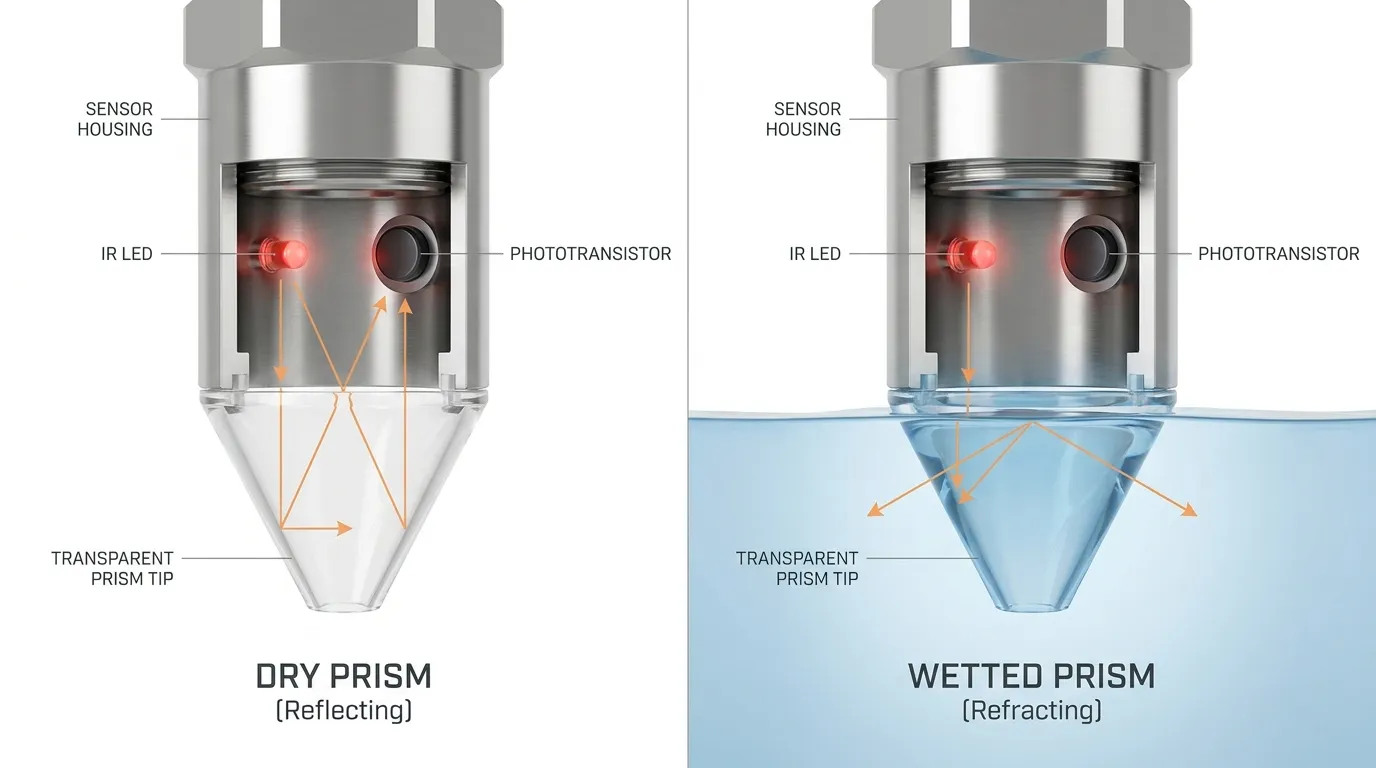
Das Arbeitsprinzip ist einfach: eine interne LED sendet Licht in eine Prismaspitze, Ein Fototransistor empfängt das reflektierte Licht, und der Ausgang ändert sich, wenn das Prisma von trockener Luft in einen feuchten flüssigen Zustand wechselt.
Es gibt keinen Float, Magnet, Reed-Schalter, oder mechanischer Arm. Wenn das Prisma trocken ist, Licht reflektiert intern in der Spitze. Wenn Flüssigkeit das Prisma bedeckt, Der optische Pfad ändert sich, Das Empfängersignal ändert sich, und der Sensor schaltet die Ausgabe um. Das macht das Design nützlich, wenn der Käufer eine schnelle Punkterkennung in kompakter Form ohne bewegliche Teile möchte.
Für eine Service-Seite, Die praktische Bedeutung ist wichtiger als die akademische Optiktheorie: Der Sensor erkennt, ob Flüssigkeit am installierten Punkt vorhanden ist. Er kann als Hochstufenalarm nahe dem oberen Teil eines Tanks verwendet werden, oder als niedrigstufiger Alarm nahe dem Boden eines Tanks.
Punktpegelerkennung für hohe und niedrige Alarme
Ein elektro-optischer Punktpegelsensor wird ausgewählt, wenn das Steuerungssystem nur eine Bedingung kennen muss: Liquid erreichte diesen Punkt, oder die Flüssigkeit unter diesen Punkt gefallen ist.
Für Hochniveau-Detektion, Der Sensor ist an der Alarmposition installiert. Wenn Flüssigkeit das Prisma berührt, Der Ausgang ändert sich und der Controller kann aufhören, sich zu füllen, Lösen Sie eine Warnung aus, Schließen Sie ein Ventil, oder eine Sicherheitsroutine starten.
Für Niedrigpegeldetektion, Der Sensor ist nahe dem zulässigen Mindeststand installiert. Wenn die Flüssigkeit das Prisma nicht mehr benetzt, Der Ausgang ändert sich und das System kann eine Pumpe stoppen, Schützen Sie eine Heizung, Trockenlauf verhindern, oder den Bediener zu warnen.
Dieses Einpunkt-Verhalten ist der Grund, warum das Produkt oft in kleinen Becken verwendet wird, Behälter, Spender, Prozessausrüstung, Kühlsysteme, Wassergeräte, Ölbehälter, Reservoirs für medizinische Geräte, sowie Module für industrielle Automatisierung.
Ausgabe, Spannung, und Verkabelungsoptionen
Die Auswahl der Ausgaben ist eines der wichtigsten Einkaufsdetails. Viele Käuferprobleme entstehen nicht, weil der Sensor keine Flüssigkeit erkennen kann, sondern weil der Ausgangstyp nicht mit dem Controller übereinstimmt.
Gängige Schaltausgangsoptionen sind NPN und PNP. NPN wird oft dort verwendet, wo der Controller einen sinkenden Ausgang erwartet, während PNP verwendet wird, wo der Controller eine Quellausgabe erwartet. Die richtige Wahl hängt von deiner SPS-Eingangskarte ab, Steuerungsplatinen-Design, Verdrahtungsstandard, und regionale Maschinenbaupraxis.
Normalerweise sollten auch offene und normalerweise geschlossene Logik bestätigt werden. Manche Systeme wollen, dass das Signal aktiv ist, wenn Flüssigkeit vorhanden ist. Andere wünschen sich einen Notfallalarm, wenn keine Flüssigkeit vorhanden ist. Unser Team kann helfen, die Logik mit Ihrem Alarmzustand abzustimmen..
Spannungsoptionen werden während der RFQ-Phase bestätigt, um mit der Platine oder dem Automatisierungsschrank des Kunden übereinzustimmen. Für detaillierte Verdrahtungsanleitung, Siehe unsere Seite auf NPN/PNP-Ausgabe.
Für Projekte, die etwa 4–20 mA verlangen, Der Antrag sollte sorgfältig überprüft werden. Ein Punktpegelsensor ist üblicherweise ein Schalter-Ausgangsgerät. Wenn dein System wirklich ein analoges Pegelsignal benötigt, Die bessere Wahl könnte eine kontinuierliche Levellösung anstelle eines Einpunktschalters sein.
Materialien, Montage, und Panzerintegration
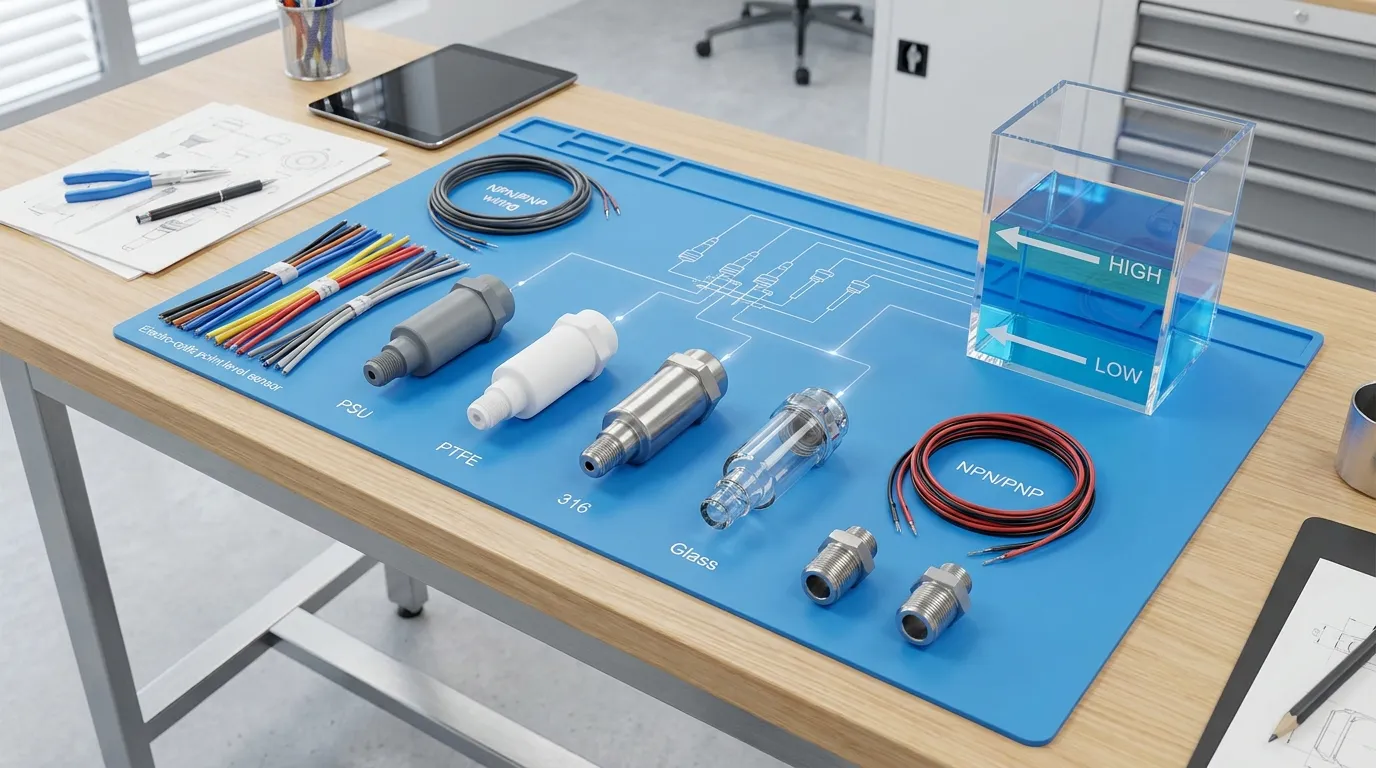
Das benetzte Material muss zur Flüssigkeit und zur Reinigungsumgebung passen.. Gängige Materialrichtungen sind Netzteile für kompakte, universelle Sensorgehäuse, PTFE für aggressive chemische Beständigkeit, 316 Edelstahl für robuste industrielle Installationen, und Glas für ausgewählte saubere oder chemische Anwendungen.
Gewinde und Montagedesign hängen von der Tankwand ab, Dichtungsverfahren, und Servicezugang. Käufer sollten überprüfen, ob der Sensor seitlich montiert wird, oben in eine Kammer montiert, installiert über einen gewindekabelten Port, In einem geformten Kunststofftank befestigt, oder in ein OEM-Gehäuse integriert. Gewinde-Optionen, Flanschkonzepte, Seilaustrittsrichtung, und Steckverbinderanforderungen können bei der Anpassung überprüft werden.
Auch die Spitzenposition spielt eine Rolle. Das Prisma sollte am wahren Alarmpunkt platziert werden, mit genügend Abstand zu den Panzerwänden, Blasen, Schaumstoffzonen, Starke Turbulenzen, und Rückstandssammlungsbereiche. Optische Punktsensoren sind für viele Anwendungen mit sauberen Flüssigkeiten stark geeignet, aber klebrig, Kristallisation, Beschichtung, oder stark kontaminierte Flüssigkeiten vor der Auswahl eine zusätzliche Überprüfung benötigen.
Spezifikationstabelle für elektro-optische Punktpegelsensoren
| Spezifikationsbereich | Optionen / Auswahlhinweise |
|---|---|
| Nachweistyp | Einpunkt-Flüssigkeitsanwesenheitserkennung |
| Sensormethode | LED, Fototransistor, und die optische Prismenspitze |
| Zustandswechsel | Ausgabeänderungen zwischen trockenem Prisma und benetztem Prisma |
| Einsatz von Alarmen | Hochstufe-Alarm, Niedrig-Pegel-Alarm, overflow prevention, Trockenlaufschutz |
| Ausgabeoptionen | NPN, PNP, Normalerweise offen, normalerweise geschlossen; Analoge Bedürfnisse werden separat überprüft |
| Spannungsoptionen | In der RFQ-Phase bestätigt, dass es mit der Kundensteuerungsplatine oder dem SPS-System übereinstimmt |
| Reaktionsverhalten | Schnelles elektronisches Schalten für Punktalarmanwendungen; Die exakte Antwort wird durch Modell und Steuerschaltung bestätigt |
| Benetzte Materialien | Netzteil, PTFE, 316 Edelstahl, Glas, oder projektspezifische Materialauswahl |
| Montagestil | Gewinde, Panzermontiert, kompakte OEM-Installation, oder eine angepasste mechanische Schnittstelle |
| Flüssigkeitskompatibilität | Wasser, Öl, Kühlmittel, Saubere Flüssigkeit, und ausgewählte chemische Anwendungen nach Materialprüfung |
| Anpassung | Kabellänge, Steckverbinder, Karosseriematerial, Faden, Ausgangslogik, Wohnen, und OEM-Kennzeichnung |
| Typischer Käufer | Ausrüstungshersteller, Panzerzulieferer, Automatisierungsintegrator, Verteiler, oder OEM-Projektteam |
Wo man diesen Sensor verwenden kann
Verwenden Sie einen elektro-optischen Punktpegelsensor, wenn Ihr Projekt dies benötigt:
- Ein fester Hochstromalarm in einem kompakten Tank
- Ein Schwachpegelsignal zum Schutz von Pumpen oder Heizungen
- Eine teilefreie Alternative zu einem Miniatur-Schwimmerschalter
- Schnelle Detektion im Wasser, Öl, Kühlmittel, oder saubere Prozessflüssigkeit
- Ein kompakter Sensor für ein OEM-Gerät oder ein geschlossenes Reservoir
- PLC- oder Steuerplatineneingang mit NPN- oder PNP-Ausgang
- Ein seitlich montierter Sensor, bei dem das Prisma direkt mit der Flüssigkeit in Kontakt tritt
- Eine maßgeschneiderte Karosserie, Faden, Kabel, oder Steckverbinder für Wiederholungsproduktion
- Eine saubere Installation, bei der mechanische Schwimmer klemmen können, tragen, oder mehr Platz benötigen
Überprüfen Sie die Anwendung sorgfältiger, wenn die Flüssigkeit klebrig ist, Blätterschuppen, enthält Partikel, bildet schweren Schaum, kristallisiert nach dem Trocknen, oder das Prisma überziehen kann. Dies sind reale Ausfallmodi, die die Leistung des optischen Schalters beeinflussen können.
Fünf-Schritte-Zustellungsprozess
1. Untersuchung
Schick deinen flüssigen Typ, Panzerzeichnung, Alarmpunkt, Montagerichtung, Spannung, Controllertyp, und erforderliche Ausgabe. Fotos oder Skizzen sind für die frühe Überprüfung nützlich.
2. Spezifikation und Anpassung
Unser Ingenieurteam prüft das Material, Ausgangslogik, Verdrahtung, Faden, Kabel, Steckverbinder, Dichtungsansatz, und Installationsposition. Für OEM/ODM-Projekte, Die Karosseriestruktur und der Kabelaustritt können angepasst werden.
3. Beispiel
Eine Probe kann für die Passform vorbereitet werden, Verdrahtung, und Flüssigkeitstests. Dies hilft, die trockenen und feuchten Zustände vor der Produktionsplanung zu bestätigen.
4. Produktion und Qualitätskontrolle
Die Fabrik produziert gemäß den bestätigten Spezifikationen, mit der Inspektion mit Schwerpunkt auf der Messung der Reaktion, Verdrahtung, Aussehen, Montage, und kundenspezifische Konfiguration.
5. Schifffahrt
Fertige Sensoren werden für den Export verpackt und gemäß der Bestellvereinbarung des Kunden verschickt. HojellyTek unterstützt internationale Käufer, die Angebote per WhatsApp oder E-Mail anfordern.
Punktsensor vs. kontinuierlicher Pegelsensor
| Anforderung | Wählen Sie einen elektro-optischen Punktpegelsensor | Wählen Sie den kontinuierlichen Pegelsensor |
|---|---|---|
| Ich brauche einen Alarmpunkt | Beste Passform | Meistens unnötig |
| Benötigt den genauen Pegelbereich | Nicht geeignet | Bessere Passform |
| Hoher Alarm/Tiefer | Starke Passung | Möglich, aber komplexer |
| Integration kompakter Panzer | Starke Passung | Das hängt von der Beckengröße ab |
| Einfacher SPS-Ein-/Aus-Eingang | Starke Passung | Es kann eine analoge oder digitale Verarbeitung erforderlich sein |
| Lagerhaltungskostenkontrolle | In der Regel einfacher | In der Regel für die erweiterte Überwachung ausgewählt |
Warum Käufer mit HojellyTek zusammenarbeiten
HojellyTek ist ein Hersteller und Exporteur aus Shenzhen, der sich auf photoelektrische optische Sensor- und Flüssigkeitspegelerkennungsprodukte spezialisiert hat.. Käufer arbeiten mit uns zusammen, wenn sie direkte Kommunikation per Fabrik benötigen, Inhouse-R&D-Unterstützung, und Sensoranpassung statt nur der Katalogauswahl.
Unser Team unterstützt OEM/ODM-Projekte für die Industrie, Gerät, Automatisierung, und intelligente Überwachungsanwendungen. Wo relevant, Wir können auch Diskussionen über Sensorintegration für Smart-Device-Ökosysteme unterstützen, einschließlich Produktkonzepten mit Bedarf an Tuya und Smart Life.
Das Ziel ist praktisch: Helfen Sie dem Käufer, einen Sensor zu erhalten, der zur Flüssigkeit passt, Panzer, Ausgabe, Spannung, und Installationsmethode vor der Massenproduktion.
RFQ-Checkliste
Bevor Sie ein Angebot anfordern, Bereitmachen:
- Flüssigkeitstyp und Konzentration
- Tankmaterial und Wanddicke
- Funktion von Hoch- oder Niederstufen-Alarmen
- Montagerichtung und Gewindeanforderungen
- Erforderliches benetztes Material
- Spannungsversorgung
- NPN- oder PNP-Ausgangsanforderungen
- Normalerweise offene oder normal geschlossene Logik
- Kabellänge und Steckverbindertyp
- Quantitätsprognose und OEM-Anpassungsbedarf
- Fotos, Zeichnungen, oder eine aktuelle Sensorreferenz, falls vorhanden
FAQ
Ist ein elektrooptischer Punktpegelsensor dasselbe wie ein optischer Punktpegelschalter?
Ja. In den meisten Kaufkontexten, Elektrooptischer Punktpegelsensor, Elektro-optischer Pegelschalter, Fotoelektrischer Flüssigkeitsstandschalter, und der optische Punktpegelschalter beziehen sich auf dieselbe Kategorie der einpunktigen optischen Flüssigkeitserkennung.
Kann es sowohl hohe als auch niedrige Werte erkennen??
Ja. Dasselbe Sensorprinzip kann für die Erkennung auf hoher oder niedriger Ebene verwendet werden. Der Unterschied liegt in der Installationsposition und der Ausgangslogik, die Ihr Steuerungssystem benötigt.
Welche Ausgabe sollte ich wählen, NPN oder PNP?
Wählen Sie NPN oder PNP je nach Ihrer SPS-Eingangskarte oder Steuerplatine. Wenn Sie unsicher sind, Senden Sie das Schaltplan oder das Steuerungsmodell, und unser Team kann helfen, den geeigneten Ausgangstyp zu bestätigen.
Gibt der Sensor ein 4–20 mA Signal aus??
Ein Punktpegelsensor liefert normalerweise einen Schaltausgang. Wenn Ihr Projekt 4–20 mA für die Messung des Höhenbereichs benötigt, Ein Stufenpegelsensor könnte geeigneter sein.
Welche Flüssigkeiten sind geeignet?
Es kann mit vielen sauberen Flüssigkeiten wie Wasser funktionieren, Öl, Kühlmittel, und ausgewählte Chemikalien. Materialkompatibilität und Rückstandsrisiko müssen vor der Bestellung überprüft werden, Vor allem bei Sticky, Kristallisation, oder Beschichtungsflüssigkeiten.
Welche Details sind für die Anpassung nötig?
Schick die Flüssigkeit, Panzerzeichnung, Montagestil, Spannung, Ausgabetyp, Kabellänge, Steckverbinder, Materialpräferenz, und Alarmlogik. Diese Details helfen der Fabrik, den Sensor mit Ihrer Ausrüstung abzustimmen.
Fordern Sie ein Angebot an
Für einen Tank wird ein elektro-optischer Punktpegelsensor benötigt, Maschine, Gerät, oder OEM-Gerät? Schick deinen flüssigen Typ, Installationszeichnung, Spannung, Ausgangsanforderungen, und Zielmenge an HojellyTek per WhatsApp oder E-Mail. Unser Team hilft dabei, die richtige Konfiguration des optischen Punktpegelschalters für Ihre Anwendung zu bestätigen.


