
Dokumentation für optische Infrarot-Wasserstandssensoren
Diese Dokumentation für optische Infrarot-Wasser-Flüssigkeitsstandsensormodule zeigt den Pinout, Elektrische Grenzen, Ausgangslogik, Abmessungen, Verdrahtungshinweise, und Fehlerbehebungspunkte an einem Ort für Erstnutzer. Anstatt den Sensor wie eine lose Teile-Bunker-Komponente zu behandeln., dieser Leitfaden erklärt, wie die IR-Optische Messspitze funktioniert, Wie man VCC/GND/OUT sicher verbindet, Und was man vor der Verwendung des Moduls im Tank überprüfen sollte, Gerät, oder Prototyp.
HojellyTek stellt photoelektrische optische Flüssigkeitspegelsensoren in Shenzhen für OEM/ODM-Projekte her, Industrieausrüstung, Intelligente Geräte, Wassersysteme, und maßgeschneiderte Tanküberwachungsdesigns. Nutzen Sie diese Seite als praktischen Ausgangspunkt, Dann bestätigen Sie die genaue Zeichnung, Ausgabetyp, und Material vor der Bestellung.
Schnelles Pinout und Spezifikationstabelle
Die gängigsten IR-optischen Wasser-/Flüssigkeitsstandsensormodule verwenden drei grundlegende Verbindungen: Macht, Spielfeld, und digitale Ausgabe. Einige industrielle Versionen verwenden möglicherweise NPN, PNP, analog, oder Stromschleifenausgänge, Also passe die Sensorversion immer mit deinem Controller-Input an.
| Gegenstand | Common Label | Was es bedeutet | Benutzerhinweis |
|---|---|---|---|
| Positive Kraft | VCC | Sensorversorgungseingang | Überprüfen Sie die Nennspannung, bevor Sie die Stromversorgung anschließen.. Viele kleine Module sind für Niederspannungs-Steuertafeln konzipiert. |
| Spielfeld | GND | 0V-Referenz | Muss Masse mit dem Mikrocontroller oder der Steuerschaltung teilen.. |
| Signalausgang | ENDE / VON | Digitaler Nass-/Trockenausgang | Verbinden Sie sich mit einem Controller-Eingang, Digitaler Arduino-Pin, SPS-Eingang, oder Schnittstellenschaltung je nach Ausgangstyp. |
| Ausgangslogik | HOCH / NIEDRIG | Veränderungen, wenn die Prismenspitze trocken oder benetzt ist | Die Logik kann je nach Moduldesign variieren, Testen Sie also trockene und feuchte Zustände vor der Installation. |
| Sensormethode | IR-optisches Prisma | Infrarot-LED + Empfänger erkennt eine Reflexionsänderung | Kein beweglicher Schwimmer ist erforderlich. |
| Kalibrierung | In der Regel keine für digitale Punktebene | Nass-/Trockenschaltung basiert auf optischer Brechung | Führen Sie einen Labortest durch; Gehen Sie nicht davon aus, dass sich jede Flüssigkeit gleich verhält. |
| Montage | Faden, Nuss, Dichtung, Flansch, oder maßgefertigte Karosserie | Fixiert den Sensor auf einer Punktebene | Bestätigen Sie die Tankwanddicke, Faden, Dichtungsverfahren, und Sondenorientierung. |
| Dimensionen | Karosserielänge, Gewindegröße, Messung der Spitzenlänge, Kabel-/Drahtlänge | Bestimmt, ob es in den Tank oder das Panel passt | Verwenden Sie die Modellzeichnung vor dem Bohren, Formen, oder Bearbeiten. |
| Benetztes Material | Netzteil, PTFE, 316 Edelstahl, Glas, oder maßgefertigte Karosserie | Material, das mit der Flüssigkeit in Kontakt kommt | Wählen Sie nach Wasser, Öl, Chemikalien, Temperatur, Druck, und Reinigungsprozess. |
Für eine umfassendere Produktübersicht, siehe HojellyTeks Optischer Pegelsensor Seite.
Wie der IR-Optische Pegelsensor funktioniert
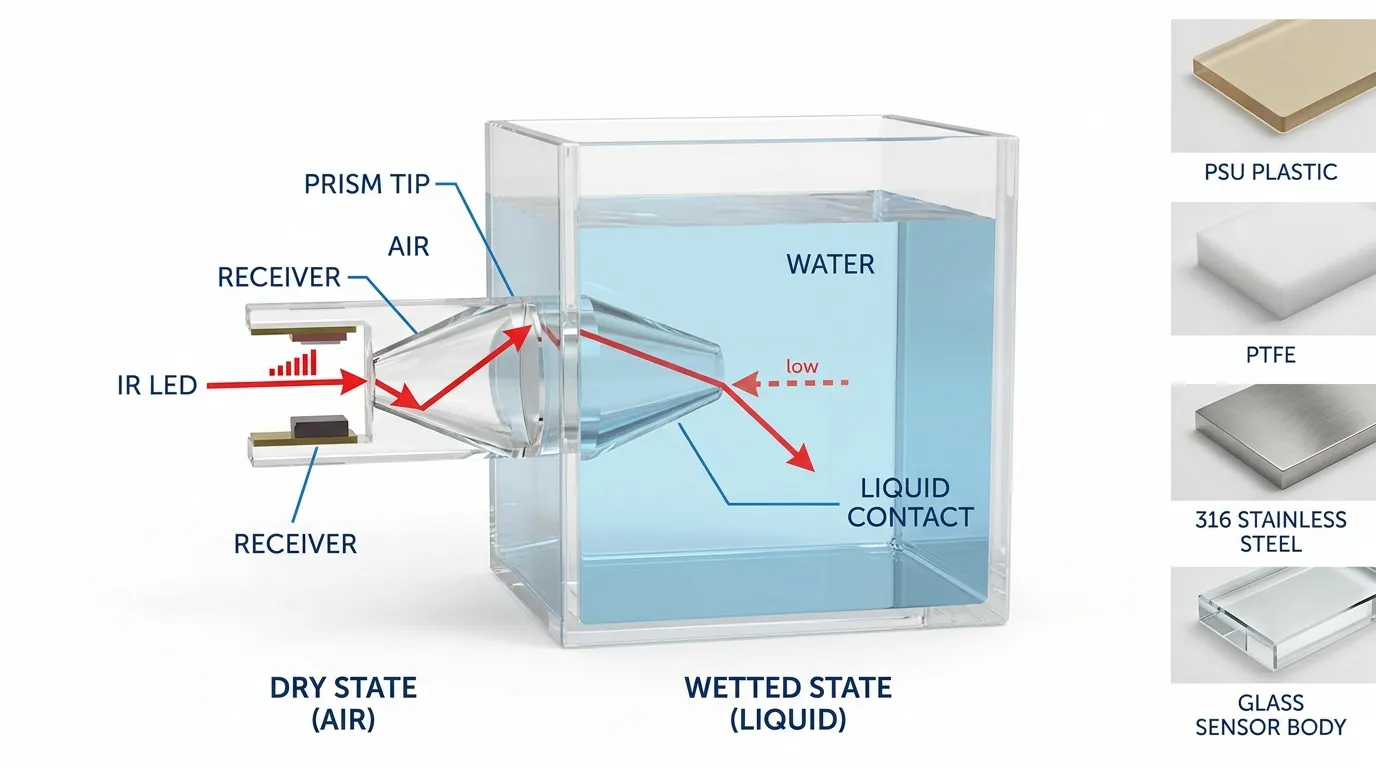
Ein optischer Infrarot-Flüssigkeitsstandsensor verwendet eine IR-LED, einen Phototransistor- oder Photodiodenempfänger, und eine transparente Prismenspitze. Wenn das Prisma in der Luft ist, Infrarotlicht reflektiert intern in der Spitze und kehrt stark zum Empfänger zurück. Wenn Flüssigkeit das Prisma bedeckt, der brechungsbedingte Zustand ändert sich, daher kehrt weniger Licht zum Empfänger zurück. Die Schaltung wandelt diese Änderung in einen elektrischen Ausgang um.
Deshalb sind optische Pegelsensoren für kompakte Wassertanks beliebt, Kühlmittelreservoirs, Kondensatdetektion, Dosiersysteme, Kaffeemaschinen, Luftbefeuchter, Medizinische Geräte, und kleine Automatisierungsgeräte. Es gibt keinen Schwimmarm, Reed-Schalter, Magnet, oder ein mechanisches Scharnier zum Blockieren. Der Sensor erkennt einen festen Punktniveau, an dem die Prismaspitze installiert ist.
Aber, Der Sensor ist kein "magischer Wasserdetektor". Es muss mit der Flüssigkeit abgestimmt werden, Panzer, Verdrahtung, Montageposition, und Controller-Eingang. Sehr reflektierende Oberflächen, Schaum, Blasen, Beschichtung auf dem Prisma, Starke Kontamination, Und falsche Verkabelung kann zu verwirrendem Verhalten führen.
Pinout: VCC, GND und OUT
Für Erstnutzer, Das wichtigste Detail ist einfach: schließen Sie den Sensor erst an, wenn Sie wissen, welcher Leiter VCC ist., was GND ist, und der AUS ist.
VCC Versorgt den internen IR-Emitter und die Signalschaltung. Die Versorgungsspannung muss der Sensorversion entsprechen. Wenn das Modul für eine Niederspannungs-Mikrocontroller-Platine ausgelegt ist, Schließen Sie ihn nicht direkt an einen höheren Industriespannungseingang an, es sei denn, das Datenblatt bestätigt diesen Bereich.
GND ist der Bezugspunkt für die Schaltung. Bei Verwendung mit Arduino, ESP32, STM32, oder eine andere Controller-Platine, Sensor-Masse und Controller-Masse müssen normalerweise gemeinsam sein.
ENDE ist das Signal. Auf einem einfachen Modul, es kann sich wie ein digitaler HOCH/NIEDRIGER Ausgang verhalten. Bei Industrieversionen, es könnte NPN sein, PNP, Open Collector, Push-Pull, Staffel, oder analog, je nach Design,. Ein SPS-Eingang und ein Arduino-Eingang sind nicht immer gleich verdrahtet.
Für Schritt-für-Schritt-Verbindungsbeispiele, Verwenden Sie das dedizierte Schaltplan Leitfaden.
Ausgangs-Logik: Trockener vs. Nasser Zustand
Der Ausgang ändert sich, wenn das sensorische Prisma trocken ist oder von Flüssigkeit bedeckt ist. Einige Module geben HOCH aus, wenn Flüssigkeit erkannt wird, und NIEDRIG, wenn sie trocken sind.. Andere Schnittstellenplatinen können die Logik invertieren. Deshalb ist der sicherste erste Schritt ein einfacher Labortest:
- Versorgen Sie den Sensor mit der richtigen Versorgung.
- Lesen Sie das OUT-Signal in der Luft aus.
- Tauche nur die Prismaspitze ins Wasser.
- Nehmen Sie auf, ob sich OUT von HOCH zu TIEF oder TIEF zu HOCH ändert.
- Verwenden Sie diese Logik in Ihrem Controller-Code oder in Ihrem SPS-Leiterprogramm.
Entwickle deine endgültige Alarmlogik nicht, bevor du dieses Verhalten bestätigt hast. Zum Beispiel, Ein Wassertank-"Niederlaufalarm" und ein "Überlaufalarm" können dieselbe Sensorhardware, aber entgegengesetzte Logik im Steuerprogramm verwenden.
Elektrische Grenzen und Steuerungskompatibilität
Die wichtigsten elektrischen Prüfungen sind die Versorgungsspannung, Ausgabetyp, Laststrom, Pull-up- oder Pull-down-Anforderung, Eingangsspannungskompatibilität, und Schutz vor Umwärtspolarität oder Verdrahtungsfehlern. Falls eines davon unklar ist, Nicht raten.
Für Arduino-ähnliche Projekte, ein 5V-Modul kann oft nach Bestätigung des Signalpegels und der Verkabelung an einen digitalen Eingang angeschlossen werden.. Für SPS- oder Industrieschalttafeln, Der Sensorausgang muss mit dem Eingangstyp übereinstimmen. Ein PNP-Sensor liefert typischerweise Strom an den Eingang, während ein NPN-Sensor typischerweise Strom abnimmt. Wenn der Controller einen Typ erwartet und der Sensor den anderen liefert, Der Eingang schaltet möglicherweise nie richtig.
Für kleine Projekte, Siehe die 5V-IR-Wassersensor Ressource. Für Mikrocontroller-Beispiele, siehe die Arduino-Leitfaden.
Dimensionen, Montage- und Installationsposition
Die Maße sind wichtig, weil es sich um einen Punkt-Level-Sensor handelt. Der Sensor misst nicht die volle Tankgröße. Es erkennt, ob die Flüssigkeit die Prismaspitze erreicht hat.
Vor der Bestellung oder dem Bohren des Tanks, Bestätigen:
- Karosseriedurchmesser und Karosserielänge
- Gewindetyp oder Befestigungsstil
- Nuss, Dichtung, oder Dichtungsstruktur
- Position der Sondenspitze nach der Installation
- Tankwanddicke
- Seilrichtung und Biegraum
- Ob der Sensor von der Seite installiert ist, Nach oben, oder unten
- Ob der Messpunkt mit dem tatsächlichen Alarm oder dem Steuerniveau übereinstimmt
Ein häufiger Anfängerfehler ist die Montage des Sensors an der Stelle von Spritzen, Wellen, oder Blasen berühren das Prisma, bevor der tatsächliche Flüssigkeitsstand den Kontrollpunkt erreicht. In diesem Fall, Softwarefilterung kann helfen, Aber eine bessere mechanische Platzierung ist in der Regel zuverlässiger.
Für maßgefertigte Ausrüstung, HojellyTek kann threaded unterstützen, Flanschmontiert, kompakt, sowie materialspezifische Sensorstrukturen basierend auf dem Panzerdesign.
Auswahl benetzter Materialien
Das Material, das die Flüssigkeit berührt, ist nicht nur eine kosmetische Wahl. Sie beeinflusst die chemische Kompatibilität, Temperaturbeständigkeit, Hygiene, Druckeignung, und langfristige Zuverlässigkeit.
Netzteil oder Ingenieurkunststoff ist üblich für kompakte Wasser- und Geräte-Sensoren, bei denen Kosten sind, Größe, und leicht formbare Materialien.
PTFE wird für viele chemische Flüssigkeiten bevorzugt, da sie eine starke Korrosionsbeständigkeit und geringe Oberflächenhaftung haben.
316 Edelstahl wird bei robuster Bauweise eingesetzt, Mechanische Festigkeit, und das industrielle Erscheinungsbild sind wichtig.
Glasoptische Spitzen kann für bestimmte Labore nützlich sein, Hochtemperatur, oder chemisch anspruchsvolle Anwendungen, je nach vollständiger Struktur und Abdichtungsmethode.
Das beste Material hängt von der Flüssigkeit ab, Reinigungsprozess, Arbeitstemperatur, Druck, Winkelinstallation, und ob der Sensor eine OEM-Gehäuseanforderung erfüllen muss.
Muss der Sensor kalibriert werden??
Für einen normalen digitalen optischen Punktpegelsensor, Eine Kalibrierung ist in der Regel nicht so erforderlich, wie ein analoger Pegelsender eine Kalibrierung benötigt. Der Sensor erkennt einen feuchten/trockenen Zustand an der Prismenspitze.
Aber "keine Kalibrierung" bedeutet nicht "keine Tests". Teste den Sensor immer mit der echten Flüssigkeit, wenn möglich,. Wasser, Öl, Kühlmittel, Schaum, Reinigungsmittelmittel, und chemische Flüssigkeiten können sich rund um das Prisma unterschiedlich verhalten. Wenn die Flüssigkeit Rückstände auf der optischen Spitze hinterlässt, Der Sensor benötigt möglicherweise Reinigungsintervalle oder ein anderes Material.
Für Produktionsanlagen, Definieren Sie die Testbedingung klar: Trockener Zustand, Befeuchteter Zustand, Erwartung der Antwortzeit, Installationsorientierung, und akzeptable Steuerungslogik.
Fehlerbehebung bei häufigen Problemen
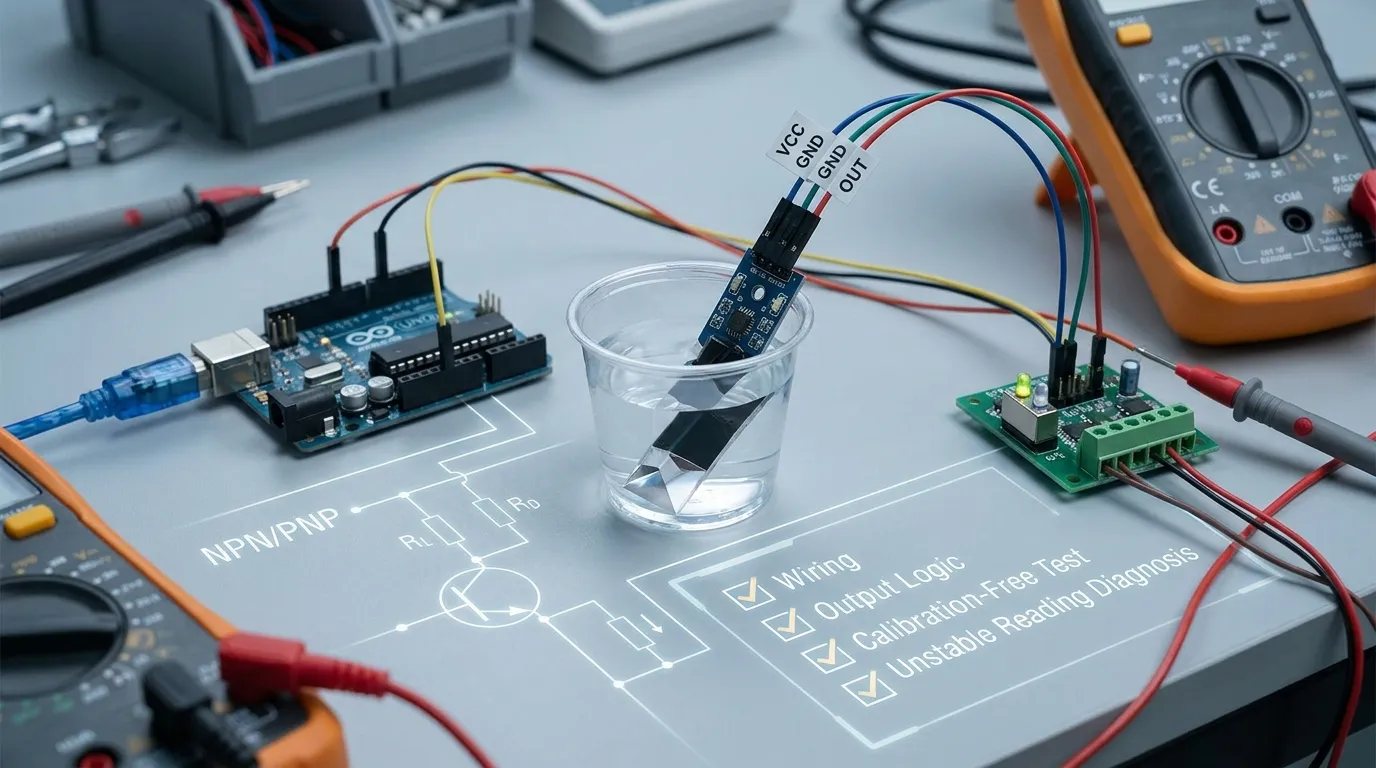
Die Ausgabe ändert sich nie
Überprüfe zuerst VCC und GND. Dann überprüfen Sie die Versorgungsspannung, Drahtreihenfolge, und ob OUT mit dem richtigen Eingangstyp verbunden ist. Wenn der Sensor einen offenen Kollektor-Ausgang hat., Die Schaltung benötigt möglicherweise einen Pull-up- oder Pull-down-Pfad.
Der Sensor ist immer HOCH oder immer NIEDRIG
Mach einen Trocken-/Nass-Labortest außerhalb des Aquariums. Wenn sich die Logik während des Labortests ändert, aber nicht im Tank, Das Problem liegt wahrscheinlich an der Installationsposition, Schaum, Blasen, Beschichtung, oder flüssiges Verhalten. Wenn es sich während des Labortests nie ändert, Verdrahtung oder Ausgangskompatibilität ist wahrscheinlicher.
Die Messwerte sind instabil
Achten Sie auf Turbulenzen, Platschen, Schwingung, Schwache Stromversorgung, Lange, ungeschirmte Kabelstrecken, oder schlechte Erdung. In der Software, Fügen Sie eine kurze Verzögerung hinzu oder lassen Sie das Signal stabil bleiben, bevor eine Pumpe oder ein Alarm umgeschaltet wird.
Der Sensor funktioniert in Wasser, aber nicht in einer anderen Flüssigkeit
Optische Sensoren hängen vom Lichtverhalten am Prisma ab. Flüssigkeiten mit unterschiedlichen brechungsfähigen Eigenschaften, Farbe, Blasen, Kontamination, oder Rückstände können den Nachweis beeinflussen. Teste mit der tatsächlichen Flüssigkeit vor der Massenproduktion.
Der Sensor fiel nach der Installation aus
Überspannung prüfen, Umgekehrte Polarität, Flüssigkeitsaustritt durch die Befestigungsdichtung, Chemischer Angriff, Kabeldehnung, und Reinigungschemikalien. Viele Feldfehler sind keine Erkennungsfehler; Sie verkabeln, Versiegelung, oder Materialauswahlprobleme.
Bevor Sie bestellen oder um den Sensor herum bauen
Bereiten Sie diese Details vor, bevor Sie eine RFQ senden oder ein Modul auswählen:
- Flüssiger Typ: Wasser, Öl, Kühlmittel, Chemikalie, Abwasser, oder gemischte Flüssigkeit
- Erforderliche Ausgabe: Digital, NPN, PNP, analog, 4–20 mA, oder benutzerdefinierte Schnittstelle
- Steuerpult: Arduino, SPS, Haushaltsleiterplatte, IoT-Modul, oder Industrial Gateway
- Versorgungsspannung und Eingangsspannungsgrenzen
- Nass-/Trocken-Ausgangslogik wird vom System benötigt
- Montagegewinde, Flansch, Nuss, Dichtung, oder maßgefertigte Karosserie
- Befeuchtungsmaterialbedarf
- Tankwanddicke und Position des Messpunkts
- Kabellänge, Steckverbinder, und Farbpräferenz für Draht
- Betriebsumgebung: Hallenbereich, Im Freien, Schwingung, Wärme, Kondensation, oder Reinigungsexposition
Für Smart-Appliance- oder IoT-Projekte, Unser Team kann auch die Integration mit Steuerungsplatinen besprechen, OEM-Kabelbaugruppen, und Produktanforderungen im Zusammenhang mit Tuya/Smart Life, wo relevant,.
Wann sollte man ein Modul im Vergleich zu einem industriellen optischen Sensor verwenden
Ein kleines IR-optisches Wasserniveaumodul ist zum Lernen nützlich, Prototyping, Arduino-Tests, und kompakte Niederspannungsanlagen. Es ist einfach, Schnell zum Testen, und leicht verständlich.
Ein industrieller oder OEM-optischer Flüssigkeitsniveausensor ist besser, wenn das Projekt ein definiertes Material benötigt, Versiegeltes Gehäuse, Stabiles Kabel, Spezifische Ausgangslogik, Wiederholbare Produktionstests, Individuelle Maße, oder exportfähige Versorgung. HojellyTek unterstützt internes R&D, Design der photoelektrischen optischen Messung, OEM/ODM-Anpassung, und Exportprojekte für Kunden in den USA, WIR, Indien, und andere Märkte.
FAQ
Was in dieser Dokumentation für die Nutzer optischer Infrarot-Wasser-Flüssigkeitsstandssensoren enthalten ist?
Es behandelt die praktischen Details, die die Nutzer normalerweise zuerst benötigen: VCC/GND/OUT Pinout, elektrische Grenzwerte zur Bestätigung, Nass/Trocken-Ausgangslogik, Abmessungen, Anmerkungen zur Montage, Kalibrierungserwartungen, Verkabelungsvorsichten, und Fehlerbehebung.
Ist die Ausgabe HOCH oder NIEDRIG, wenn der Sensor Wasser berührt.?
Das hängt vom Modulschaltkreis ab. Einige Sensoren geben bei Nassigkeit HOCH aus; andere geben LOW aus oder verwenden invertierte Logik. Teste den Sensor immer im trockenen und feuchten Zustand, bevor du die endgültige Steuerungslogik schreibst.
Kann ich einen optischen Wasserstandssensor direkt an den Arduino anschließen??
Viele Niederspannungsmodule können nach Bestätigung der Versorgungsspannung mit Arduino verwendet werden, Signalspannung, und Ausgabetyp. Wenn die Ausgabe NPN ist, PNP, Open Collector, oder Industriespannung, Verwenden Sie die richtige Schnittstellenschaltung.
Braucht ein optischer Infrarot-Wasserstandssensor eine Kalibrierung??
Ein digitaler optischer Sensor auf Punktniveau benötigt in der Regel keine Kalibrierung. Es sollte trotzdem mit der echten Flüssigkeit getestet werden, Panzerstellung, und Controller-Eingabe vor der endgültigen Installation.
Warum bleibt mein optischer Sensor aktiviert, nachdem die Flüssigkeit entfernt wurde??
Residue, Tröpfchen, Schaum, Ölfilm, oder eine Verunreinigung am Prisma kann den optischen Weg verändern. Reinige die Spitze, Test mit der echten Flüssigkeit, und betrachte ein anderes benetztes Material, wenn Rückstände häufig vorkommen.
Was sollte ich an HojellyTek schicken, um ein individuelles Sensorangebot zu erhalten??
Senden Sie den flüssigen Typ, Versorgungsspannung, Ausgabetyp, Nass-/Trockenlogik, Montagemethode, Materialbedarf, Abmessungen, Kabellänge, Steckverbinder, Quantitätsziel, sowie Anwendungsfotos oder Zeichnungen. Sie können ein Angebot per WhatsApp oder per E-Mail anfordern.


