
Spezifikationen für optische Pegelsensoren & Auswahl
Diese Ressource für die Spezifikation des optischen Pegelsensors hilft Käufern, die wichtigsten elektrischen Spezifikationen zu vergleichen, mechanisch, und Details zu benetzten Materialien, bevor ein Datenblatt angefordert wird, Beispiel, oder Zitat. HojellyTek stellt photoelektrische optische Pegelmesslösungen in Shenzhen für OEM/ODM-Projekte her, Industriepanzer, Gerätereservoirs, Ölsysteme, Wassersysteme, und exportierte Sensorbaugruppen für die USA, WIR, und indische Käufer.
Verwenden Sie diese Seite als Auswahl-Checkliste, bevor Sie eine Optischer Pegelsensor für dein Aquarium, Controller, oder Gerätedesign.
Spezifikationsblatt für den optischen Pegelsensor
Ein optischer Pegelsensor wird normalerweise ausgewählt, indem zuerst das Regelsystem abgestimmt wird, Dann der Tank und die flüssige Umgebung. Der Käufer sollte die Stromversorgung überprüfen, Stromlast, Ausgabetyp, Schaltlogik, Benetzte Materialien, Temperatur, Druck, Montagegewinde, Kabelstil, und Schutz des geistigen Eigentums vor der Bestellung.
| Spezifikationselement | HojellyTek Standardreihe / Status | Hinweis zur Käuferauswahl |
|---|---|---|
| Sensorprinzip | Photoelektrische optische Messung | IR-LED + Fototransistor + Prismenspitze |
| Versorgungsspannung | 5–24VDC | Match PCB, SPS, Relaismodul, oder Controller-Eingang |
| Versorgungsstrom / Aktueller Verbrauch | Fortsetzung folgt | Bestätigen Sie während der RFQ basierend auf Modell- und Schaltungsdesign |
| Laststrom | ≤ 100 mA | Überprüfen Sie die Eingangs- und Lastgrenze des Controllers vor dem Verdrahten |
| Ausgangstyp | NPN / PNP | Wählen Sie nach PLC-/Controller-Eingangstyp |
| Ausgabefunktion | NEIN / NC | Wählen Sie basierend auf dem Hochstufenalarm, Niedrig-Pegel-Alarm, oder fail-safe-Logik |
| Schaltantwort | Fortsetzung folgt | Überprüfen Sie, ob sich der Flüssigkeitsstand schnell ändert oder der Tank vibriert |
| Standardgehäusematerial | SUS316 | Geeignet für viele Wasserquellen, Öl, und industrielle Anwendungen mit flüssigem Kontakt |
| Standard-Sensorspitze / Prismenmaterial | Glas | Verwendet für die Änderung der optischen Reflexion zwischen trockenen und benetzten Zuständen |
| Weitere Materialauswahlen | Netzteil / PTFE / 316 Edelstahl / Glas, Bestätigen nach Projekt | Verwenden Sie RFQ-Review für Chemikalie, Temperatur, und OEM-Gehäuseanforderungen |
| Betriebstemperatur | -10~80°C | Flüssigkeitstemperatur bestätigen, Umgebungstemperatur, und Reinigungszyklus |
| Druckbegrenzung | Fortsetzung folgt | Bestätigen Sie die versiegelten Tanks, Druckbehälter, Pumps, oder Kraftstoffsysteme |
| Faden / Montierungsoptionen | 1/2" NPT, G1/2, 3/8" NPT | Match-Tank-Boss, Wanddicke, Dichtung, und Installationsrichtung |
| IP-Schutzart | IP67 | Geeignet für geschützte Industrie- und Ausrüstungsanlagen |
| Kontrollleuchte | Rot: Macht; Grün: Wasserstatus | Nützlich für Labortests und Fehlersuche im Feld |
| Datenblatt / Zeichnung / Verdrahtung | Auf Anfrage verfügbar | Verwenden Sie ein Formular, WhatsApp, oder eine E-Mail senden, um die richtige Modelldatei anzufordern |
Wie die optische Sensorspezifikation funktioniert
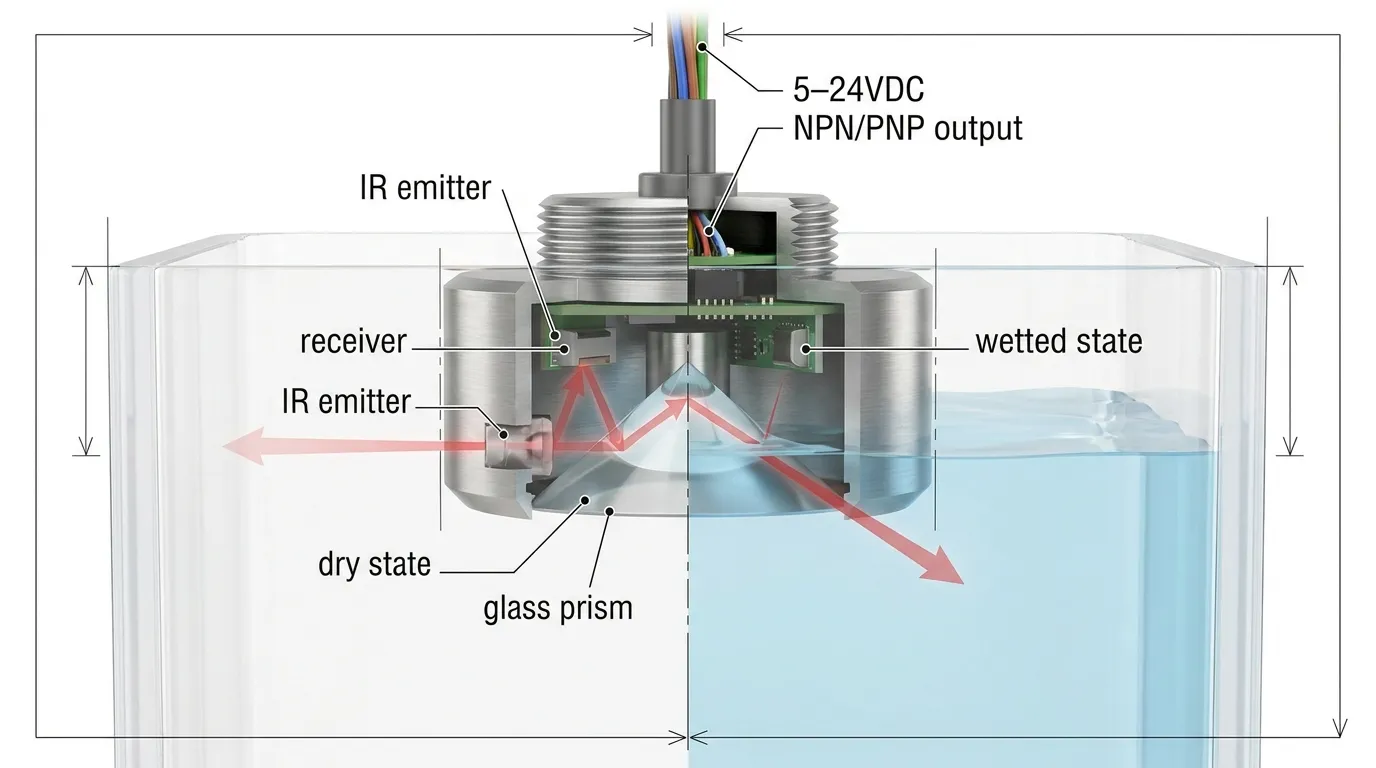
Ein photoelektrischer optischer Pegelsensor verwendet eine Infrarot-LED, Ein Phototransistorempfänger, und eine prismaförmige Messspitze. Im trockenen Zustand, Das Prisma reflektiert das Licht intern zurück zum Empfänger. Wenn Flüssigkeit das Prisma bedeckt, Der optische Weg ändert sich, weil die Flüssigkeit ein anderes brechungsartiges Verhalten als Luft zeigt. Die Elektronik wandelt diese optische Änderung in einen Schaltausgang um.
Dadurch sind optische Punktpegelsensoren dort nützlich, wo der Käufer eine kompakte Größe möchte, Kein beweglicher Schwimmer, Schnelles elektronisches Schalten, und ein sauberes Signal für Nieder- oder Hochpegeldetektion. Aber, Die Spezifikation muss auf die reale Flüssigkeit und die Installation passen. Schaum, Blasen, Schwere Beschichtung, Starke Kontamination, schlechter Montagewinkel, Falsche Ausgangsverdrahtung, oder inkompatible benetzte Materialien können alle Feldprobleme verursachen.
Elektrische Spezifikationen mit dem Controller abgleichen
Der erste Auswahlschritt ist Leistung und Ausgangsleistung. HojellyTeks Standardversorgungsspannungsbereich ist 5–24VDC, was den Einsatz in vielen Niederspannungs-Steuerplatinen ermöglicht, Gerätesysteme, Industrie-Steuerungen, und OEM-Tanküberwachungsschaltungen.
Für einfache Punktdetektion, Die Standardausgabeoptionen sind NPN oder PNP. NPN wird üblicherweise dort ausgewählt, wo der Eingang ein sinkendes Signal erwartet, während PNP verwendet wird, wo der Eingang ein Quellsignal erwartet. Der falsche Ausgangstyp kann den Sensor selbst dann als "tot" erscheinen lassen, selbst wenn die Messspitze richtig funktioniert. Für Details zur Verkabelung, vergleichen Sie die NPN/PNP-Ausgabe Leiten Sie vor der Bestätigung des Befehls.
Einige Projekte verlangen etwa 4–20 mA, da sie an kontinuierliche Pegelsender gewöhnt sind. Für diese Ressourcenseite, Der bestätigte Standardbereich ist für die optische Punktpegelschaltung vorgesehen. Wenn die Anwendung ein analoges kontinuierliches Signal erfordert,, die Ausgabeanforderung sollte in der RFQ-Phase separat überprüft werden und nicht angenommen werden.
Auch der Laststrom ist wichtig. Der bestätigte Standardlaststrom ist ≤ 100 mA. Wenn der Sensor einen SPS-Eingang steuert, dies ist in der Regel eine Signalpegellast. Wenn der Käufer ein Relais antreiben möchte, Lampe, Summer, oder direkt mit dem Magnetventil, Die Schaltung muss sorgfältig überprüft werden, da diese Lasten die Ausgangsangabe des Sensors überschreiten können.
Wählen Sie NO oder NC Logic für die Alarmfunktion
Dasselbe Sensorgehäuse kann je nach Schalt-Logik für unterschiedliche Steuerungszwecke verwendet werden. NEIN und NC Sollte entsprechend ausgewählt werden, wie sich die Maschine verhalten soll, wenn der Messpunkt trocken ist, nass, Verbindungsunterbrochen, oder in Alarm.
Für einen Tiefflug-Schutztank, Der Käufer möchte vielleicht, dass der Controller eine Pumpe stoppt, wenn Flüssigkeit unter den Sensor fällt. Für einen Überlaufalarm, Der Käufer möchte möglicherweise ein Signal, wenn die Flüssigkeit den oberen Punkt erreicht. In sicherheitsrelevanten Konstruktionen, Der Steuerungsingenieur sollte entscheiden, ob der Normalzustand unter Strom gestellt oder abgeschaltet werden soll, damit ein Kabelausfall, Sensorausfall, oder Stromausfall führt nicht zu einer unsicheren Annahme.
Benetzte Materialien und Flüssigkeitskompatibilität
Die benetzten Teile entscheiden, ob der Sensor die Flüssigkeit überleben kann. Käufer vergleichen oft Netzteil, PTFE, 316 Edelstahl, und Glas Weil sich jedes Material mit Wasser unterschiedlich verhält, Öl, Brennstoff, Kühlmittel, Chemische Flüssigkeiten, Reinigungsmittel, und Temperaturzyklen.
Für die derzeit standardisierte Konfiguration, Das bestätigte Wohnmaterial ist SUS316 und die Sensorspitze ist Glas. Diese Kombination ist bei Korrosionsbeständigkeit nützlich, Mechanische Haltbarkeit, und eine stabile optische Prismaoberfläche sind erforderlich. PTFE kann für aggressivere chemische Umgebungen in Betracht gezogen werden., während Netzteilgehäuse für kompakte oder kostenempfindliche OEM-Anwendungen relevant sein können, aber Materialverfügbarkeit und Eignung sollten während der Ausschreibung bestätigt werden.
Vor der Bestellung, Share the Liquid Name, Konzentration, Temperatur, ob die Flüssigkeit Rückstände hinterlässt, ob der Tank mit Chemikalien gereinigt wird, und ob die Sensorspitze dem Ölfilm ausgesetzt sein könnte, Maßstab, Schaum, oder suspendierte Teilchen. Optische Sensoren funktionieren am besten, wenn die Prismaoberfläche klar zwischen Luft und Flüssigkeit übergehen kann.
Temperatur, Druck, IP-Bewertung und Montage
Der bestätigte Betriebstemperaturbereich ist -10~80°C. Dies sollte sowohl mit der Flüssigkeit als auch mit der Umgebungstemperatur überprüft werden. Ein Tank in einer warmen Fabrik kann noch in Reichweite sein, während eine Kesselseite, Sterilisation, oder eine Hochtemperaturreinigungsumgebung benötigt möglicherweise eine separate Modellüberprüfung.
Die Druckangabe ist gekennzeichnet Fortsetzung folgt weil es von der mechanischen Struktur abhängt, Siegel, Faden, und endgültige Modellkonfiguration. Wenn der Sensor in einem geschlossenen Tank verwendet wird,, Pumpenleitung, Kraftstoffsystem, Kühlmittelkreislauf, oder Gefäß mit Druckschwankungen, Der Druck muss vor der Probenfreigabe bestätigt werden.
Die bestätigte IP-Bewertung ist IP67, das viele Geräte und industrielle Installationen unterstützt, wenn das Kabel austritt, Steckverbinder, und die Installationsmethode sind ordnungsgemäß geschützt. Die IP-Zulassung sollte nicht als chemische Kompatibilität oder unbegrenzte Taucherlaubnis betrachtet werden; Es ist nur ein Teil der Umweltauswahl.
Montagegewinde umfassen 1/2" NPT, G1/2, und 3/8" NPT. Wähle das Gewinde entsprechend dem Design des Panzerbosses, Wanddicke, Dichtungsmethode, Flüssigkeitsrichtung, und verfügbarer Platz für das Kabel. Für OEM-Panzer, Bestätigen Sie, ob der Sensor horizontal von der Seitenwand aus installiert wird, vertikal von oben, oder in eine Sonderkammer.
Anwendungsmapping-Tabelle
| Anwendung | Spezifikationen zu priorisieren | Auswahlhinweise |
|---|---|---|
| Wassertank Hoch-/Tief-Alarm | 5–24VDC, NPN/PNP, Schließer/Öffner, IP67 | Controller-Eingangstyp und Alarmlogik bestätigen |
| Öl- oder Treibstoffreservoir | SUS316, Glasspitze, Gewindedichtung, Druck TBC | Ölfilm bestätigen, Schwingung, und Temperatur |
| HLK-Kondensat oder Abflussbecken | Kompakte Montage, IP67, Schließer/Öffner | Kontamination überprüfen, Reinigung, und Kabelführung |
| OEM-Gerätetank | Spannung, Ausgabe, Faden, Körpergröße | Bestätigen Sie die Passform des Musters, bevor das Design von Form oder Tank finalisiert wird |
| Industrie-Flüssigkeitstank | Material, Temperatur, Druck, Montage | Teilen Sie Flüssigkeitsdaten und Installationszeichnungen |
| Pumpen-Trockenlaufschutz | Schaltlogik, Antwort folgt nach., Laststrom ≤100 mA | Bestätigen Sie das Sicherheitsverhalten im Steuerungsprogramm |
Wie man einen optischen Pegelsensor spezifiziert
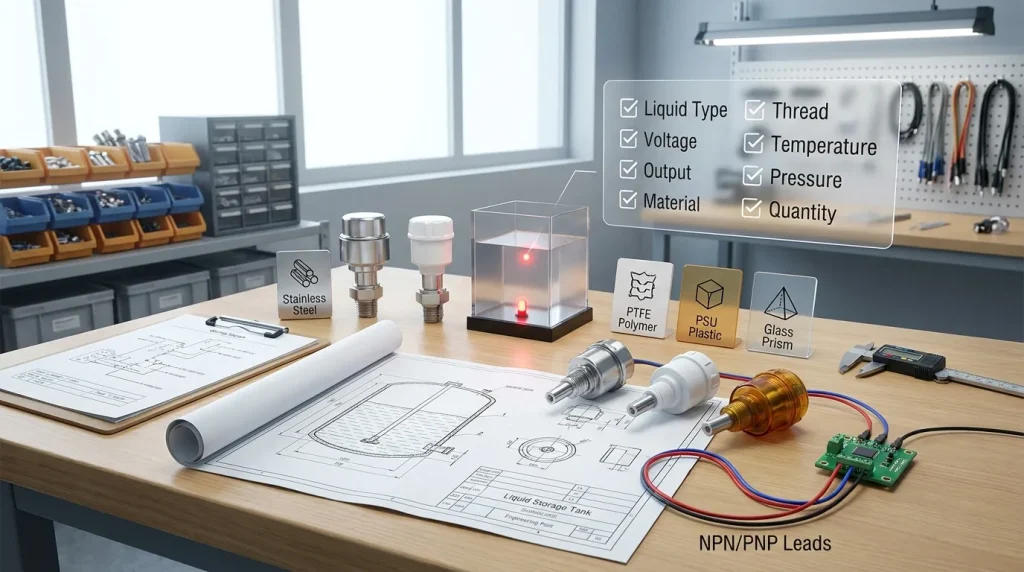
Verwenden Sie diese Checkliste, bevor Sie die Datenblatt des optischen Pegelsensors oder ein Werksangebot.
- Bestätigen Sie die Flüssigkeit: Wasser, Öl, Brennstoff, Kühlmittel, Chemische Mischung, Abwasser, oder eine andere Flüssigkeit.
- Bestätigen Sie die Funktion: Hochstufe-Alarm, Niedrig-Pegel-Alarm, Trockenlaufschutz, overflow prevention, oder OEM-Statuserkennung.
- Elektrische Eingabe bestätigen: 5V, 12V, 24V, SPS-Eingang, MCU-Eingang, Relaismodul, oder Steuerplatine.
- Wählen Sie den Ausgabetyp: NPN oder PNP.
- Wähle Schaltlogik: NO oder NC.
- Bestätigen Sie den Laststrombedarf und ob der Sensor nur ein Signal sendet oder ein anderes Gerät antreibt..
- Materialbedarf bestätigen: SUS316, Glas, PTFE, Netzteil, oder benutzerdefinierte Diskussion.
- Tankmontage bestätigen: 1/2" NPT, G1/2, 3/8" NPT, Seitenhalterung, Oberste Montage, oder OEM-Struktur.
- Bestätigen Sie Temperatur- und Druckbedingungen.
- Teilteilungsverlosung, Quantitätsziel, Kabel-/Stecker-Präferenz, Kennzeichnungsbedarf, und Exportziel.
Häufige Fehlermodi zu vermeiden
Die meisten Probleme mit optischen Pegelsensoren werden nicht durch das Sensorprinzip selbst verursacht. Sie entstehen meist aus einer Diskrepanz zwischen der Spezifikation und der Anwendung.
Eine falsche NPN/PNP-Wahl kann verhindern, dass der Controller das Signal ausliest. Eine falsche NO/NC-Wahl kann die Alarmlogik umkehren. Eine Flüssigkeit, die das Prisma beschichtet, kann den optischen Übergang verzögern oder blockieren. Luftblasen, Schaum, oder turbulente Flüssigkeit kann instabiles Schalten in der Nähe des Messpunkts verursachen. Eine Fehlanpassung im Gewinde kann zu Leckagen führen. Ein nicht offengelegter Druckzustand kann die Abdichtung beeinflussen. Eine Last darüber ≤ 100 mA kann die Ausgangsschaltung beschädigen.
Der sicherste Weg ist die Genehmigung der Spezifikation, Verdrahtung, Zeichnung, und Probentests vor der Serienproduktion.
HojellyTek Fertigungsunterstützung
HojellyTek ist ein Hersteller und Exporteur aus Shenzhen, der sich auf photoelektrische optische Sensoren spezialisiert hat, Flüssigkeitsstandsdetektion, sowie OEM/ODM-Sensorprojekte. Unser internes R&Das D-Team unterstützt die Modellauswahl, Verdrahtungsbestätigung, Materialübersicht, und Diskussionen über Individualisierung für Ausrüstungshersteller, Verleiher, und industrielle Käufer.
Für umfassendere Modelldetails, Überprüfen Sie die Produkt des optischen Pegelsensors Seite, dann senden Sie Ihre Bewerbungsanforderungen per WhatsApp oder per E-Mail zur Bestätigung.
FAQ
Was sollte eine Spezifikation für einen optischen Pegelsensor enthalten??
Eine Spezifikation für optische Pegelsensoren sollte die Versorgungsspannung enthalten, Aktuell, Ausgabetyp, Laststrom, Schaltlogik, Antwortanforderung, Benetzte Materialien, Betriebstemperatur, Druckbedingungen, Gewindegröße, Montagerichtung, IP-Schutzart, Kabel-/Steckerbedarf, und die Zielflüssigkeit.
Ist 5–24VDC für meinen Controller geeignet??
Es könnte geeignet sein, wenn deine Steuerplatine, SPS, oder das Eingangsmodul arbeitet innerhalb dieses Versorgungsbereichs. Du musst noch die NPN/PNP-Ausgabe bestätigen, NO/NC-Logik, Laststrom, und die Verdrahtungsmethode vor der Bestellung.
Kann ein Sensor sowohl Wasser als auch Öl erkennen??
Optische Sensoren können in verschiedenen Flüssigkeiten verwendet werden, aber das optische Verhalten der Flüssigkeit, Beschichtungstendenz, Viskosität, Temperatur, und chemische Kompatibilität muss überprüft werden. Wasser, Öl, und Brennstoffprojekte sollten ohne Probentests nicht als identisch behandelt werden.
Was ist der Unterschied zwischen SUS316, PTFE, Netzteil und Glas?
SUS316 wird häufig wegen Korrosionsbeständigkeit und mechanischer Festigkeit ausgewählt. Glas wird als optische Prismenspitze verwendet. PTFE kann für aggressive Chemikalien in Betracht gezogen werden. PSU-ähnliches Material kann für einige OEM-Designs geeignet sein. Die endgültige Materialauswahl sollte mit der Flüssigkeit und der Installation übereinstimmen.
Messen optische Pegelsensoren den kontinuierlichen Pegel??
Standard-optische Punktpegelsensoren erkennen, ob an einem festen Messpunkt Flüssigkeit vorhanden ist. Wenn Ihr Projekt eine kontinuierliche Pegelmessung oder eine 4–20 mA-Ausgabe erfordert., Geben Sie dies während der Ausschreibung klar an, damit die richtige Lösung überprüft werden kann.
Warum sind Druck- und Schaltantwort als TBC gekennzeichnet??
Sie hängen vom genauen Modell ab, Siegel, Mechanische Struktur, und Projektbedingungen. Anstatt Figuren zu erfinden, Wir bestätigen die Druckbewertung und die Schaltreaktion während der Datenblattprüfung, Probengenehmigung, oder Diskussion über benutzerdefinierte Spezifikationen.
Datenblatt herunterladen oder ein Angebot anfordern
Um das korrekte Datenblatt zu erhalten,, Zeichnung, Verdrahtungsanleitung, und Zitat, Schick deinen flüssigen Typ, Spannung, Ausgangsanforderungen, Gewindegröße, Montagerichtung, Materialpräferenz, Temperatur, Druckbedingungen, und geschätzte Menge.
Kontaktieren Sie HojellyTek per WhatsApp oder per E-Mail, um ein Datenblatt anzufordern, Beispieldiskussion, oder ein OEM/ODM-Angebot für Ihr optisches Pegelsensorprojekt.


