
Braiteoir Leibhéal Optúil le haghaidh Umair Cuisnithe
Cuidíonn réiteach umar cuisnithe braiteoir leibhéal optúil le róthéamh íseal-chuisnithe a chosc, caidéil ag rith tirim, cavitation, agus múchadh meaisín gan choinne sula sroicheann an taiscumar leibhéal contúirteach. Le haghaidh uirlisí meaisín, innill, fuaraithe, Sleamhnáin fuaraithe, agus taiscumair thionsclaíocha, Soláthraíonn HojellyTek braiteoirí leibhéal fótaileictreach dlúth le haghaidh braite aláraim ísealleibhéil, dearbhú láithreacht cuisnithe, agus comhtháthú umar cuisnithe OEM.
Tá an sprioc simplí: a bhrath an bhfuil cuisnithe ann ag an íosleibhéal sábháilte, ansin seol comhartha iontaofa chuig PLC, Bord Rialaithe, sealaíocht, dordánaí, lampa rabhaidh, nó ciorcad múchta.
Cumas Braite Leibhéal Umar Cuisnithe
Tá braiteoirí optúla HojellyTek deartha le haghaidh braite pointe-leibhéal in umair dhlúth agus taiscumair thionsclaíocha ina bhféadfadh lasca snámhphointe a bheith ró-toirtiúil, neamhiontaofa go meicniúil, nó íogair do chreathadh.
Le haghaidh feidhmchlár umar cuisnithe, Is féidir linn tacú:
- Brath aláraim íseal-chuisnithe i dtaiscumair cuisniúcháin uirlisí meaisín CNC
- Cosaint inlet caidéil le haghaidh caidéil cúrsaíochta cuisnithe
- Monatóireacht ar leibhéal taiscumar cuisnithe innill do threalamh tionsclaíoch
- Braite aláraim ísealleibhéil umar chiller
- Monatóireacht ar leibhéal bealaidh fuaraithe i gcórais miotalóireachta
- Saincheaptha braiteoir OEM / ODM do thógálaithe umar agus déantúsóirí trealaimh
- Modúil braite fótaileictreach le cábla saincheaptha, cónascaire, Aschur, agus roghanna tithíochta
- Roghnú braiteoir bunaithe ar chineál cuisnithe, ábhar umar, Suíomh gléasta, agus loighic rialaithe
Má theastaíonn ardán braiteoir ginearálta pointe-leibhéal ó d'iarratas, féach ar ár Braiteoir Leibhéal Optúil Roghanna do thionscadail caighdeánacha braite leacht.
Cosc a chur ar róthéamh íseal-chuisnithe agus damáiste caidéil
I gcórais chuisnithe, Ní cúlpháirtí monatóireachta amháin é an braiteoir leibhéil. Is gléas cosanta é. Nuair a thiteann cuisnithe faoi bhun an leibhéal sábháilte, Is féidir leis an gcóras cumas fuaraithe a chailleadh, Féadfaidh an caidéal aer a tharraingt, agus féadfaidh an meaisín leanúint ar aghaidh ag rith gan dóthain sreabhán chun teas a bhaint.
I measc na dteipeanna coitianta a chuidíonn braiteoir optúil ísealleibhéil a chosc tá:
- Caidéal ag rith tirim nuair a thiteann leibhéal an umar cuisnithe faoi bhun an phointe súchán
- Róthéamh in uirlisí meaisín, innill, nó fuaraithe
- Droch-chúrsaíocht cuisnithe de bharr iontógáil aeir nó cavitation
- Caitheamh uirlisí nó éagobhsaíocht phróisis mar gheall ar shreabhadh fuaraithe neamhleor
- Lochtanna ísealleibhéil chiller agus múchadh éigeandála
- Downtime neamhphleanáilte de bharr iniúchadh láimhe moillithe
- Damáiste séala caidéil ó oibriú arís agus arís eile gan go leor leachta
Le haghaidh feidhmchlár atá dírithe ar chaidéal, Ár ngaolta Cosaint tirim-reáchtáil caidéil Míníonn leathanach conas is féidir braiteadh pointe-leibhéal a úsáid mar idirghlasáil sula ritheann an caidéal i ndálaí neamhshábháilte.
Conas a Aimsíonn an Braiteoir Optúil Leibhéal Cuisnithe
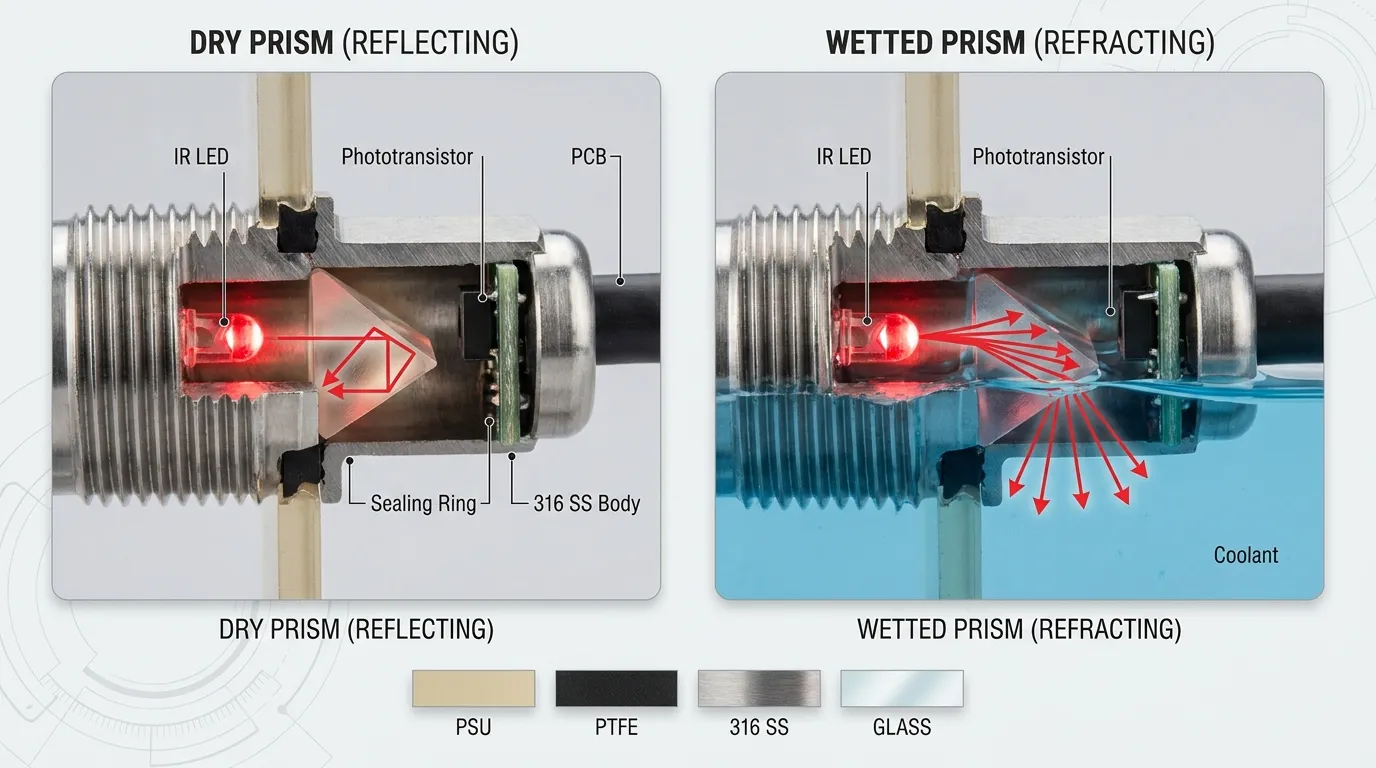
Is gnách go n-úsáideann braiteoir leibhéal cuisnithe fótaileictreach LED infridhearg, fóta-trasraitheoir, agus barr braite priosma-chruthach. Tá an barr braite suiteáilte ag an spriocleibhéal aláraim taobh istigh nó trí bhalla an taiscumair cuisnithe.
Nuair a bhíonn an barr priosma san aer, Frithchaitear solas infridhearg go hinmheánach taobh istigh den phriosma agus filleann sé ar an nglacadóir. Nuair a chlúdaíonn cuisnithe an priosma, athraíonn an solas isteach sa leacht in ionad frithchaiteachas a dhéanamh ar ais. Braitheann an leictreonaic braiteoir an t-athrú seo agus athraíonn sé an staid aschuir.
Tugann an modh braite tirim-versus-fliuch seo roinnt buntáistí in umair chuisnithe:
- Níl aon lámh snámhphointe ag gluaiseacht le subh, bata, nó a chaitheamh
- Leid braite dlúth do thaiscumair bheaga
- Freagra tapa ar leibhéal an phointe ag an airde gléasta socraithe
- Brath cobhsaí do go leor uisce-bhunaithe, glycol-bhunaithe, agus leachtanna olabhunaithe
- Comhtháthú aláraim ísealleibhéil éasca le córais rialaithe leictreonacha
- Oiriúnach le haghaidh gléasta taobh cothrománach nó comhtháthú umar saincheaptha
Ní dhéanann an braiteoir anailís ar cháilíocht cuisnithe nó ar fhoirmle cheimiceach. Is é an jab atá aige ná brath leibhéil: cibé an bhfuil an barr braite tirim nó fliuch ag an bpointe aláraim.
Comhoiriúnacht Cuisnithe agus Roghnú Teochta
Braitheann comhoiriúnacht cuisnithe ar an gcineál leachtach, tiúchan, Breiseáin, teocht, brú, Próiseas glantacháin, agus ábhar fíuch. Ar an gcúis seo, Ba chóir an comhlacht braiteora agus an t-ábhar priosma a roghnú de réir an fhíor-chuisnithe a úsáidtear san umar, ní hamháin ainm an fheidhmchláir.
I measc na roghanna coitianta ábhar fliuch tá plaisteach PSU, PTFE, 316 cruach dhosmálta, agus gloine. Le haghaidh taiscumair ardteochta, lúbanna cuisnithe téite, nó sreabhán tionsclaíocha crua, Ba chóir athbhreithniú a dhéanamh ar an tsamhail agus ar an ábhar cábla sula ndéantar sampláil orthu. Le haghaidh feidhmchlár teocht ardaithe, féach ar ár braiteoir optúil ardteochta Leathanach roghnúcháin.
| Cuisnithe / Cineál Leachtach | Cás Úsáide Tipiciúil | Treo Ábhar Braiteoir Molta | Breithniú Teochta | Seiceáil an Cheannaitheora Sula n-Ordaíonn tú |
|---|---|---|---|---|
| Cuisnithe uisce-bhunaithe | Uirlisí meaisín CNC, Ionaid meaisínithe, Umair fuaraithe ghinearálta | PSU nó dhosmálta / gloine ag brath ar bhreiseáin agus dearadh umar | Deimhnigh gnáththeocht oibriúcháin agus glantacháin | Seiceáil cúr, sceallóga, tiúchan breiseán, agus airde an aláraim |
| Cuisnithe glycol-bhunaithe | Fuaraithe, Sleamhnáin fuaraithe, Taiscumair thionsclaíocha a bhaineann le hinneall | PSU, PTFE, nó dhosmálta / gloine tar éis athbhreithniú comhoiriúnachta | Deimhnigh raon oibriúcháin teocht íseal agus ardteochta | Comhroinn tiúchan glycol agus raon teochta taiscumar |
| Cuisnithe ola-bhunaithe / ola a ghearradh | Miotalóireacht, Córais lubrication-fuaraithe | PTFE nó 316 Is minic a bhearr le haghaidh sreabhán níos géire | Deimhnigh athrú slaodachta ag teocht oibriúcháin | Tástáil le sampla ola / cuisnithe iarbhír roimh ordú mórchóir |
| Eibleacht bealaidh fuaraithe | Umair cuisniúcháin uirlisí meaisín | Braitheann roghnú ábhair ar cheimic eibleachta agus ar leibhéal éillithe | Deimhnigh má ritheann an umar te le linn oibríochta leanúnach | Seiceáil sloda, cúr, sceallóga, agus modh glantacháin |
| Uisce fuaraithe / cuisnithe próisis | Fuaraitheoirí tionsclaíocha agus taiscumair fuaraithe próisis | PSU nó dhosmálta / gloine ag brath ar sreabhán agus suiteáil | Deimhnigh timthriall teochta chiller agus riachtanas freagartha aláraim | Seiceáil loighic aláraim ísealleibhéil agus sreangú idirghlasála caidéil |
| Cuisnithe crua nó anaithnid | Meaisíní OEM, trealamh próisis speisialta | PTFE, 316 dhosmálta, nó ba chóir athbhreithniú a dhéanamh ar ghloine ar dtús | Ní mór raon teochta a dhearbhú ag céim RFQ | Seol sonraí cuisnithe nó iarr bailíochtú samplach |
Le haghaidh creimneach, ardteocht, nó iarratais umar miotail, a 316 Braiteoir dhosmálta D'fhéadfadh sé a bheith níos oiriúnaí ná braiteoir plaisteach-chorp.
Sreangú Aláraim Ísealleibhéil le haghaidh Taiscumair Cuisnithe
Úsáideann an chuid is mó de thionscadail umar cuisnithe an braiteoir optúil mar lasc ísealleibhéil. Is féidir an t-aschur a chumrú chun córas rialaithe an mheaisín a mheaitseáil, Bord Aláraim, PLC, nó comhéadan sealaíochta.
I measc na roghanna aschuir coitianta tá:
- Aschur NPN le haghaidh ciorcaid ionchuir a chur go tóin poill
- Aschur PNP chun ciorcaid ionchuir a fhoinsiú
- Loighic NO nó NC ag brath ar cé acu ba chóir an t-aláram a spreagadh nuair a bhíonn an barr tirim nó fliuch
- Comhéadan sealaíochta nuair a theastaíonn athrú scoite ón meaisín
- Aschur lampa rabhaidh nó dordánaí trí chiorcad rialaithe
- Idirghlasáil stad caidéil chun cosc a chur ar rith tirim
- 4-20 mA aschur nuair a roghnaítear braiteoir leibhéil leanúnach in ionad lasc pointe-leibhéal
Le haghaidh cosaint íseal-chuisnithe, Is fearr le go leor ceannaitheoirí loighic teip-shábháilte: nuair a bhíonn an braiteoir dícheangailte, damáiste, nó braitheann sé barr tirim, Ba chóir don mheaisín dul isteach i mód aláraim nó stad seachas leanúint ar aghaidh go ciúin. Ba chóir an loighic seo a dhearbhú le d'innealtóir rialaithe roimh an táirgeadh.
An Braiteoir a Gléasadh in Umar Cuisnithe
Cinneann an suíomh gléasta cé chomh húsáideach is a bheidh an t-aláram. Ní féidir le braiteoir atá suiteáilte ró-íseal an fhadhb a bhrath ach amháin tar éis don chaidéal tosú ag tarraingt aer cheana féin. Is féidir le braiteoir atá suiteáilte ró-ard aláraim núis a chruthú go minic fiú nuair a bhíonn go leor cuisnithe inúsáidte fós ag an gcóras.
Maidir leis an gcuid is mó de na taiscumair chuisnithe, Ba chóir an braiteoir a shuiteáil ag an leibhéal íosta sábháilte os cionn an inlet caidéil nó an phointe súchán. Braitheann an airde cruinn ar gheoiméadracht umar, Suíomh caidéil, gluaiseacht sreabhach, agus cé mhéad toirt cúltaca atá ag teastáil roimh dhúnadh.
I measc na bpointí gléasta tábhachtacha tá:
- Suiteáil an leid braite ag an airde aláraim fíor-ísealleibhéil
- Coinnigh an barr ar shiúl ó chriosanna carntha sliseanna troma agus sloda
- Seachain gléasta áit a mbuaileann cúr nó suaitheadh láidir an priosma i gcónaí
- Bain úsáid as modh séalaithe atá oiriúnach don bhalla umar agus don chineál cuisnithe
- Deimhnigh méid an snáithe, Treo cábla, agus imréiteach suiteála
- Cosain an cábla ó dhromchlaí te, páirteanna ag gluaiseacht, sceallóga a ghearradh, agus spraeála cuisnithe
- Le haghaidh umair miotail, Deimhnigh an talamh, torann leictreach, agus cosaint cónascaire
- Le haghaidh umair phlaisteacha, Tiús balla agus neart snáithe a dhearbhú
I measc na roghanna gléasta tipiciúla tá gléasadh taobh snáithithe, Suiteáil Boss Umar Saincheaptha, gléasta inmheánach dlúth, nó comhtháthú taiscumar OEM. Snáithe, fad cábla, Stíl an Chónascaire, agus is féidir ábhar tithíochta a shaincheapadh le linn na céime RFQ.
Seicliosta Aláraim Ísealleibhéil Sula n-Ordaítear
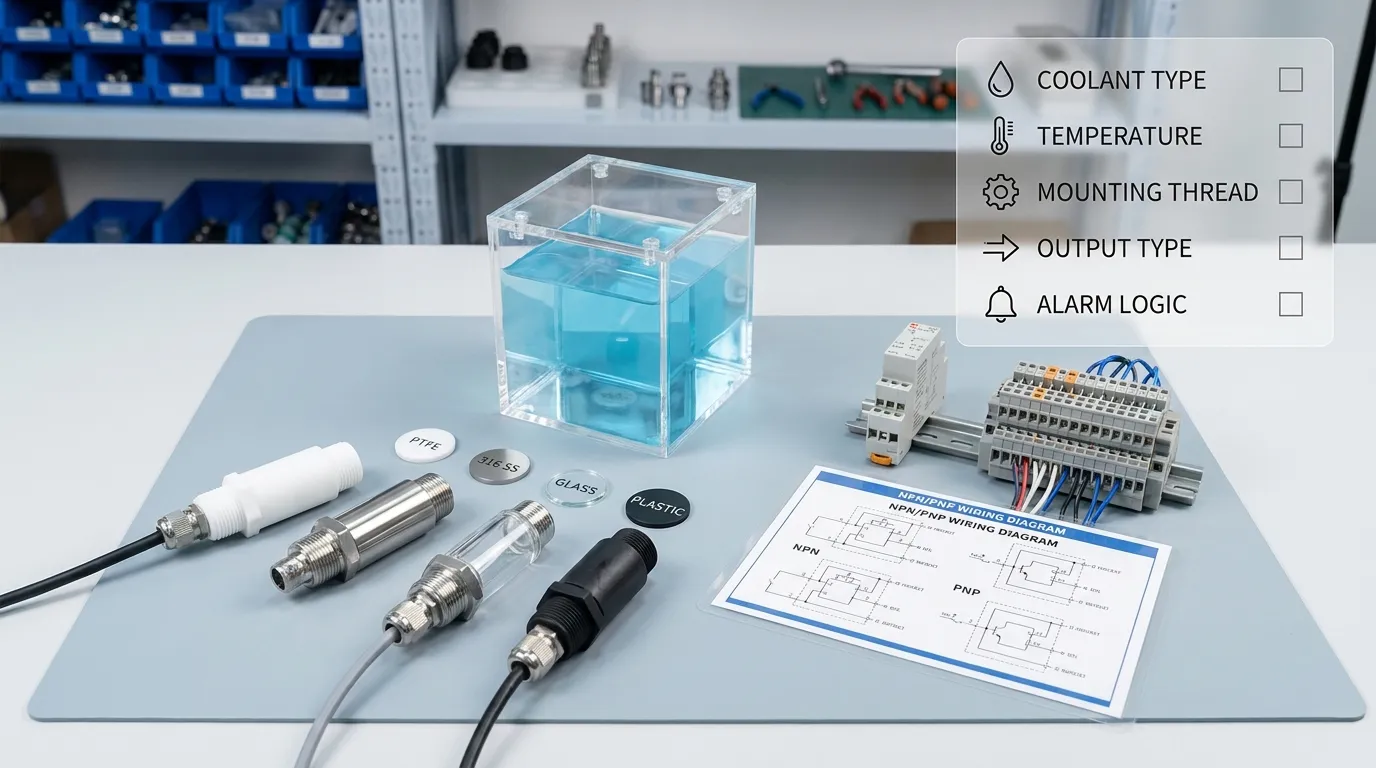
Sula roghnaíonn tú braiteoir optúil le haghaidh monatóireachta umar cuisnithe, an t-eolas seo a leanas a ullmhú:
- Cineál cuisnithe: uisce-bhunaithe, glycol-bhunaithe, ola-bhunaithe, eibleacht, uisce fuaraithe, nó eile
- Branda nó sampla cuisnithe iarbhír má tá comhoiriúnacht éiginnte
- Gnáth-theocht oibriúcháin agus teocht uasta glantacháin nó próisis
- Ábhar umar agus tiús balla
- Stíl gléasta: balla taobh, Boss Snáithithe, Flange, nó sealbhóir saincheaptha
- Leibhéal aláraim riachtanach arna thomhas ó bhun an umair nó inlet caidéil
- Cineál aschuir: NPN, PNP, sealaíocht, nó comhartha leanúnach analógach
- Loighic aláraim: oscailte de ghnáth nó dúnta de ghnáth
- Voltas soláthair a theastaíonn ón mbord rialaithe meaisín
- Sprioc ceangail: PLC, sealaíocht, dordánaí, lampa rabhaidh, nó idirghlasáil caidéil
- Fad cábla, cineál cónascaire, agus ceanglas seaicéad cábla
- Nochtadh do chreathadh, sceallóga a ghearradh, cúr, ceo ola, nó spraeála cuisnithe
- Ábhar comhlacht braiteora riachtanach: PSU, PTFE, 316 cruach dhosmálta, nó gloine
- Cainníocht samplach agus plean tástála roimh ordú táirgthe
5-Próiseas Seirbhíse Céim
1. Fiosrúchán
Seol chugainn d'iarratas ar umar cuisnithe, cineál leachtach, Líníocht umar nó grianghraf, airde aláraim, agus riachtanas sreangaithe trí WhatsApp nó ríomhphost.
2. Sonraíocht agus Saincheaptha
Déanann ár bhfoireann innealtóireachta athbhreithniú ar ábhar fliuch, snáithe gléasta, Cineál Aschuir, cábla, cónascaire, agus loighic aláraim. Do thionscadail OEM / ODM, Is féidir linn tacú le struchtúr braiteoir saincheaptha agus sreangú.
3. Tástáil Samplach
Is féidir samplaí a ullmhú le haghaidh bailíochtaithe le do fhíor-chuisnithe, taiscumar, Bord Rialaithe, agus ciorcad aláraim. Tá an chéim seo tábhachtach le haghaidh glycol-bhunaithe, ola-bhunaithe, ardteocht, nó cuisnithe saibhir breiseán.
4. Táirgeadh agus QC
Tar éis dearbhú samplach, Táirgeann an mhonarcha de réir na cumraíochta comhaontaithe. Díríonn QC ar fheidhm braiteora, staid aschuir, Séalaithe, cáilíocht cábla, agus cuma.
5. Loingseoireacht agus Tacaíocht
Onnmhairímid braiteoirí do chustaiméirí sna Stáit Aontaithe, TÁIMID, An India, agus margaí eile. Is féidir le tacaíocht dearbhú sreangaithe a áireamh, Moltaí Suiteála, agus roghnú samhlacha do thionscadail amach anseo.
Ceanglais agus Pointí Sonraíochta le Deimhniú
| Ceanglas | Cén fáth a mbaineann sé le |
|---|---|
| Cineál cuisnithe | Cinneann ábhar fliuch agus riachtanas tástála samplach |
| Raon teochta | Bíonn tionchar aige ar chorp braiteora, Priosma, Séalaithe, agus rogha cábla |
| Snáithe nó struchtúr gléasta | Cinntíonn go n-oireann an braiteoir don taiscumar gan sceitheadh |
| Airde an phointe aláraim | Cuireann cosc ar róthéamh agus ag rith tirim caidéil roimh damáiste |
| Cineál aschuir | Ní mór PLC a mheaitseáil, sealaíocht, Bord Aláraim, nó ionchur an rialaitheora |
| Loighic NO/NC | Cinneann sé cathain a ghníomhachtaítear an t-aláram ísealleibhéil |
| Cábla agus cónascaire | Caithfidh sé a bheith oiriúnach do leagan amach an mheaisín agus do thimpeallacht seirbhíse |
| Timpeallacht umar | Sceallóga, cúr, tonnchrith, sloda, agus is féidir le spraeála tionchar a imirt ar dhearadh suiteála |
Braiteoir Optúil vs Athraigh Snámhphointe le haghaidh Umair Cuisnithe
| Mír | Braiteoir leibhéal optúil | Athraigh Snámhphointe |
|---|---|---|
| Modh braite | Braitheann priosma fótaileictreach IR staid tirim nó fliuch | Gluaiseachtaí snámhphointe meicniúil le leibhéal leachtach |
| Páirteanna ag gluaiseacht | Gan aon mheicníocht braite ag gluaiseacht | Is féidir le snámhphointe ag gluaiseacht bata nó a chaitheamh |
| Méid | Dlúth, oiriúnach d'umair bheaga agus taiscumair OEM | Is minic a bhíonn níos mó spáis inmheánach ag teastáil uaidh |
| Éilliú cuisnithe | Riachtanais gléasta ceart ar shiúl ó sloda nó sceallóga troma | Is féidir le snámhphointe subh le sceallóga, salachar, nó iarmhar greamaitheach |
| Sreangú | NPN, PNP, Comhéadan Sealaíochta, nó ionchur an rialaitheora | Aschur lasc simplí de ghnáth |
| An úsáid is fearr | Aláram leictreonach ísealleibhéil, taiscumair dhlúth, Dearaí OEM | Umair shimplí ina bhfuil gluaiseacht mheicniúil inghlactha |
Cén fáth a roghnaigh HojellyTek
Is monaróir braiteoir leibhéal optúil agus leachtach Shenzhen é HojellyTek le R intí&D agus taithí braite fótaileictreach. Tacaímid le saincheaptha OEM / ODM le haghaidh monatóireachta umar cuisnithe, taiscumair trealamh dlúth, Córais rialaithe tionsclaíocha, agus comhtháthú feistí cliste i gcás inarb ábhartha.
Oibríonn ceannaitheoirí linn le haghaidh:
- Forbairt braiteoir monarcha-dhíreach agus tacaíocht onnmhairithe
- Dearadh lasc leibhéal optúil d'umair dhlúth
- Cábla saincheaptha, cónascaire, snáthaid, agus cumraíocht aschuir
- Roghanna ábhair lena n-áirítear PSU, PTFE, 316 cruach dhosmálta, agus gloine
- Tacaíocht iarratais d'uirlisí meaisín, innill, fuaraithe, agus cosaint caidéil
- Taithí easpórtála le custaiméirí sna Stáit Aontaithe, TÁIMID, An India, agus margaí eile
Ceisteanna CCanna
An féidir le réiteach umar cuisnithe braiteoir leibhéal optúil cuisnithe íseal a bhrath roimh damáiste caidéil?
Tá. Tá an braiteoir suite ag an leibhéal cuisnithe sábháilte íosta. Nuair a éiríonn an barr priosma tirim, Athraíonn an t-aschur staid agus is féidir leis aláram a spreagadh, Ionchur PLC, sealaíocht, dordánaí, lampa rabhaidh, nó idirghlasáil stad caidéil.
An n-oibreoidh braiteoir leibhéal optúil le cuisnithe glycol-bhunaithe?
Is féidir é a úsáid le haghaidh go leor feidhmchlár cuisnithe glycol-bhunaithe, ach ba cheart comhoiriúnacht a dhearbhú le tiúchan cuisnithe, teocht, Breiseáin, agus ábhar fíuch. Do thionscadail OEM, Moltar tástáil leis an bhfuaraitheoir iarbhír.
An féidir leis an braiteoir cuisnithe ola-bhunaithe nó ola ghearrtha a bhrath?
Tá, Is féidir braiteoir leibhéal optúil a úsáid le cuisnithe ola-bhunaithe nó ola ghearrtha nuair a roghnaítear an t-ábhar braiteoir ceart agus an seasamh gléasta. PTFE, cruach dhosmálta, nó is féidir roghanna gloine a mheas le haghaidh sreabhán níos géire.
Cá háit ar chóir an braiteoir a shuiteáil i dtaiscumar cuisnithe?
Cuir é ag an airde aláraim ísealleibhéil riachtanach, De ghnáth os cionn an inlet caidéil nó an phointe súchán. Seachain criosanna sloda, limistéir charntha sliseanna, suaitheadh láidir, agus suíomhanna ina bhféadfadh cúr a bheith ina chúis le haláraim núis.
Ar cheart dom aschur NPN nó PNP a roghnú le haghaidh braiteoir umar cuisnithe?
Roghnaigh an t-aschur a mheaitseálann do PLC, Bord Rialaithe, nó ciorcad aláraim. Tá NPN agus PNP araon coitianta. Ba chóir loighic NO / NC a dhearbhú freisin ionas go n-imoibríonn an meaisín i gceart nuair a bhíonn leibhéal cuisnithe íseal.
An bhfuil 4-20 mA ag teastáil chun monatóireacht a dhéanamh ar leibhéal umar cuisnithe?
Ní i gcónaí. Le haghaidh aláram simplí ísealleibhéil, lasc optúil pointe-leibhéal le NPN, PNP, nó is leor comhéadan sealaíochta de ghnáth. Bain úsáid as 4-20 mA ach amháin nuair a theastaíonn tomhas leibhéal leanúnach ó do chóras seachas pointe aláraim amháin.
Iarr ar Luachan Braiteoir Umar Cuisnithe
Seol do chineál cuisnithe, grianghraf umar nó líníocht, airde aláraim, snáithe gléasta, Cineál Aschuir, riachtanas voltais, agus rogha cábla / cónascaire do HojellyTek trí WhatsApp nó ríomhphost. Cuideoidh ár bhfoireann le braiteoir leibhéal cuisnithe optúil a roghnú nó a shaincheapadh d'uirlisí meaisín, innill, fuaraithe, agus córais taiscumar OEM.


