
Optical Sensors for Groundwater Level Monitoring
This article explains where optical level sensors help, where they do not, and how to choose the right technology for groundwater, well, tank, and remote monitoring projects.
The Honest Fit: Optical Point Sensors Are Not Deep-Well Level Loggers
An optical liquid level sensor is a point-level device. It detects whether liquid is present at one fixed position. It does not measure the full water column in a borehole, and it does not automatically tell you the changing water depth unless you install multiple points or combine it with other systems.
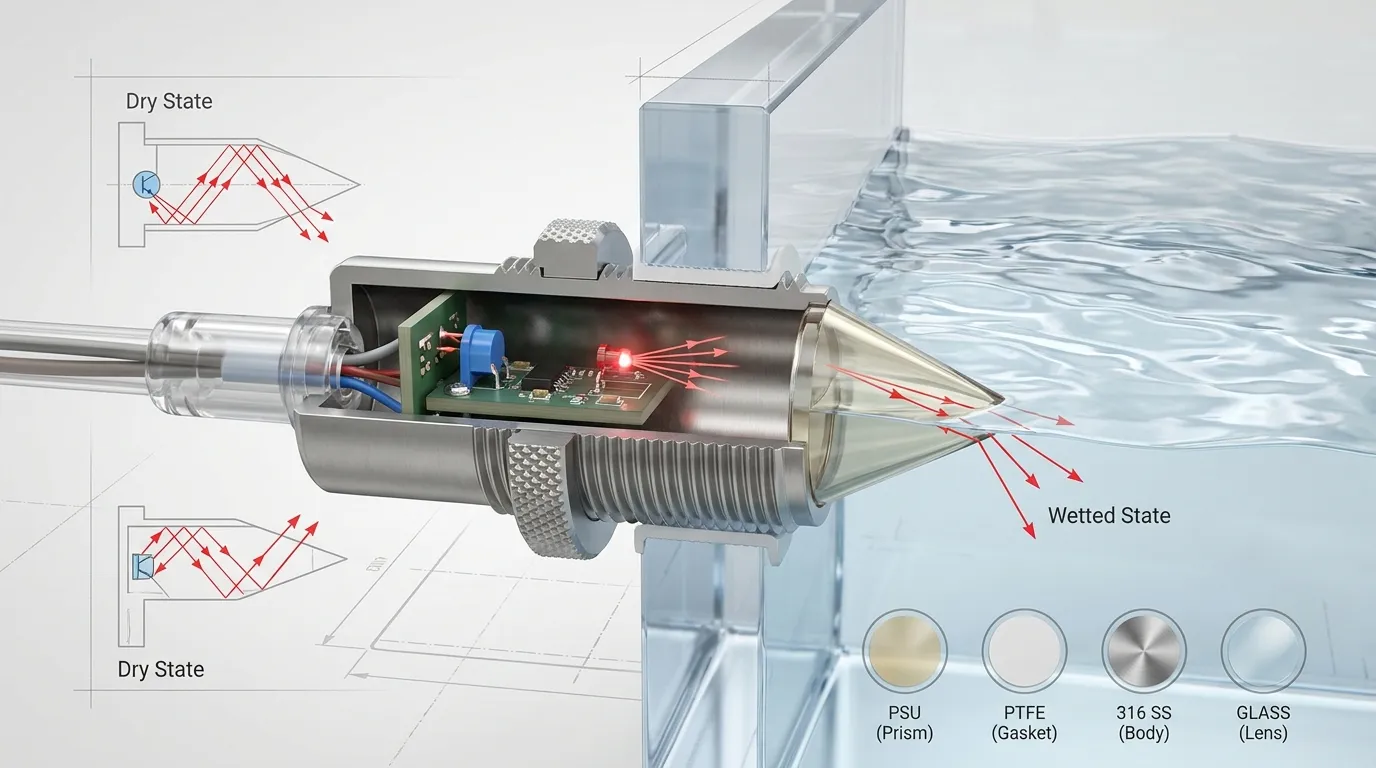
A typical photoelectric optical sensor uses an infrared LED, a phototransistor, and a prism sensing tip. In air, infrared light reflects internally inside the prism and returns to the receiver. When the prism is wetted by liquid, the refractive condition changes, less light returns, and the sensor switches output state. This dry/wet detection is fast, compact, and has no moving float mechanism.
That working principle is very effective in clean water tanks, dosing reservoirs, condensate trays, coolant tanks, small pump chambers, and overflow alarm positions. It is less suitable for a deep groundwater well where the sensor may face mud, biofilm, iron deposits, sediment, cable strain, difficult maintenance, and a long submerged installation.
So the honest answer is simple: use optical sensors for groundwater system alarms around the tank, sump, or pump skid; use pressure or logging instruments for continuous borehole level data.
Where Optical Sensors Help in a Groundwater System
Groundwater monitoring is not only the borehole. A complete system may include a well, submersible pump, pipeline, storage tank, treatment tank, sump, control panel, and telemetry gateway. Optical level sensors can add value in several of these supporting points.
Clean Storage Tank High-Level or Low-Level Alarm
After groundwater is pumped from a well into a clean storage tank, an optical point sensor can detect a high-level limit, overflow risk, or low-level condition. This is a much better fit than placing the same sensor deep inside a dirty borehole.
For example, a prism-tip optical switch mounted through a tank wall can provide a simple “tank full” signal to a controller. A second sensor near the bottom can provide a “low water” signal to protect a transfer pump.
For this kind of clean tank application, a compact optical level sensor is often practical because it has no float arm, responds quickly, and can fit into small tank designs.
Pump Dry-Run Protection in a Chamber or Small Reservoir
If a groundwater system fills a small buffer chamber before pumping to another process, an optical point sensor can confirm whether liquid is present at the pump intake level. If the chamber runs dry, the controller can stop the pump before damage occurs.
This is different from measuring the full well depth. The optical sensor is not trying to map the water table. It is simply confirming wet or dry at one safety point.
Sump High-Level Alarm
Groundwater pump rooms and underground utility areas sometimes include sumps. In a relatively clean sump, an optical point switch can act as a compact high-level alarm. However, if the sump contains sludge, oil, mud, algae, or heavy scaling, a float switch, pressure sensor, or other robust device may be more appropriate.
Through-Wall Detection for Non-Contact Alarm Points
Some applications need liquid detection without a wetted probe inside the container. In selected clear or translucent tank materials, non-contact sensing can detect liquid through the wall. This can reduce contamination risk and simplify cleaning.
This approach is useful for clean water reservoirs, small equipment tanks, and controlled indoor systems. It is not a solution for opaque steel borehole casing or deep well measurement.
Where Pressure, Ultrasonic, and Radar Sensors Win
For groundwater level measurement inside wells and boreholes, the most common requirement is continuous depth data. Operators want to know whether the groundwater level is rising, falling, recovering after pumping, or changing seasonally. A single optical point switch cannot provide that trend.
Pressure Transducers for Boreholes
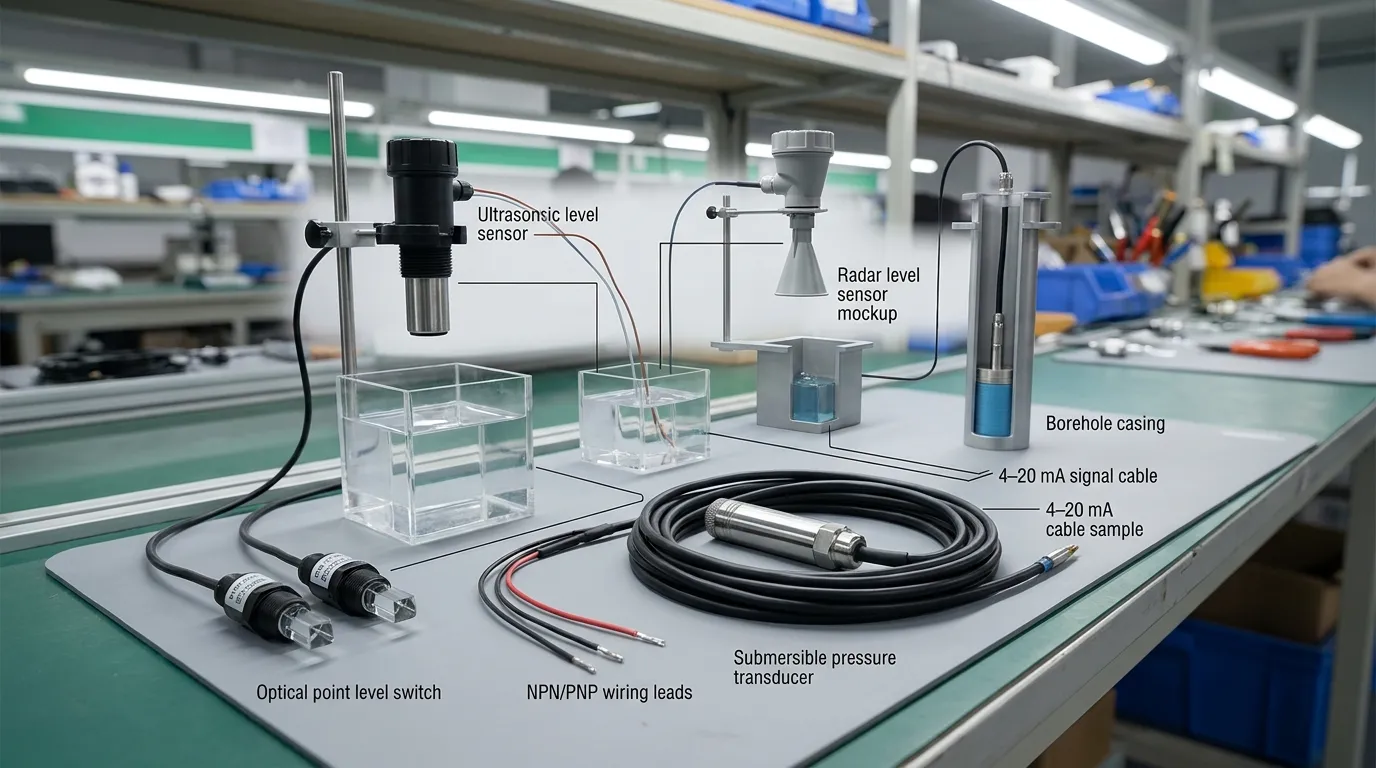
A submersible pressure transducer measures water pressure above the sensor. Because pressure increases with water column height, the system can calculate level. This makes pressure sensing a strong choice for boreholes, narrow wells, and long-term groundwater monitoring.
Pressure sensors still require correct range selection, cable planning, barometric compensation where needed, and periodic verification. But for submerged continuous well measurement, they are normally more suitable than optical point switches.
Water Level Loggers for Long-Term Data
A water level logger combines a sensor, memory, and power source to record readings over time. It is useful for groundwater studies, pumping tests, seasonal monitoring, aquifer observation, and remote sites where manual readings are expensive.
If the project requires trend charts, historical data, or compliance-style records, a logger or pressure-based telemetry system is usually the right direction.
Ultrasonic Sensors for Open Tanks and Channels
Ultrasonic sensors measure distance by sending sound waves and reading the echo from the water surface. They are non-contact, so they can be useful above open tanks, reservoirs, and channels.
However, a narrow borehole can create poor echoes, reflections from the casing, condensation problems, and installation challenges. Ultrasonic sensing can work well in the right geometry, but it is not automatically suitable for every well.
Radar Sensors for Harsh Non-Contact Measurement
Radar level sensors also measure from above the surface, but they are generally more robust than ultrasonic sensors in some difficult conditions such as vapor, temperature variation, or outdoor exposure. They may be selected for tanks, reservoirs, and certain surface-water or industrial monitoring points.
For deep boreholes, the same question remains: is there a clean path to the water surface, and does the casing geometry support stable measurement? If not, pressure measurement may still be the better choice.
Groundwater Level Monitoring Method Comparison
| Method | Best use in groundwater systems | Strengths | Limitations | Honest recommendation |
|---|---|---|---|---|
| Optical point level switch | Clean storage tank, sump alarm, pump dry-run point, overflow detection | Compact, fast response, no moving parts, simple wet/dry output | Point detection only, prism can foul, not designed for deep dirty boreholes | Use for alarm and protection points around the groundwater system, not as the main borehole level instrument |
| Optical continuous level sensor | Clean or controlled tanks requiring more than one point reading | Can support continuous level indication in suitable tanks | Application-dependent; still sensitive to installation and liquid condition | Consider for clean tank-level control, not muddy well deployment |
| Submersible pressure transducer | Boreholes, wells, groundwater depth measurement | Continuous measurement, works below the water surface, good for narrow wells | Needs correct pressure range, installation depth, cable protection, compensation, verification | Best default choice for many borehole monitoring projects |
| Water level logger | Long-term groundwater observation and trend recording | Stores data over time, useful for remote monitoring and studies | Requires retrieval or telemetry plan, battery/data management | Best when historical data matters |
| Ultrasonic level sensor | Open tanks, reservoirs, channels, some accessible wells | Non-contact, easy top mounting in suitable spaces | Echo issues in narrow casings, foam, condensation, obstructions | Good for open surface measurement, less reliable in many boreholes |
| Radar level sensor | Outdoor tanks, reservoirs, harsh non-contact measurement | Non-contact, stronger performance than ultrasonic in some environments | Higher cost and setup complexity; geometry still matters | Good for harsh non-contact applications when budget allows |
| Manual water level meter | Field checks and calibration reference | Simple, direct, trusted spot measurement | Not continuous, labor required | Use for verification even when automated sensors are installed |
Fouling: The Main Risk for Optical Sensors in Well Water
Optical sensors depend on a clean optical path at the prism tip. If mud, biofilm, algae, iron deposits, scale, oil film, or suspended solids coat the prism, the sensor may misread the wet or dry state.
This is why the liquid condition matters more than the word “water.” Clean process water and dirty groundwater behave very differently for optical sensing. A clear tank may be excellent. A borehole with sediment and mineral buildup may create maintenance problems.
Common optical failure modes include:
- Prism coating that makes the sensor think it is always wet
- Air bubbles trapped around the sensing tip
- Condensation or droplets causing false wet detection
- Sediment buildup around the mounting point
- Incorrect orientation that traps debris
- Chemical incompatibility with the sensor body
- Cable sealing problems in wet environments
- Wrong output type for the controller input
For buyers, the key question is not “Can it detect water?” The better question is: “Will the sensing tip stay clean enough in my installation to detect reliably for the required maintenance interval?”
Depth and Installation: Why Boreholes Are Different
A borehole is not just a tall tank. It may have a narrow casing, long cable runs, a submersible pump, changing water levels, turbulence during pumping, sediment at the bottom, and limited access for cleaning.
An optical point sensor installed deep in a well creates practical issues. How will the cable be supported? How will the sensor be removed for cleaning? Will the prism be exposed to sediment? Is the target only one alarm point, or is continuous level required? Can the controller interpret a single wet/dry signal in a useful way?
If the purpose is “alert me when the water drops below a critical pump-protection point,” an optical point switch may be considered in a clean, accessible chamber. If the purpose is “monitor groundwater level over time,” choose a continuous method.
For controlled tanks where continuous optical-style detection is needed, HojellyTek can discuss continuous level sensing options, but the application should be reviewed carefully before applying it to any groundwater-related system.
Accuracy: Point Detection Is Not the Same as Level Measurement
Accuracy depends on the measurement goal.
An optical point switch gives a repeatable switching position when the liquid reaches the prism. In a clean tank, that can be accurate enough for a high-level alarm or pump stop signal. But it does not measure the distance from ground surface to water table. It also does not show gradual drawdown or recovery.
Pressure transducers and loggers are better for continuous level accuracy, but they also need correct installation. Buyers should consider pressure range, sensor placement, water density assumptions, temperature effects, barometric compensation, cable movement, drift, and manual reference checks.
In practical terms:
- Use optical when you need a reliable yes/no liquid presence signal at one position.
- Use pressure/logging when you need continuous groundwater level data.
- Use ultrasonic or radar when non-contact surface measurement is possible and the geometry supports stable readings.
- Use manual measurement to verify automated systems, especially in important monitoring projects.
Telemetry and Remote Monitoring Considerations
Many groundwater projects are remote. The sensor is only one part of the system. You may also need a controller, data logger, power supply, battery, solar input, enclosure, signal cable, and communication device.
Optical point switches typically connect to control systems using discrete outputs such as NPN or PNP. Some level systems may use analog outputs such as 4–20 mA when continuous measurement is required. The right choice depends on whether the controller needs a simple alarm or a live level value.
For remote monitoring, common options include local data logging, RS485 connection, 4–20 mA input to a PLC, LoRa-based telemetry, cellular gateway, or cloud platform. Tuya or Smart Life-style connectivity may be relevant for small smart monitoring projects, but industrial groundwater systems usually need stronger attention to enclosure protection, power stability, data reliability, and service access.
Before ordering any sensor, define the signal path from sensing point to decision point: sensor output, cable length, controller input, alarm logic, power source, enclosure, and remote notification method.
Material and Mounting Choices for Optical Sensors
In clean tank or sump applications, the sensor body and prism material must match the liquid, temperature, cleaning method, and mounting structure.
Common material options include PSU plastic for general clean-water applications, PTFE for stronger chemical resistance, 316 stainless steel for rugged industrial mounting, and glass for selected optical or high-compatibility requirements. The best choice depends on the actual water quality, additives, disinfectants, cleaning chemicals, and mechanical load.
Mounting also matters. Optical level switches may use threaded installation, compact panel mounting, or custom housings. Thread size, sealing method, cable direction, sensor orientation, wall thickness, and access for cleaning should be confirmed before production. For tank applications, the buyer should also decide whether the sensor detects high level, low level, overflow, or dry-run protection.
HojellyTek is a Shenzhen manufacturer and exporter focused on photoelectric optical sensing, with in-house R&D and OEM/ODM support for sensor body, output logic, wiring, material, and mounting customization.
What Buyers Should Confirm Before Selecting a Sensor
For groundwater and well-related projects, do not start with the sensor type. Start with the measurement job.
Confirm these points before choosing optical, pressure, ultrasonic, or radar:
- Is the measurement point inside a deep borehole, open tank, closed tank, sump, or pump chamber?
- Do you need point detection or continuous level data?
- Is the water clean, turbid, muddy, mineral-rich, oily, or biologically active?
- What is the maximum depth or level range?
- Is the sensor easy to remove and clean?
- What output does the control system accept: NPN, PNP, relay, RS485, or 4–20 mA?
- Is the installation indoor, outdoor, submerged, or exposed to flooding?
- Is remote telemetry required?
- How often can the system be inspected or maintained?
- Is this for alarm, control, research data, compliance, or pump protection?
If the answer points to a deep well with changing water levels, choose a pressure transducer or logger. If the answer points to a clean tank alarm in the groundwater system, an optical point switch may be the simpler and more compact choice.
Where HojellyTek Fits
HojellyTek should not be positioned as a deep borehole logger supplier if the application really needs pressure-based groundwater instrumentation. The better fit is optical sensing around groundwater handling systems: clean storage tanks, small reservoirs, pump protection points, overflow alarms, sump alerts, and OEM equipment that needs compact wet/dry detection.
As a Shenzhen optical liquid level sensor manufacturer, we support photoelectric point-level detection, material selection, NPN/PNP output configuration, custom wiring, and OEM/ODM design for export projects in the US, EU, India, and other markets.
For borehole monitoring, our team can also help buyers clarify whether optical sensing belongs in the system at all—or whether the main level device should be pressure, ultrasonic, radar, or a logger.
FAQ
Are optical sensors for groundwater level monitoring suitable for deep wells?
Usually not as the primary measuring device. Optical point switches detect wet or dry at one fixed location, while deep wells usually need continuous level data. For boreholes, pressure transducers or water level loggers are normally better choices.
Can an optical level sensor be used in a groundwater tank?
Yes. If groundwater is pumped into a clean storage tank, an optical level sensor can be used for high-level alarm, low-level alarm, overflow prevention, or pump dry-run protection.
Why do optical sensors fail in dirty groundwater?
The prism sensing tip must stay optically clear. Mud, iron deposits, biofilm, algae, scale, or oil film can coat the prism and cause false switching. Dirty or hard-to-clean wells increase this risk.
What is the best sensor for continuous borehole water level monitoring?
A submersible pressure transducer or water level logger is usually the best starting point for continuous borehole monitoring. These devices are designed to measure water column change over time.
Is ultrasonic sensing better than optical sensing for wells?
It depends on the installation. Ultrasonic sensors can work for open tanks and some accessible water surfaces, but narrow boreholes can create echo problems. Optical sensors are better for point detection in clean tanks, not distance measurement in deep wells.
What information should I send for a sensor recommendation?
Send the installation type, water condition, depth or tank size, required output, power supply, mounting method, cable length, control system, and whether you need point alarm or continuous data. For optical tank or sump applications, request a quote via WhatsApp or email with drawings or photos if available.


