
Optical Level Sensors for Liquid Nitrogen: What Works
If you are searching for an optical level sensor for liquid nitrogen, the first thing to know is this: a standard photoelectric optical liquid level sensor is usually not suitable for direct LN2 service at -196C. Liquid nitrogen is a cryogenic fluid, and its temperature, boil-off behavior, icing risk, and safety requirements are far beyond normal water, oil, coolant, fuel, or chemical tank applications.
This guide explains where conventional optical sensors fail, what technologies are actually used for LN2 level measurement, and where HojellyTek genuinely fits as a manufacturer of optical and photoelectric liquid level sensors.
The Honest Answer: Standard Optical Level Sensors Are Not LN2 Sensors
Most compact photoelectric optical level switches are built for point level detection in normal industrial liquids. They use an infrared LED, a phototransistor or receiver, and a clear prism sensing tip. When the prism is dry, light reflects internally inside the tip. When liquid covers the prism, the refractive condition changes and less light returns to the receiver. The electronics convert that optical change into an output signal, commonly NPN, PNP, or a digital switch signal.
That principle works well for many clean liquids, including water, coolant, low-viscosity oils, and certain chemicals. It is why optical sensing is popular for compact tanks, pump protection, overflow detection, and small equipment reservoirs. You can learn more about normal-temperature optical level sensor applications on our main guide.
Liquid nitrogen is different. At -196C, the problem is not only whether the light path can detect a liquid. The bigger questions are whether the housing, prism, seal, cable, adhesive, potting material, electronics, and mounting interface can survive cryogenic shock and repeated thermal cycling. For a standard photoelectric optical switch, the answer is usually no unless the entire assembly is specifically designed and rated for cryogenic service.
Why Photoelectric Optical Sensors Fail in Liquid Nitrogen
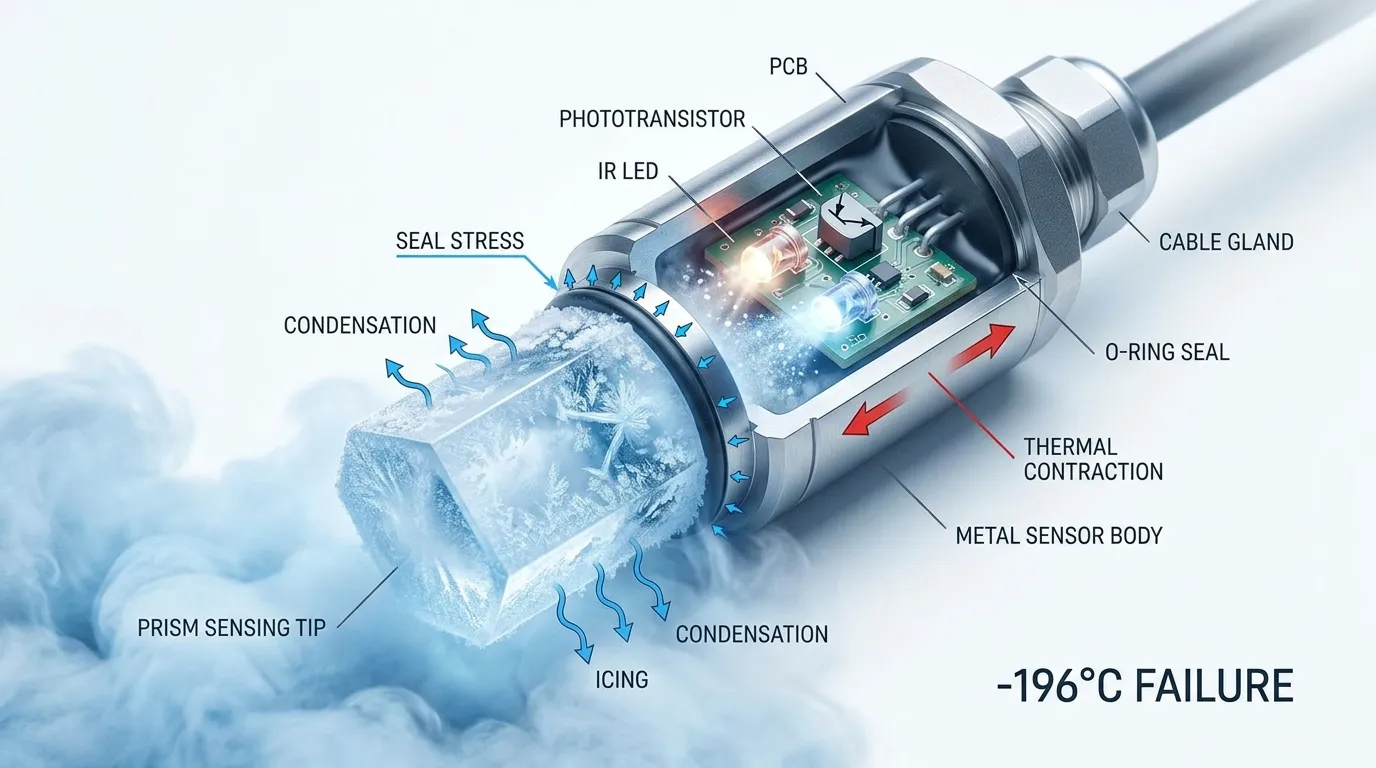
A standard optical level sensor may look simple from the outside, but cryogenic service stresses every part of the device.
Thermal Shock Can Crack or Deform the Sensing Tip
The optical prism is often made from plastic, glass, or a transparent engineered material. In normal liquid sensing, the prism only needs to handle moderate temperature, chemical compatibility, and pressure conditions. In liquid nitrogen, the sudden temperature drop can cause severe contraction. If the prism, metal body, seal, and cable gland contract at different rates, stress builds at the joints.
Glass may offer good optical clarity and chemical resistance, and a glass optical sensor can be useful for selected non-cryogenic liquids. But glass alone does not make a sensor suitable for LN2. The full construction, sealing method, cable, and electronics must all be cryogenic-rated.
Seals and Potting Materials May Become Brittle
Many compact optical sensors rely on O-rings, epoxy, molded plastics, or internal sealing compounds. At cryogenic temperatures, ordinary elastomers can harden, shrink, crack, or lose sealing force. Once a seal fails, moisture ingress, vapor leakage, or mechanical loosening can damage the sensor.
Electronics Are Not Designed for -196C
Photoelectric sensors contain an IR emitter, receiver, PCB, solder joints, and signal-conditioning electronics. Even if the sensing tip touches the liquid while the electronics remain outside the tank, cold conduction through the body can still create thermal stress. If the electronics are exposed to extreme cold, output stability and lifetime become unreliable.
Cable Jackets and Wiring Can Stiffen or Crack
Buyers often focus on the sensing tip and forget the cable. Standard PVC, rubber, or general-purpose cable jackets may become rigid in cryogenic environments. Movement, vibration, or installation stress can then cause cracking or conductor damage.
Condensation and Icing Can Create False Signals
Liquid nitrogen cools surrounding air and surfaces. Moisture can condense and freeze around the sensor body, prism, cable entry, and mounting port. For an optical sensor, frost on the prism is especially problematic because the sensor depends on a clean optical interface. Ice, vapor, bubbles, and frost can all disturb the light path and cause false wet/dry readings.
What Is Actually Used for Liquid Nitrogen Level Measurement?
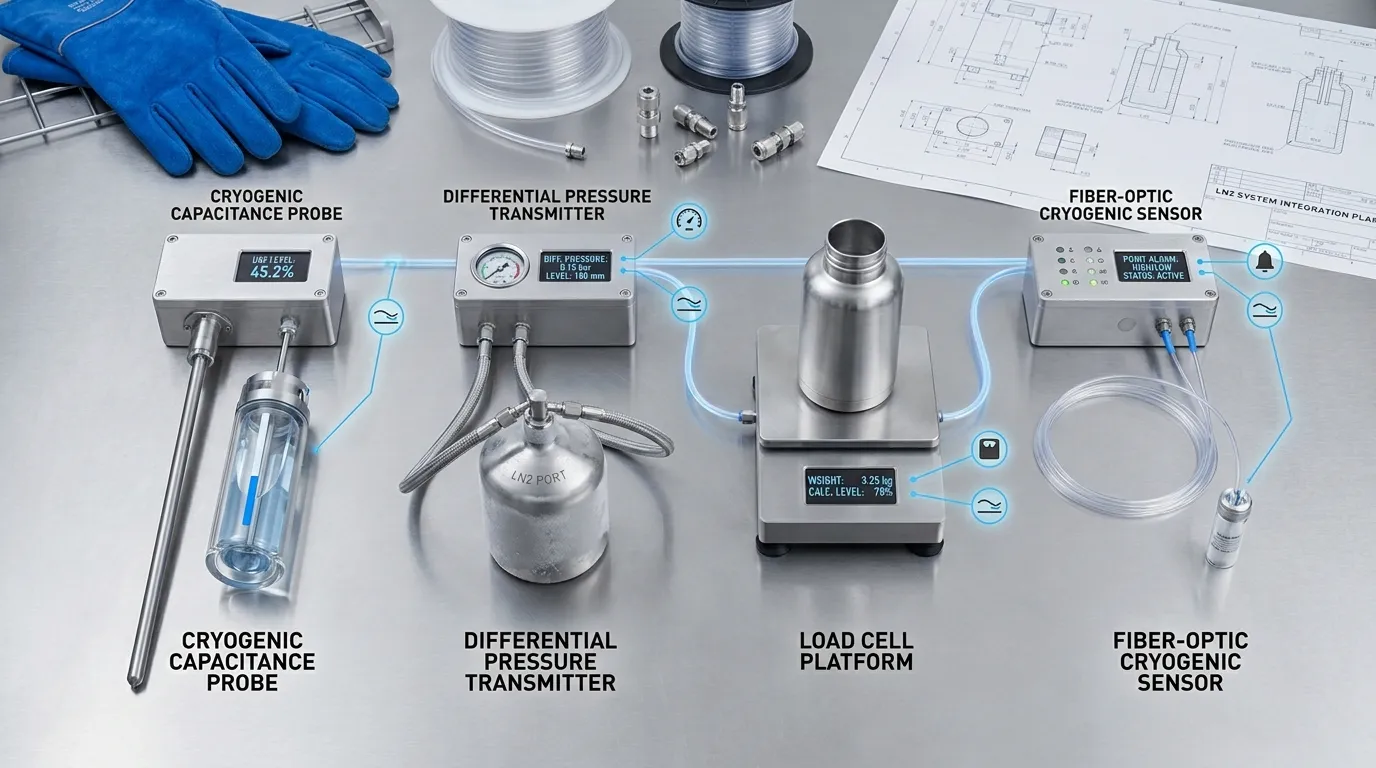
For LN2 tanks, dewars, laboratory cryostats, and industrial cryogenic storage, engineers usually choose technologies designed for cryogenic service. The right option depends on tank size, whether the vessel is open or pressurized, required accuracy, access points, safety requirements, and whether continuous or point level measurement is needed.
| Cryogenic Level Option | Best Fit | Strengths | Limitations | LN2 Suitability |
|---|---|---|---|---|
| Cryogenic capacitance probe | Continuous LN2 level in dewars and cryogenic vessels | Common for cryogenic liquids, no moving parts, can provide continuous reading | Must be designed for LN2 dielectric behavior, probe length, vessel geometry, and cryogenic insulation | Strong option when cryogenic-rated |
| Differential pressure measurement | Pressurized or engineered tanks with proper tapping points | Familiar industrial method, can connect to control systems | Requires correct cryogenic installation, impulse line management, density compensation, and safe pressure design | Suitable only with cryogenic-rated components |
| Load cell or weighing system | Portable dewars, supply cylinders, non-invasive monitoring | Measures remaining mass without internal probe contact | Needs stable mounting and tare setup; not direct level inside the vessel | Good option where weight-based inventory is acceptable |
| Cryogenic-rated point level switch | High/low alarm points | Simple alarm function when certified for the temperature and vessel | Not continuous; must be specifically rated for LN2 | Suitable if fully cryogenic-rated |
| Specialty fiber-optic cryogenic sensor | Research, aerospace, or specialized cryogenic systems | Remote optical measurement, no electrical signal at sensing tip in some designs | Not the same as a standard prism photoelectric switch; requires specialized engineering | Possible with dedicated cryogenic design |
| Manual dipstick or visual gauge | Small lab use or backup verification | Simple, low electronics dependency | Manual, less automation-friendly, safety-dependent | Useful as a backup method |
Capacitance Sensors: A Common LN2 Choice
Cryogenic capacitance probes are widely used because liquid nitrogen and vapor have different dielectric properties. As the liquid level rises or falls along the probe, the measured capacitance changes. With correct calibration, the system can report continuous level.
This is different from a compact optical point switch. A capacitance probe is typically designed as a long sensing element that extends into the vessel. Materials, insulation, feedthroughs, and electronics must be selected for cryogenic use. The buyer should confirm probe length, tank geometry, dielectric calibration, pressure rating, mounting style, and whether the electronics are remote from the cold zone.
Differential Pressure: Useful, But Installation-Sensitive
Differential pressure can measure level by comparing pressure at two points and relating that pressure difference to liquid head. For cryogenic liquids, this is not a simple “install any pressure sensor” application. LN2 boil-off, density changes, thermal gradients, frozen moisture, and pressure relief design all matter.
DP can work in engineered cryogenic tanks when the tapping points, impulse lines, seals, transmitters, and installation procedure are designed for cryogenic service. Poor installation can create unstable readings, blocked lines, or unsafe conditions.
Fiber-Optic Sensing: Possible, But Not the Same as Standard Optical Sensors
The phrase “optical level sensor” can be confusing in cryogenic discussions. A standard photoelectric prism switch is one type of optical sensor. A specialized fiber-optic cryogenic level system is another.
A fiber-optic level sensor may use optical fibers, light transmission, reflection, or changes in optical properties to detect level. Some advanced cryogenic systems use fiber-based sensing because optical fibers can move the measurement signal away from electrical components at the cold point. However, cryogenic fiber-optic measurement requires purpose-built materials, feedthroughs, calibration, and mechanical design. It should not be treated as interchangeable with a normal plastic or metal-body optical level switch.
Material and Mounting Checks Before Any LN2 Project
For normal optical liquid level sensors, buyers may choose PSU, PTFE, 316 stainless steel, or glass depending on chemical compatibility, temperature, pressure, and hygiene requirements. For LN2, ordinary material compatibility is not enough. The buyer must check cryogenic behavior.
Key checks include:
- Whether the sensor body is rated for direct or indirect contact with LN2
- Whether seals remain flexible and leak-tight at cryogenic temperature
- Whether the prism or optical window survives thermal shock
- Whether the cable jacket stays usable in cold environments
- Whether the electronics are isolated from the cryogenic zone
- Whether the mounting thread, flange, or feedthrough is designed for contraction
- Whether the vessel is open, vacuum-jacketed, insulated, or pressurized
- Whether the sensor is for point alarm or continuous measurement
- Whether the output must be NPN, PNP, relay, analog, or 4–20 mA
Thread and mounting style also matter. In standard optical level switches, buyers may specify threaded mounting, side-wall installation, top installation, gasket sealing, or compact tank mounting. For LN2, the port design must also consider boil-off gas, icing, safe venting, and thermal isolation. Never modify a cryogenic vessel without qualified engineering review.
For applications that need continuous monitoring in normal liquids, not LN2, our continuous level sensing information may be more relevant.
Condensation, Frost, and Safety Are Not Minor Details
Liquid nitrogen can rapidly cool nearby surfaces and condense moisture from the air. Frost buildup can block visibility, interfere with mechanical parts, and disturb optical sensing. In open or poorly controlled areas, oxygen can also condense on very cold surfaces, creating additional hazards.
The larger safety issue is oxygen displacement. Nitrogen gas is colorless and odorless. As LN2 boils off, it can displace oxygen in enclosed spaces and create an asphyxiation risk. Any LN2 level measurement project should consider ventilation, oxygen monitoring, pressure relief, PPE, training, and safe handling procedures. Sensor selection is only one part of the safety design.
Where HojellyTek Genuinely Fits
HojellyTek is a Shenzhen manufacturer and exporter focused on photoelectric optical sensing, optical liquid level switches, customized sensor structures, and OEM/ODM support for normal industrial liquid applications. Our in-house R&D team works on compact optical detection, wetted material selection, NPN/PNP output matching, mounting customization, and sensor integration for equipment manufacturers. We export to markets including the US, EU, and India.
For direct liquid nitrogen measurement, we do not recommend positioning a standard HojellyTek photoelectric optical sensor as an LN2-rated probe. That would be the wrong application unless a sensor has been specifically engineered and validated for cryogenic service.
Where we can help is in adjacent, realistic applications: normal-temperature liquid tanks, coolant reservoirs, water and oil detection, compact equipment level switches, non-cryogenic laboratory devices, and OEM designs where optical sensing is genuinely suitable. For smart device ecosystems, Tuya or Smart Life integration may be relevant in selected non-cryogenic monitoring projects, but not as a shortcut for LN2 safety-critical measurement.
FAQ
Can I use an optical level sensor for liquid nitrogen?
A standard optical level sensor for liquid nitrogen is usually not appropriate unless the full sensor assembly is specifically rated for -196C cryogenic service. Most compact photoelectric prism sensors are designed for normal industrial liquids, not direct LN2 contact.
Why does a normal photoelectric sensor fail in LN2?
The main risks are thermal shock, cracked prisms, brittle seals, cable damage, electronics instability, condensation, icing, and mechanical stress from rapid contraction. The optical detection principle may be simple, but the physical construction is not designed for cryogenic exposure.
What level sensor works best for liquid nitrogen?
Common choices include cryogenic capacitance probes, differential pressure systems with cryogenic-rated components, load cell weighing systems, and specialty cryogenic point level switches. The best method depends on the vessel design, accuracy needs, safety requirements, and whether continuous or point level detection is required.
Can glass optical sensors measure liquid nitrogen?
Not automatically. Glass can handle some demanding liquids, but a glass optical tip alone does not make the full sensor LN2-rated. Seals, housing, cable, electronics, thermal shock resistance, and mounting design must all be validated for cryogenic use.
Is fiber-optic sensing suitable for LN2?
Specialized fiber-optic cryogenic sensors can be used in some advanced applications, but they are not the same as standard compact optical prism switches. A cryogenic fiber-optic solution must be designed around LN2 temperature, feedthroughs, calibration, and mechanical protection.
What should I tell a supplier before choosing an LN2 level sensor?
Share the liquid, temperature, tank type, pressure condition, level range, mounting port, required output, safety classification, installation environment, and whether you need continuous measurement or only high/low alarm points. For LN2, also confirm ventilation, pressure relief, icing risk, and cryogenic material compatibility.
Need Help Choosing the Right Sensor Type?
If your project involves liquid nitrogen, start with a cryogenic-rated sensing technology rather than a standard optical switch. If your project is for water, oil, coolant, fuel, or other normal-temperature liquids, HojellyTek can help review optical sensor feasibility, output type, wetted material, mounting style, and OEM/ODM customization. Contact us by WhatsApp or email to request a quote or discuss the right sensing approach for your application.


