
Rugged Electro-Optic Level Sensor
Our rugged electro-optic level sensor service helps buyers select the right sensing tip, housing, sealing method, cable design, output type and protection features before ordering samples or production units.
Rugged Optical Level Sensor Capabilities
HojellyTek designs and supplies optical liquid level sensors based on photoelectric sensing. Inside the sensor, an infrared LED sends light into a prism tip, and a phototransistor receives the reflected signal. In air, the light reflects internally inside the prism. When liquid wets the prism, refraction changes and the receiver sees a different signal. The electronics then switch the output for dry or wetted state detection.
For a broader overview of standard models, see our optical level sensor page.
For rugged industrial service, we help configure:
- Point level detection for low-level, high-level, overflow or dry-run protection
- Rugged housing options for mobile tanks, industrial skids and equipment reservoirs
- Wetted material selection such as PSU, PTFE, 316 stainless steel or glass
- NPN, PNP and application-matched output configurations
- Cable, connector and strain-relief designs for vibration-prone equipment
- IP-rated sealing concepts for dust, splash, washdown or outdoor exposure
- Electrical protection planning, including over-voltage and reverse-polarity needs
- OEM/ODM customization for tank geometry, mounting thread and control board interface
Built for the Abuse Case: Vibration, Shock, Dust, Water and Rough Handling
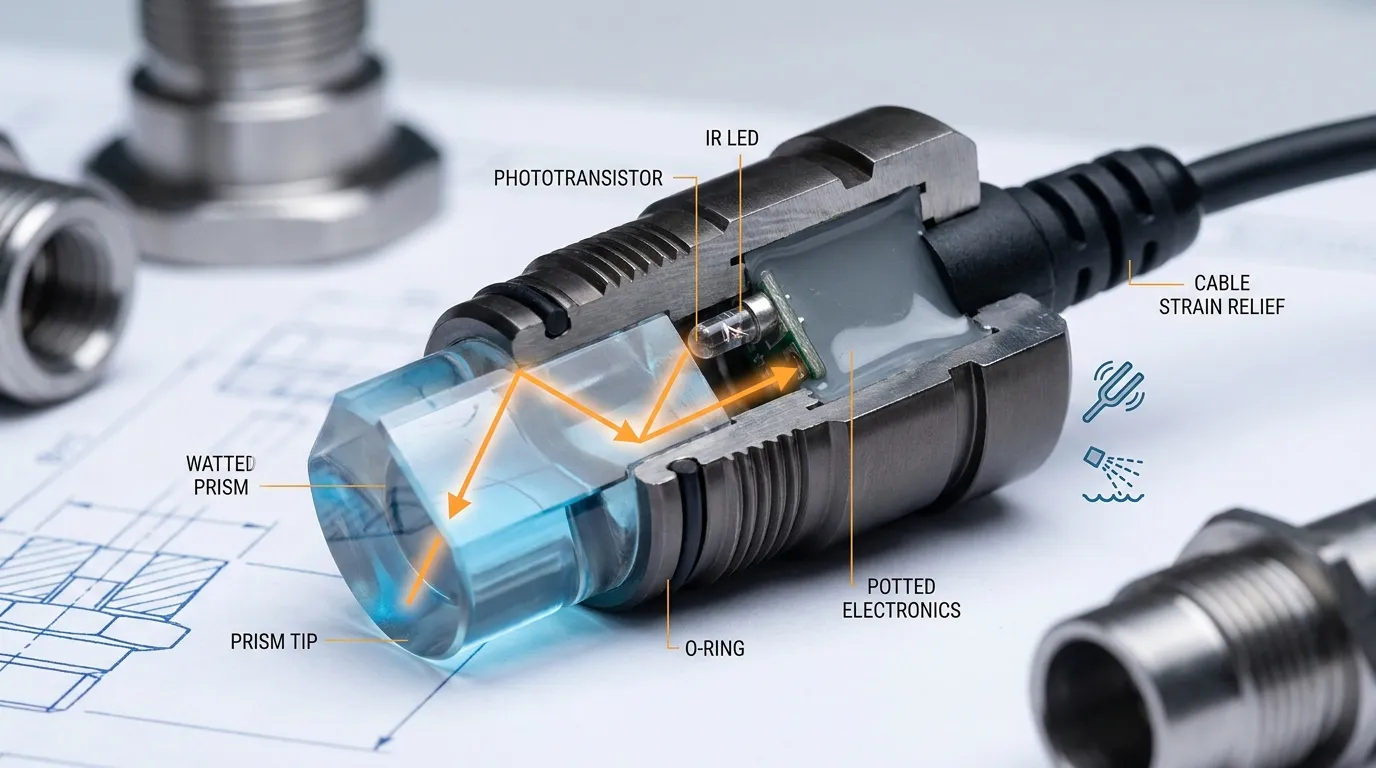
Harsh-duty level sensing is not only about detecting liquid. The sensor must survive the way the machine is used. Mobile equipment, industrial reservoirs, cleaning systems, construction machinery, coolant tanks and outdoor liquid containers all create different mechanical and environmental stress.
A normal sensor may work on a clean test bench but fail after cable pulling, vibration, washdown, thermal cycling or repeated service handling. For rugged electro-optic level sensors, the mechanical package matters as much as the sensing circuit.
Vibration and Shock Resistance
On mobile and industrial equipment, vibration can loosen threaded mounts, fatigue cable exits, damage internal solder joints or create intermittent electrical contact. A rugged design should consider the full load path from the tank wall to the sensing tip and cable.
Important design points include stable thread engagement, a secure body structure, internal potting or over-molding where required, and a cable exit that does not transfer every vibration directly into the internal electronics. The sensor should also avoid moving mechanical floats, because moving parts can chatter, stick or wear in vibrating tanks.
Dust and Water Ingress Protection
Dust, splash water and washdown exposure can attack the sensor through the cable exit, body joint, connector area or thread interface. For this reason, the IP rating should be selected based on the real duty condition, not only the brochure target.
A protected design may include sealed housing construction, O-ring or gasket planning, potted electronics, molded cable entry and correct mounting orientation. If the application involves outdoor tanks, cleaning cycles, road spray or dusty industrial areas, share that detail during the RFQ stage so the sealing approach can be matched correctly.
Housing and Potting Design
The housing is the first defense against impact, chemical exposure, rough handling and installation damage. Plastic bodies can be suitable for compact and cost-sensitive equipment. PTFE is useful where chemical resistance is a priority. 316 stainless steel is preferred when buyers need a more robust metal body, stronger mechanical protection or compatibility with demanding industrial fluids. For corrosive or sanitary-type material discussions, review our 316 stainless body option.
Potting helps protect electronics from moisture, vibration and handling stress. In rugged units, potting and sealing should be considered together with heat dissipation, repairability, cable flexibility and sensor size.
Cable Strain Relief and Connector Choices
Cable failure is one of the most common real-world problems in mobile and harsh-duty installations. A sensor may pass electrical testing, but fail later because the cable is bent sharply, pulled during maintenance or routed near moving equipment.
A rugged optical sensor should use a cable exit and strain-relief structure suitable for the installation. Buyers should confirm cable length, jacket material, bending route, connector type, wire gauge, shielding needs and whether the cable will face oil, water, abrasion or repeated movement.
Wide Temperature and Power Variation
Industrial equipment may see cold starts, hot reservoirs, engine-bay heat, outdoor seasonal change or unstable supply voltage. The operating temperature range should be confirmed against the actual liquid temperature, ambient temperature and tank wall temperature.
Electrical protection is also important. Over-voltage, reverse polarity, surge exposure and incorrect wiring can damage sensor electronics. During customization, our engineering team can review the control board input, supply voltage, output logic and protection requirements so the sensor can be matched to the machine instead of treated as a generic component.
For higher temperature applications, see our high-temperature sensor page.
Ruggedness Specification Table
| Ruggedness Item | What to Confirm | Why It Matters in Harsh Duty |
|---|---|---|
| IP rating target | Dust, splash, washdown, outdoor or immersion exposure | Prevents water or dust entry through body joints, cable exits and mounting points |
| Housing material | PSU, PTFE, 316 stainless steel, glass or custom body | Balances impact strength, chemical compatibility, temperature and cost |
| Potting / over-molding | Whether electronics need full or partial encapsulation | Helps resist moisture, vibration and shock-related internal failure |
| Cable strain relief | Cable exit style, bend direction, pull risk and routing | Reduces broken wires, intermittent signals and field service failures |
| Temperature range | Liquid, ambient and tank-wall temperature conditions | Avoids drift, seal damage or material mismatch under thermal cycling |
| Electrical protection | Over-voltage, reverse polarity, surge and wiring error risk | Protects sensor electronics in unstable industrial power systems |
| Output type | NPN, PNP, dry/wet logic or control-board interface | Ensures direct compatibility with PLCs, controllers or OEM electronics |
| Mounting thread | Thread size, tank wall thickness, sealing method and orientation | Prevents leakage, loose installation and incorrect prism positioning |
| Wetted material | Fluid type, additives, oil, coolant, water or chemical media | Prevents swelling, cracking, corrosion or optical tip contamination |
| Handling risk | Assembly line handling, field replacement and service access | Reduces breakage during installation and maintenance |
Duty Checklist Before Requesting a Quote
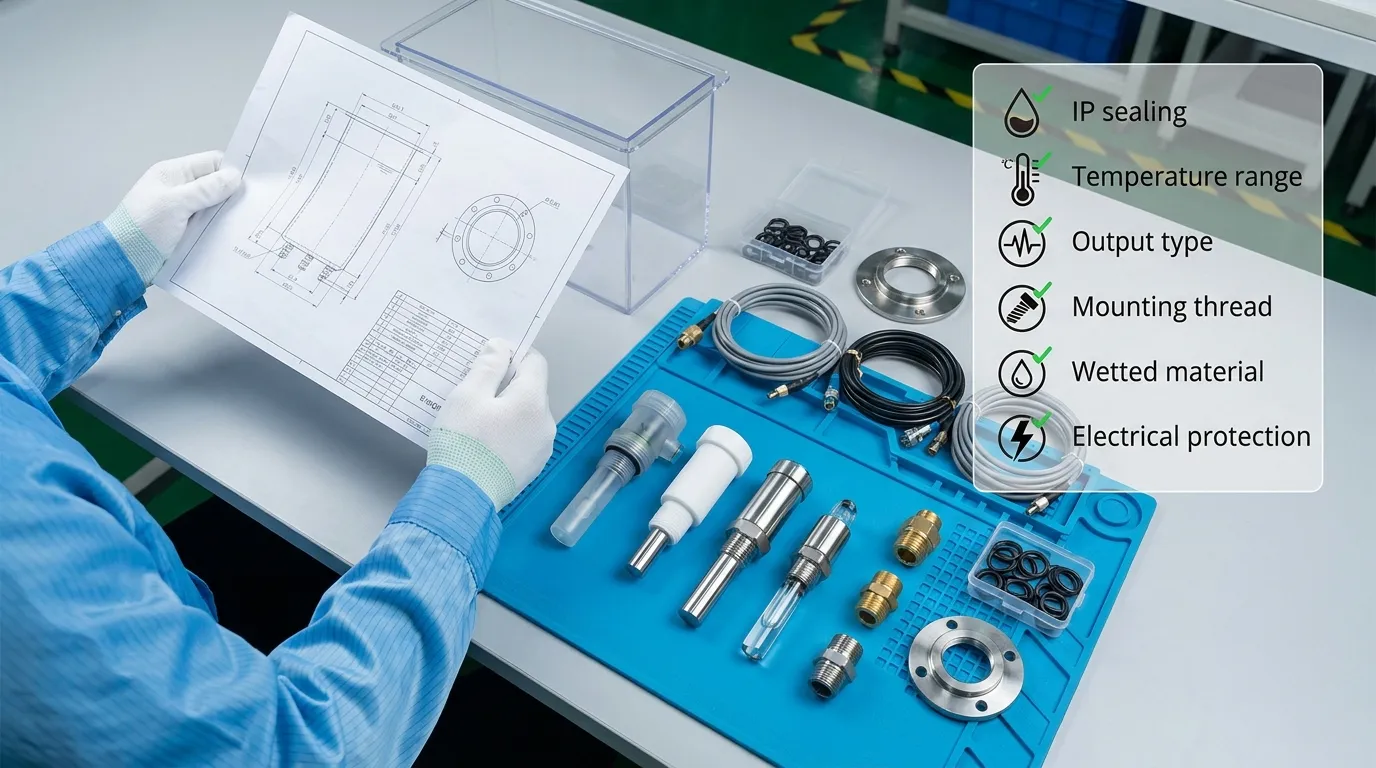
Before ordering a rugged optical level switch, prepare the following details:
- Equipment type: mobile machine, industrial tank, generator, cleaning system, coolant reservoir or OEM product.
- Liquid type: water, oil, coolant, fuel-related liquid, chemical mixture or interface media.
- Failure risk: vibration, shock, washdown, dust, cable pull, outdoor exposure or rough service handling.
- Mounting position: side mount, bottom mount, top entry, vertical tank wall or compact reservoir.
- Required switching point: low level, high level, overflow, dry-run protection or leak detection.
- Wetted material preference: plastic, PTFE, 316 stainless steel or glass.
- Output requirement: NPN, PNP, switching logic, signal direction or 4–20 mA requirement for related continuous monitoring projects.
- Power condition: supply voltage, controller input, over-voltage risk and wiring protection needs.
- Cable requirement: cable length, connector, jacket material, strain relief and routing direction.
- Environmental requirement: IP target, temperature range, dust/water exposure and service location.
5-Step Service Process
1. Enquiry Review
Send the liquid type, tank drawing, mounting direction, output requirement and working environment by WhatsApp or email. Our team checks whether a standard optical sensor, rugged custom version or alternative level sensing approach is the better fit.
2. Specification and Customization
We confirm material, thread, cable, output logic, sealing method and electrical protection needs. OEM/ODM changes can include housing shape, wire length, connector, sensing direction and control-board interface.
3. Sample Preparation
Samples can be prepared for fit testing, electrical testing and liquid detection checks. Buyers should test the sensor in the real tank where possible, especially when the equipment has vibration, foam, splashing or tight installation space.
4. Production and QC
Production is handled with in-house R&D support and photoelectric optical sensing experience. QC focuses on function, wiring, sealing structure, appearance, cable condition and customer-agreed configuration details.
5. Shipping and Export Support
HojellyTek is a Shenzhen manufacturer and exporter serving customers in the US, EU, India and other markets. Packaging and shipment details are confirmed based on order quantity and destination.
Requirements and Configuration Options
| Requirement | Common Options | Buying Note |
|---|---|---|
| Detection mode | Point level dry/wet switching | Best for low, high and overflow level detection |
| Output | NPN, PNP, customized signal interface | Match PLC or controller input before ordering |
| Continuous signal | 4–20 mA for related continuous level solutions | Confirm if you need point detection or continuous measurement |
| Body material | PSU, PTFE, 316 stainless steel, glass | Select by liquid, temperature and mechanical load |
| Mounting | Threaded, compact body or custom OEM fitting | Confirm tank wall thickness and sealing method |
| Cable | Custom length, jacket and connector | Choose based on vibration, oil, water and routing risk |
| Protection | IP-rated sealing and over-voltage planning | Confirm real exposure, not only indoor test conditions |
Rugged Optical Sensor vs Standard Float Switch
| Item | Rugged Electro-Optic Level Sensor | Mechanical Float Switch |
|---|---|---|
| Moving parts | No moving float; optical prism sensing | Uses a moving float or reed mechanism |
| Vibration performance | Better suited for compact vibrating equipment when properly mounted | Float movement can chatter or wear |
| Size | Compact sensing tip for small tanks | Often needs more tank clearance |
| Rough handling risk | Depends on housing, potting and cable relief | Float arm or moving parts may be damaged |
| Liquid detection | Fast dry/wet optical switching | Mechanical movement depends on buoyancy |
| Maintenance | Low mechanical wear | Can stick due to deposits, debris or viscosity |
Important Note for Hazardous-Area Buyers
This rugged service page does not claim hazardous-area or explosion-proof approval. If your project involves explosive gas, vapor, fuel storage zones or regulated Ex environments, please review the dedicated explosion-proof optical sensor page and share the required approval standard during enquiry.
Why Choose HojellyTek
HojellyTek combines Shenzhen manufacturing, in-house R&D and photoelectric optical sensing experience for OEM and industrial buyers. We support custom sensor bodies, cable assemblies, output logic and application-matched ruggedization instead of only supplying off-the-shelf parts.
For smart tank monitoring projects, our team can also discuss Tuya / Smart Life integration where relevant. For industrial OEMs, the main value is direct factory communication, practical customization and support from sample testing to batch production.
Rugged Electro-Optic Level Sensor FAQs
How does a rugged electro optic level sensor work?
It uses an IR LED, phototransistor and prism tip. In air, light reflects inside the prism. When liquid touches the prism, the light path changes, and the electronics switch the output to indicate wet or dry state.
Is an optical level sensor suitable for vibration?
Yes, it can be suitable because it has no moving float. However, the housing, mounting thread, potting, cable strain relief and wiring protection must be selected for the actual vibration and shock conditions.
Which housing material should I choose?
PSU is common for compact industrial designs, PTFE is useful for chemical resistance, 316 stainless steel supports stronger metal-body requirements, and glass can be used where optical or material compatibility makes sense. The liquid and duty cycle decide the best choice.
Can the sensor be used outdoors or in washdown areas?
It may be configured for dust and water exposure, but the IP rating, cable exit, connector, sealing method and mounting orientation must be confirmed before ordering. Share whether the sensor faces splash, washdown, rain, dust or immersion risk.
What output types are available?
Common choices include NPN and PNP switching outputs for point level detection. For projects needing continuous measurement or analog transmission, 4–20 mA requirements should be discussed separately so the correct sensor architecture is selected.
Can this page’s rugged sensor be used in explosion-proof areas?
Do not assume that. Rugged construction and hazardous-area approval are different requirements. For Ex or explosion-proof applications, use the dedicated explosion-proof optical sensor enquiry route and provide the required approval conditions.
Request a Rugged Sensor Quote
Send your tank drawing, liquid type, mounting position, cable requirement, output type, IP target, temperature condition and vibration/shock details. HojellyTek can review the duty case and recommend a rugged electro-optic level sensor configuration for sample testing or OEM production. Contact us by WhatsApp or email to request a quote.
