
The Best Wi-Fi Propane Tank Meters and Sensors (for Home, RV, & Business)
There are few things more frustrating than the "thud" of a furnace quitting on the coldest night of the year. Or the panic of shaking a frozen 20-pound tank, wondering if you have enough fuel to get through the BBQ.
Manual float gauges are notoriously inaccurate, often sticking at "20%" when you're really running on fumes. Running out of propane isn't just an inconvenience; it can mean an expensive, emergency service call to bleed your lines and restart your system.
The solution is a smart propane tank monitor. These Wi-Fi, Bluetooth, or Cellular sensors give you real-time, accurate propane levels directly on your smartphone.
But not all monitors are created equal. As someone who's installed and tested these sensors on everything from 20-lb grill tanks to 500-gallon home tanks, I've learned that the "best" monitor depends entirely on your setup. A sensor that's perfect for an RV is useless for a remote cabin.
This guide will cut through the confusion. We'll help you find the right monitor for your home, RV, or business. Most importantly, we’ll show you how to avoid the hidden subscription fees that most competitors won't talk about. This is all a key part of building a reliable smart propane tank monitoring system.
Before You Buy: The 3 Types of "Smart" Connectivity (Wi-Fi vs. Bluetooth vs. Cellular)
This is the single most critical decision you'll make, and it's where most people go wrong. You might be searching for "Wi-Fi propane tank meters," but that’s often not what you actually need.
Let's break down the technology.
Bluetooth Monitors (Best for RVs & Grills)
- How it Works: The sensor on your tank connects directly to your smartphone via Bluetooth.
- Range: This is for short-range only, typically 30 to 100 feet in an open area. You must be near the tank to get a reading.
- Pros: Almost always subscription-free. Easiest setup. Perfect for portable tanks.
- Cons: You cannot check your tank levels when you're away from home (e.g., at the office or on vacation).
Wi-Fi Monitors (Best for Homes with Good Wi-Fi)
- How it Works: The sensor (which is often still Bluetooth) talks to a small "bridge" device you plug in inside your house. That bridge connects to your home's 2.4 GHz Wi-Fi network, sending the data to the cloud.
- Range: As far as your Wi-Fi reaches.
- Pros: Lets you check your tank levels from anywhere in the world via the app.
- Cons: Useless if your tank is located out of your Wi-Fi's range. Setup is more complex, and a weak signal (through multiple walls) will cause constant dropouts.
Cellular (LTE) Monitors (Best for Remote Homes & Businesses)
- How it Works: The sensor has its own built-in 4G LTE cellular modem, just like your smartphone. It communicates directly with a cell tower to send data.
- Range: Anywhere you have a cell signal.
- Pros: The most reliable "set it and forget it" option. Perfect for remote properties, vacation homes, or tanks located hundreds of feet from the house.
- Cons: Almost always requires a monthly or annual subscription fee (this is how they pay for the cell service).
My Expert Takeaway: Here's my rule of thumb: Go stand next to your propane tank with your smartphone. Try to stream a YouTube video. If you can't, you don't have a strong enough Wi-Fi signal for a Wi-Fi monitor. You'll need a Cellular model.
Best Propane Tank Meters for Homeowners (100-1,000 Gallon Tanks)
For a primary residence, you have two main goals: reliability and remote access. You want to know your tank level from your couch or from your vacation condo. Your choice comes down to Wi-Fi vs. Cellular.
Top Pick (Wi-Fi): MoPEKA Pro Check Sensor + Wi-Fi Bridge
- Why it's #1: This setup gives you the best balance of features, accuracy, and cost, all without a mandatory subscription.
- Technology: This is an ultrasonic sensor that magnetically attaches to the bottom of your steel tank to measure the liquid level. It's incredibly accurate.
- Connectivity: The sensor itself is Bluetooth. You must also buy the MoPEKA Wi-Fi Bridge (a separate $50 plug) and place it inside your home, within Bluetooth range of the sensor and Wi-Fi range of your router. This "bridges" the sensor to your network.
- Pros:
- Extremely accurate readings (usually +/- 1%).
- No subscription fees.
- App is simple and can monitor multiple sensors.
- Works on 20-lb all the way up to 1,000-gallon ASME tanks.
- Cons:
- You have to buy two pieces of hardware (sensor + bridge).
- It's 100% dependent on your Wi-Fi signal reaching the tank.
Top Pick (Cellular): Generac 7009 LTE Propane Monitor
- Why it's #1 (Cellular): This is the most robust, hands-off solution for any home, especially remote ones or properties with Generac home standby generators.
- Technology: This monitor doesn't use ultrasound. It attaches directly to your tank's existing "Remote Ready" (R3D) dial. (You must check if your gauge has "R3D" printed on it).
- E-E-A-T (Trust): Let's be crystal clear about this product. This is the new, modern version of the old "TankUtility" monitor. Generac acquired TankUtility, and this new model is Cellular (LTE), not Wi-Fi.
- Pros:
- Extremely reliable. It just works, as long as you have a cell signal.
- Seamless integration with the Generac Mobile Link app (a must-have for generator owners).
- Cons:
- Requires a non-optional subscription. The first year is often included, but after that, expect to pay $50-$70 per year. This is the cost of convenience.
- It only works if your tank has a compatible R3D dial.
The "Supplier Monitor" Trap (e.g., Ferrellgas, Amerigas)
You've probably gotten an offer from your propane supplier for a "free" smart monitor and an "auto-fill" program. Sounds great, right?
Here's the catch: That "free" monitor is a cellular model that only works with their system. You're now locked into their service. You can't shop around for better propane prices because if you switch suppliers, they take their monitor back. It’s convenient, but that convenience almost always costs you more per-gallon in the long run.
Best Propane Tank Sensors for RVs, Grills, & Campers (20-40 lb Tanks)
For portable use, your needs are totally different. You don't need to check your tank from 1,000 miles away. You need to check it from your driver's seat or kitchen. Portability and simplicity are king, which makes Bluetooth the clear winner.
Top Pick: MoPEKA Pro Check (Standard Bluetooth Sensor)
- Why it's #1: It’s the undisputed industry standard for RVers, and for good reason. It's rugged, accurate, and just works. (Note: This is the same sensor as the homeowner pick, just used without the Wi-Fi bridge).
- Technology: An ultrasonic sensor that magnetically sticks to the bottom of your 20, 30, or 40-lb DOT tanks.
- Connectivity: Bluetooth. You just open the app on your phone when you're within 50-100 feet of the RV.
- Pros:
- The app can monitor multiple tanks, making it perfect for dual-tank RV setups.
- Highly accurate—no more shaking the tank.
- Long battery life (3-5 years on a CR2032).
- Rugged and waterproof (IP44 rated).
- Comes with small plastic spacers to create an air gap under the tank, which is essential for a clear signal.
- Cons:
- Limited Bluetooth range, but this isn't really a "con" for its intended use.
Runner Up: AP Products GasCheck (Level-Check Tool)
- Why it's a good alternative: This isn't a "smart" monitor, but a handheld tool. If you hate apps and just want a quick, accurate check, this is for you.
- Technology: It's a handheld ultrasonic "pen." You press it firmly to the side of your steel tank. It shows a red light if it's in the gas (empty) section and a green light when it hits the liquid (full) section. You just move it down the tank until it turns green.
- Pros:
- No installation, no app, no batteries (for a sensor), no syncing.
- Costs less upfront than a full smart sensor.
- Very simple and reliable.
- Cons:
- It's 100% manual. You have to go outside in the rain or snow to check it.
- Doesn't provide a percentage, just a level.
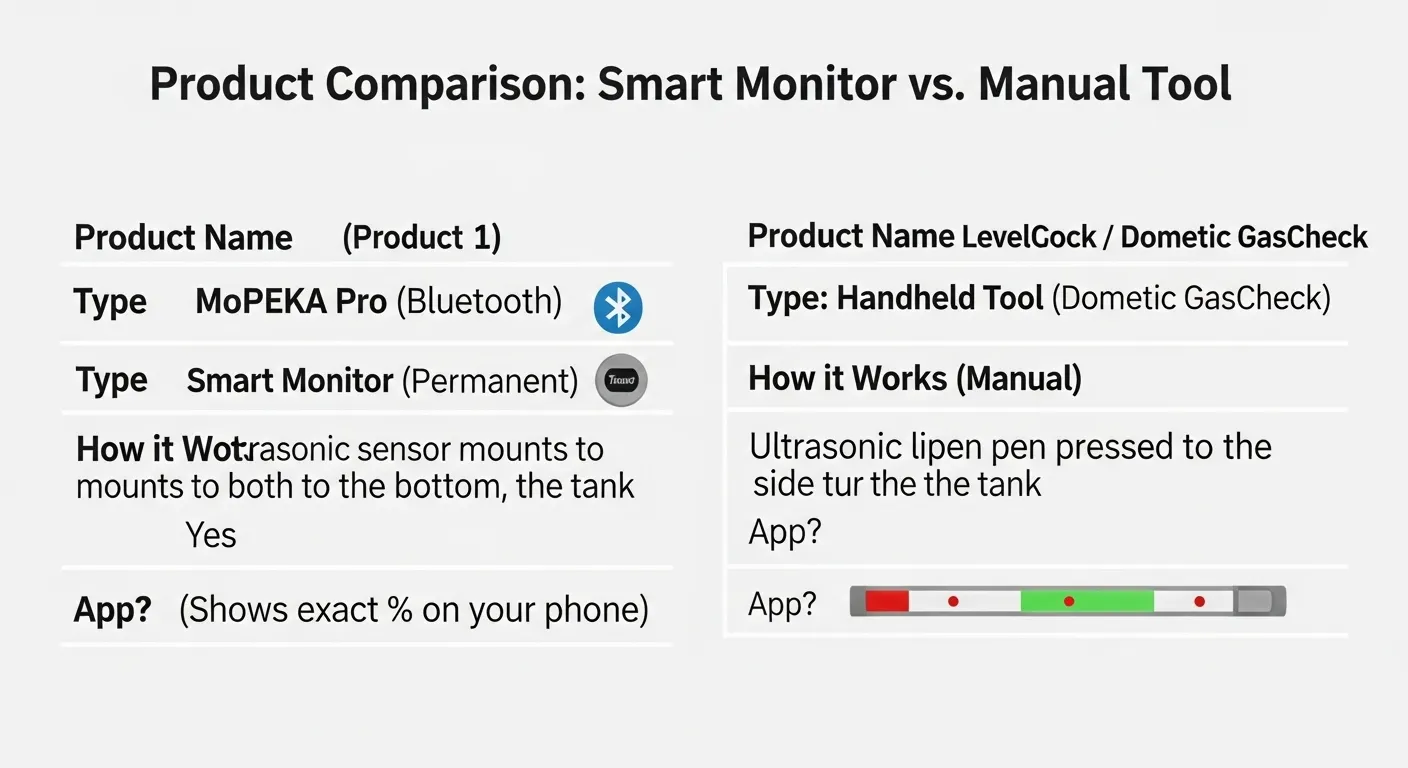
| Feature | MoPEKA Pro Sensor (Bluetooth) | AP Products GasCheck |
| Type | Smart Monitor (Permanent) | Handheld Tool (Manual) |
| How it Works | Ultrasonic sensor on tank bottom | Ultrasonic pen pressed to tank side |
| App? | Yes (shows % on your phone) | No (shows red/green light) |
| Remote? | No (Bluetooth range only) | No (You must be at the tank) |
| Best For | RVers, dual-tanks, tech-savvy users | Grillers, simple checks, no-fuss users |
Smart Propane Monitoring for Businesses (Restaurants, Forklifts, Job Sites)
Now, let's talk about the commercial user. This is a completely different ballgame and an almost totally untapped market in the consumer space.
If you run a restaurant with a dozen patio heaters, running out of propane means cold, unhappy customers and lost revenue. If you manage a warehouse, an empty forklift tank means 30 minutes of lost productivity.
Don't buy a residential Wi-Fi model for this. You need a B2B cellular fleet management solution.
Top Pick (Commercial): Otodata / Nee-Vo Solutions
- Why: You've probably never heard of them, but Otodata is one of the largest B2B monitor manufacturers in the world. Companies like Generac and many local propane suppliers often "white-label" (rebrand) their hardware and software.
- How it Works: These are heavy-duty, subscription-based cellular sensors. But instead of a simple app, you get a powerful web dashboard.
- The Business Value: You can see all 100 of your tanks on a single map. You can track historical usage data, get low-level alerts, and optimize your propane delivery routes. The monthly fee is a simple business expense that pays for itself by preventing a single "run-out" incident.
- Takeaway: If you're a business, call your propane supplier and ask what "commercial remote monitoring" or "fleet management" solutions they offer.
How to Install Your Propane Monitor (What the Manual Won't Tell You)
I've installed dozens of these things, and the manual always misses the most important real-world steps. You can learn more about the deep specifics of how these wireless LP tank monitors work, but here's the practical, on-the-ground guide.
Step 1: Check Compatibility
- For Ultrasonic (MoPEKA): These work best on steel tanks. They can struggle with aluminum tanks (common on some RVs) as the metal density is different. Check your tank with a magnet.
- For Gauge-Reader (Generac): Look at your tank's gauge. Does it clearly say "R3D" or "Remote Ready"? If not, the Generac monitor will not fit.
Step 2: Test Your Signal First!
This is the number one mistake everyone makes. Before you buy anything, take your phone out to the tank.
- For a Wi-Fi model: Can you stand right next to the tank and get 2-3 bars of Wi-Fi? Can you stream a video? If not, it will not work. A 2.4 GHz signal doesn't travel well through metal and concrete.
- For a Cellular model: Do you have at least 1-2 bars of cell service? If not, it won't be able to send its signal.
Step 3: Prepare the Tank (Crucial for Ultrasonic)
For bottom-mounted sensors like the MoPEKA, the connection is everything. A bad connection means a bad reading.
- Flip your 20-lb tank over. For a large home tank, reach underneath (be careful).
- The bottom center of the tank must be clean. Use a wire brush or sandpaper to scrape off any thick paint, flaking rust, or caked-on mud.
- Wipe the area clean.
Step 4: Install the Hardware
- For MoPEKA: Apply a generous glob of the included dielectric grease to the sensor's rubber feet. This ensures a perfect ultrasonic connection. Press it firmly onto the clean center spot on the tank's bottom.
- For RV Tanks: Your tank probably sits in a metal "pan." You must use the included 3-4 small rubber spacers. Stick them around the bottom rim of the tank to lift it about 1/4 inch. This creates an air gap so the sensor isn't crushed and its signal isn't blocked.
- For Generac: This is easy. Just remove the two screws holding the plastic dial cover on, pop the Generac monitor in its place, and replace the screws.
Step 5: Sync with the App
Follow the app's instructions to the letter. Be patient. It can take a few minutes (or even an hour) for the first accurate reading to appear as the sensor calibrates.
Conclusion: The Right Data Makes All the Difference
Choosing the right smart propane monitor isn't about the flashiest app. It's about honestly assessing your needs and matching the connectivity (Bluetooth, Wi-Fi, or Cellular) to your specific setup.
Here are the key takeaways:
- For RVs & Grills: A Bluetooth sensor (like the MoPEKA Pro) is all you need. It's simple and subscription-free.
- For Homes: If your tank is close to your house with a strong Wi-Fi signal, the MoPEKA Pro + Wi-Fi Bridge is the best no-fee option.
- For Remote Properties: If your tank is far from the house or has no Wi-Fi, a Cellular sensor (like the Generac LTE) is the most reliable choice, but you will pay an annual subscription.
- For Businesses: Skip residential models entirely and invest in a dedicated cellular fleet solution from your supplier.
Stop guessing and start monitoring. You'll save yourself a lot of money and a massive headache.
Have you installed a smart monitor? Share your experience or ask a question in the comments below. We're here to help.
Frequently Asked Questions (FAQ)
It depends on the model. A true Wi-Fi monitor like the MoPEKA (which uses your home's Wi-Fi via their bridge) does not require a subscription. However, Cellular (LTE) models, like the Generac 7009 or most supplier-provided monitors, always have a mandatory monthly or annual fee to pay for the built-in cell service.
Modern ultrasonic sensors (like MoPEKA) that measure the actual liquid level from the bottom are extremely accurate, often within +/- 1% to 3%. They are far more reliable than old-fashioned float gauges, which can get stuck and be off by 10-20% or more.
Most leading wireless sensors (MoPEKA, Generac) use a single, common CR2032 coin cell battery. With the sensor reporting data a few times a day, this single battery will typically last 3 to 5 years. They are inexpensive and easy to replace yourself.
For horizontal RV tanks, yes. The MoPEKA Pro has settings in the app specifically for horizontal DOT tanks. For large underground home tanks, you cannot use a bottom-mounted ultrasonic sensor. Your only option is a dial-reader (like the Generac LTE) that attaches to the R3D gauge on the tank's dome (which is accessible at ground level).
The main difference is build quality and features. The "Pro" model (which we recommend) has a stronger magnet, better waterproofing (a higher IP rating), and is more rugged, making it ideal for the harsh conditions on a home tank or underneath an RV. The "Standard" model is less expensive but better suited for a stationary grill that's somewhat protected from the elements.
Absolutely. All the models listed in this guide are designed for a 10-minute DIY installation. They require no special tools and do not involve opening any gas lines. They either attach with magnets (MoPEKA) or screw onto the existing gauge (Generac).


