
Hoë-temperatuur optiese vloeistofvlaksensor
HojellyTek vervaardig foto-elektriese vloeistofvlaksensoroplossings in Shenzhen vir OEM/ODM- en industriële kopers wat materiaalleiding benodig voordat monsters of produksiebondels bestel word.
Hoë-temperatuur optiese vlakwaarnemingsvermoëns
Ons hoë-temperatuur optiese vlak sensordiens dek puntvlak-opsporing vir warm-media toepassings waar vlotskakelaars kan vassteek, absorbeerresidu, of meganies slytasie. Die sensor gebruik 'n infrarooi LED, Fototransistor, en optiese prismapunt om te bepaal of die prisma droog is of deur vloeistof bedek is.
In die droë toestand, Infrarooi lig weerkaats intern binne die prisma en keer terug na die ontvanger. Wanneer vloeistof die prisma bedek, Die brekingstoestand verander, Lig word in die vloeistof herlei, en die uitset verander toestand. Dit maak optiese sensing nuttig vir hoëvlak-alarms, Laevlak-alarm, Droogloopbeskerming, Koelmiddeltenkvlak-opsporing, Oliereservoirmonitering, en kompakte OEM-tenkintegrasie.
Afhangend van die projek, Ons ondersteun:
- Foto-elektriese puntvlakwaarneming vir warm vloeistofdeteksie
- PSU, 316 Vlekvrye staal, Glas, PTFE, en gemengde-materiaal strukture
- NPN, PNP, en digitale skakelaar-uitsetopsies
- 4–20 mA bespreking vir deurlopende vlak- of sendergebaseerde projekte
- Draad, Kompakte, Sy-montering, Onderste montering, en aangepaste monteerstrukture
- OEM-kabellengte, Konnektor, Uitsetlogika, en behuisingsontwerp
- Monstertoetsing voor massaproduksie vir warmmedia-toepassings
Vir algemene optiese puntvlakseleksie, sien ons optiese vlaksensor omvang.
Die Werklike Mislukkingsrisiko: Plastiekprisma's en seëls bo die gradering
Kopers met hoë temperature vra gewoonlik eers vir die maksimum temperatuur. Dit is verstaanbaar, Maar 'n enkele "maksimum temperatuur" getal kan misleidend wees as dit net een deel van die sensor beskryf.
'n Plastiekprisma kan 'n kort warm plons oorleef, maar vervorm tydens deurlopende onderdompeling. 'n Seël kan verhard, Swel, of verloor kompressie voordat die metaalomhulsel faal. 'n Kabelomhulsel kan naby 'n warm tenkmuur kraak selfs al is die sensorpunt nog funksioneel. Potmiddel, Kleefmiddel, Konnektorplastiek, en interne elektronika kan ook die werklike limiet word.
Om hierdie rede, HojellyTek beveel nie aan om 'n warm-vloeistof sensor slegs op grond van liggaamsmateriaal te kies nie. 'n Vlekvrye staal liggaam beteken nie outomaties die kabel nie, Seël, Optiese venster, en elektronika deel dieselfde plafon. 'n Glaspunt kan harder media hanteer as baie plastiek, Maar die samestelling het steeds 'n bevestigde seël en kabelontwerp nodig.
Die veilige manier om 'n hot-media optiese sensor te spesifiseer, is om te bevestig:
- Normale deurlopende vloeistoftemperatuur
- Maksimum piektemperatuur
- Hoe lank duur piektemperatuur
- Of die sensor se punt, gare, Kabel, of die konnektor word aan hitte blootgestel
- Of die vloeistof water is, Koelmiddel, Olie, Chemiese oplossing, of gemengde media
- Of druk, Vibrasie, Skuim, Borrels, of skoonmaaksiklusse teenwoordig is
Temperatuurplafon per materiaal: PSU vs 316SS vs Glas/PTFE
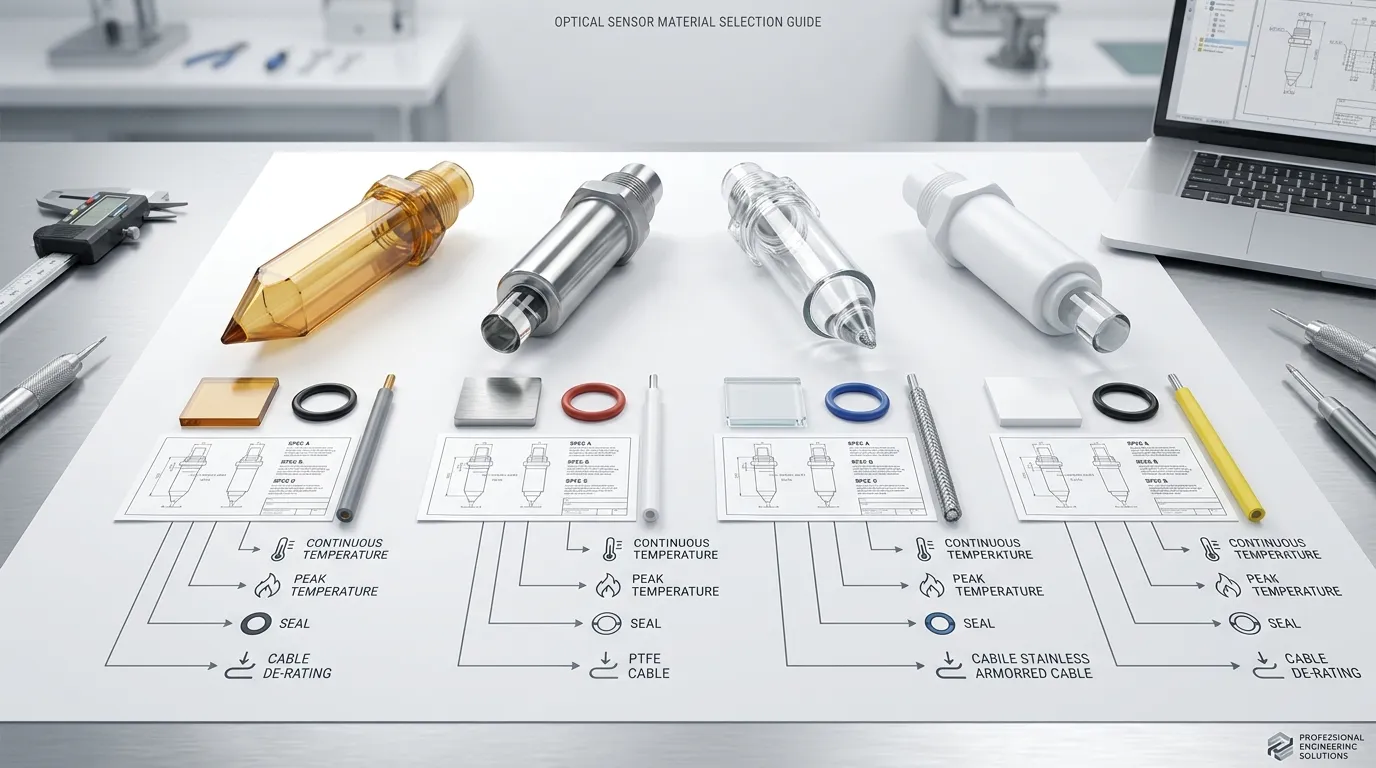
Vir hoë-temperatuur optiese vloeistofvlaksensorprojekte, Die "werklike plafon" moet uit die volledige sensorbou bevestig word, nie van een rou materiaal aanvaar nie. Die tabel hieronder is ontwerp vir koperkeuse, Nie as 'n gepubliseerde temperatuur-eis nie.
| Sensormateriaal / Konstruksie | Beste Pasvorm | Temperatuurgraderingsriglyne | Hoofrisiko om te kontroleer |
|---|---|---|---|
| PSU plastiek optiese prisma of liggaam | Kompakte OEM-tenks, Watergebaseerde vloeistowwe, Laer-koste projekte | Slegs geskik wanneer die bevestigde deurlopende en piekgradering van die presiese onderdeel ooreenstem met die toepassing. Moet nie aanneem "ingenieursplastiek" beteken veilig vir alle warm tenks nie. | Prisma-versagting, Kraak, swelling, Seëlspanning, Langtermyn-deformasie |
| 316 Vlekvrye staal behuizing met optiese punt | Warm koelmiddel, Olie, Nywerheidstenks, sterker meganiese beskerming | Liggaamsduursaamheid is sterker as plastiek, Maar die werklike plafon hang af van die optiese punt, Seël, Kabel, en interne samestelling. | Seëlveroudering, Kabelafgradering, Hitte-oordrag na elektronika |
| Glasoptiese sensing punt | Warm water, Olies, Chemikalieë, en toepassings waar plastiekprisma-verenigbaarheid 'n bekommernis is | Word dikwels gekies wanneer kopers 'n meer stabiele optiese koppelvlak as plastiek benodig. Die werklike plafon moet steeds deur volledige samestellingontwerp bevestig word. | Glas-tot-metaal seëling, Skok, installasiespanning, Kabelblootstelling |
| PTFE-natgemaakte dele met glassensorarea | Chemiese media, Korrosiewe vloeistowwe, Toepassings wat lae oppervlakadhesie benodig | PTFE kan chemiese verenigbaarheid verbeter, maar chemiese weerstand en temperatuurgradering moet afsonderlik nagegaan word. | Seëlverenigbaarheid, Meganiese rigiditeit, Media-deurdrenking, Kabellimiet |
| Gemengde pasgemaakte samestelling | OEM-tenks met beperkte ruimte, Bedrading, en mediavereistes | Die beste hanteer as 'n RFQ-gebaseerde ontwerp waar materiaal, Seël, Kabel, Uitset, en montering word saam gespesifiseer. | Een komponent in die samestelling word die beperkende punt |
Vir kopers wat 'n nie-plastiek sensorgesig benodig, Ons Glasoptiese sensor Page is 'n nuttige verwysing. Vir strenger industriële behuising, Hersien die 316 Vlekvrye vlekvrye optiese sensor Opsie.
Deurlopende Temperatuur vs Piektemperatuur
Deurlopende temperatuur is die temperatuur wat die sensor tydens normale werking vir lang periodes moet oorleef. Piektemperatuur is 'n kort gebeurtenis, soos aanvangshitte, Skoonmaak, Spoeling, of tydelike oorverhitting.
Hierdie onderskeid maak saak omdat baie mislukkings nie onmiddellik gebeur nie. 'n Plastiekprisma mag dalk 'n kort toetstoets slaag, maar stadigaan groei na weke in warm koelmiddel. 'n Seël kan kamertemperatuur-lektoetsing slaag maar elastisiteit verloor na herhaalde verhitting en afkoeling. Kabelisolasie kan aanvanklik buigsaam bly, dan hard en kraak dit na lang blootstelling naby 'n tenkmuur.
Wanneer 'n RFQ gestuur word, Moet nie net "hoë temperatuur" skryf nie. Stuur die deurlopende bedryfstemperatuur, Maksimum piektemperatuur, Piekduur, en of die sensor deurlopend ondergedompel word of slegs tydens vul blootgestel word. As die toepassing CIP-skoonmaak insluit, Stoom, Warm wasmiddel, Oliebymiddels, of glikol-koelmiddel, Sluit daardie inligting in voor die keuse van monsters.
Kabelgradering, Koppelstuk-afgradering, en Installasiehitte
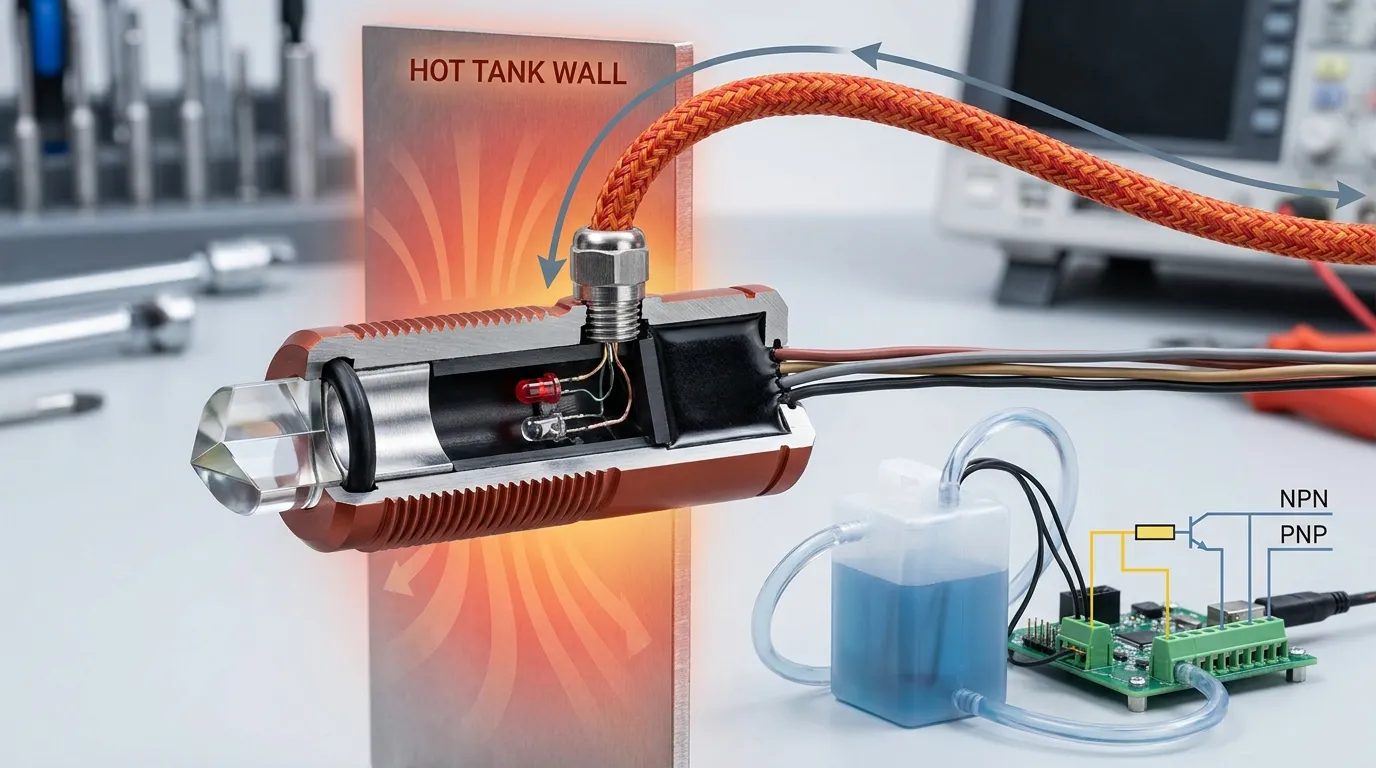
In warm tenks, Die sensorpunt is nie die enigste blootgestelde deel nie. Kabelroetering kan bepaal of die projek slaag.
'n Kabel wat vir normale omgewingstoestande gesertifiseer is, kan faal as dit 'n warm metaaltenk raak, loop langs 'n verwarmer, of verlaat deur 'n warm omhulsel. Die kabel mag dalk hoër-temperatuur isolasie benodig, Ekstra spanningsverligting, 'n koeler roetepad, of 'n metaalliggaamontwerp wat direkte hitte-oordrag na die kabelinvoer verminder.
Koppelstukkeuse maak ook saak. M8, M12, Inpropverbindings, Vlieënde leidrade, en pasgemaakte harnasse het verskillende hittebeperkings. As die konnektor buite die warm sone sit, Die ontwerp mag makliker wees. As die konnektor naby die tenkwand is, Die verbindingsmateriaal en seëling moet saam nagegaan word.
Vir hoë-temperatuur toepassings, Kopers moet bevestig:
- Kabelomhulselmateriaal en hitte-blootstellingsarea
- Afstand van warmtenkmuur na konnektor
- Of die kabel vas is, buiging, of aan vibrasie blootgestel is
- Of olie, Koelmiddel, of skoonmaakchemikalieë kontak die kabel
- Of uitsetbedrading NPN gebruik, PNP, of 'n ander beheerkoppelvlak
- Of die beheerbord normaalweg oop moet wees, Normaalweg gesluit, Hoog-in-vloeistof, of lae-in-vloeistof logika
Hot-Media Toepassingskontrolelys
Gebruik hierdie kontrolelys voordat jy 'n kwotasie of voorbeeld versoek:
| RFQ-item | Wat om te voorsien |
|---|---|
| Vloeistoftipe | Water, Koelmiddel, Olie, skoonmaakmiddel, Chemiese oplossing, of gemengde media |
| Deurlopende temperatuur | Normale langtermyn bedryfstemperatuur van die vloeistof |
| Piektemperatuur | Hoogste verwagte temperatuur en blootstellingsduur |
| Monteringsposisie | Symontering, Onderste montering, Topinskrywing, of pasgemaakte tenkmuurontwerp |
| Voorkeur vir nat materiaal | PSU, 316 Vlekvrye staal, Glas, PTFE, of fabrieksaanbeveling |
| Seëlvereiste | Media-verenigbaarheid, Druktoestand, en skoonmaaksiklus |
| Kabelblootstelling | Warm-sone lengte, Koppelstukafstand, en roeteringsomgewing |
| Uitsettipe | NPN, PNP, Skakelaaruitset, of senderbespreking |
| Kragtoevoer | Beheerbordspanning bevestig by RFQ-fase |
| Toepassingsdoel | Hoëvlak-alarm, Laevlak-alarm, Droogloopbeskerming, lekopsporing, of OEM-tenkbeheer |
| Steekproefvalidering | Banktoets, Warm-vloeistof weektoets, en installasietoets voor produksie |
Vir warm koelmiddel- en reservoirprojekte, die Koelmiddeltenk-sensor Die bladsy gee toepassingskonteks vir kompakte tenkmonitering.
5-Stap OEM/ODM Voorsieningsproses
1. Navraag
Stuur die vloeistof, Temperatuurprofiel, Monteringsposisie, Uitsetvereiste, Tekening, Foto, of bestaande onderdeelmonster. Ons span hersien of 'n standaard optiese skakelaar is, Vlekvrye vlekvrye weergawe, Glasweergawe, of aangepaste struktuur meer geskik is.
2. Spesifikasie en Aanpassing
Ons bevestig die praktiese sensorkonfigurasie: natgemaakte materiaal, gare, Kabel, Uitsetlogika, Konnektor, Seël, en of die temperatuurplafon deur monstertoetsing gevalideer moet word.
3. Voorbeeld
Monsters word voorberei vir elektriese toetsing, Onderdompelingstoetsing, en installasiekontroles. Vir warm-media projekte, Ons beveel aan om onder werklike vloeistoftemperatuur en dienssiklustoestande te toets.
4. Produksie en kwaliteitsbeheer
Na die goedkeuring van die monster, Produksie volg die bevestigde tekening en spesifikasie. QC kan voorkomsinspeksie insluit, Bedradingkontrole, Uitvoerfunksiekontrole, Seëlkontrole, en toepassingspesifieke toetsing wat voor produksie ooreengekom is.
5. Skeepsvaart
HojellyTek voer sensorprodukte na die VSA uit, ONS, Indië, en ander markte. Skeepsvaart, Verpakking, Etikettering, en dokumentasie kan bespreek word op grond van die koper se bestelling en bestemming.
Vereistes en Spesifikasies om te bevestig voordat jy bestel
'n Betroubare hoë-temperatuur optiese sensororde behoort meer as die sensorliggaam te bevestig. Ten minste, definieer:
- Sensortipe: Puntvlak optiese skakelaar of deurlopende vlak projek
- Nat materiaal: PSU, 316 Vlekvrye staal, Glas, PTFE, of gebruik
- Uitset: NPN, PNP, Digitale skakelaar-uitset, of 4–20 mA bespreking
- Uitsetlogika: Aktief in vloeistof of aktief in lug
- Montering: gare, Flens, Symuur, Onderste montering, of kompakte OEM-struktuur
- Kabel: Lengte, Mantelmateriaal, Konnektor, en hitteblootstelling
- Seël: Versoenbaarheid met vloeistof- en temperatuursiklus
- Elektriese integrasie: Toevoerspanning, Laai, Beheerder, PLC, of PCB-invoer
- Media-gedrag: Skuim, Borrels, Bedekking, Oliefilm, residu, Kleur, of viskositeit
- Valideringsplan: Monstertoetstoestande voor bondelproduksie
Materiaal- en toepassingsvergelyking
| Aansoeksituasie | Beter Beginopsie | Hoekom |
|---|---|---|
| Kompakte plastiektenk met warm vloeistof | PSU optiese sensor indien bevestig geskik | Koste-effektief en kompakt, maar moet binne die werklike materiaal en seëlgradering bly |
| Warm koelmiddelreservoir | 316 Vlekvrye vlekvrye staal of glaspuntontwerp | Beter keuse waar hitte, Bymiddels, en vibrasie is bekommernisse |
| Warm olietenk | Vlekvrye staal behuizing met geskikte optiese punt en kabel | Olie-verenigbaarheid, Kabelomhulsel, en seëlmateriaal moet sorgvuldig nagegaan word |
| Korrosiewe warm chemikalie | Glas/PTFE-bespreking | Chemiese weerstand en temperatuur moet albei gevalideer word |
| Koper ken net "warm vloeistof" | RFQ-gebaseerde materiaalkeuse | Die fabriek het media nodig, Deurlopende temperatuur, Piektemperatuur, en monteerbesonderhede voordat 'n veilige kwotasie gemaak word |
Hoekom HojellyTek kies
HojellyTek is 'n vervaardiger en uitvoerder in Shenzhen wat fokus op foto-elektriese optiese vloeistofvlakwaarneming. Ons ondersteun in-huis R&D, OEM/ODM-aanpassing, Kompakte sensorstrukture, Industriële materiaalkeuse, en toepassingsgebaseerde steekproefvalidering.
Kopers werk saam met ons wanneer hulle 'n praktiese fabriek-direkte sensorvennoot nodig het eerder as 'n katalogus-alleen verskaffer. Ons kan help om PSU te vergelyk, 316 Vlekvrye staal, Glas, en PTFE-opsies, Pas kabel- en uitsetbesonderhede aan, en OEM-integrasie vir tenks te ondersteun, Toestelle, Industriële toerusting, Koelmiddelsisteme, en slim vloeistofmoniteringsprodukte. Tuya- en Smart Life-integrasie kan ook bespreek word waar die projek gekoppelde vloeistofmonitering vereis in plaas van 'n eenvoudige bedrade skakelaar.
Vrae
Wat is die werklike maksimum temperatuur van 'n hoë-temperatuur optiese vloeistofvlaksensor??
Die werklike maksimum temperatuur hang af van die volledige samestelling: Prisma, Behuising, Seël, Kabel, Konnektor, Potting, en vloeistofversoenbaarheid. Ons beveel nie aan om op een opskrifnommer te kies nie. Stuur jou deurlopende en piektemperatuurvereistes sodat die korrekte plafon bevestig kan word.
Is deurlopende temperatuur anders as piektemperatuur?
Ja. Deurlopende temperatuur is langtermyn normale blootstelling. Piektemperatuur is 'n kort gebeurtenis. 'n Sensor kan 'n kort piek oorleef, maar faal in deurlopende onderdompeling as die prisma, Seël, of kabel is nie vir daardie dienssiklus gesertifiseer nie.
Watter materiaal is die beste vir warm vloeistof: PSU, 316 Vlekvrye staal, Glas, of PTFE?
PSU kan by kompakte OEM-toepassings pas wanneer dit binne die gradering bevestig is. 316 Vlekvrye staal verbeter meganiese duursaamheid. Glas word dikwels verkies wanneer plastiese verenigbaarheid 'n bekommernis is. PTFE is nuttig vir chemiese verenigbaarheid, Maar temperatuur en seël moet nog bevestig word.
Kan optiese vlaksensors in warm koelmiddeltenks werk?
Ja, optiese sensors kan gebruik word vir koelmiddelvlak-opsporing wanneer die materiaal, Seël, Kabel, en die uitset korrek gekies word. Koelmiddelbymiddels, Temperatuursiklus, Vibrasie, en die monteerposisie moet gedeel word voor die keuse van monsters.
Is optiese sensors deurlopende vlaksensors?
Die meeste optiese prisma-sensors is puntvlakskakelaars. Hulle bepaal of die punt droog of nat is. As jou projek deurlopende meting of 4–20 mA uitset benodig, Bespreek 'n aparte deurlopende vlak of sendergebaseerde oplossing.
Wat moet ek stuur voordat ek 'n kwotasie versoek?
Stuur vloeibare tipe, Deurlopende temperatuur, Piektemperatuur, Monteringsmetode, Tenkmateriaal, Draadvereiste, Kabellengte, Konnektortipe, Uitsettipe, en teikenbestellingshoeveelheid. Foto's, Tekeninge, of 'n bestaande sensormonster is ook nuttig.
Versoek 'n Kwotasie
Vir 'n hoë-temperatuur optiese vloeistofvlaksensor, Die veiligste eerste stap is om die werklike plafon van die volledige sensorsamestelling te bevestig voordat jy bestel. Stuur jou warm-media kontrolelys, Tenktekening, en bedrading aan HojellyTek per WhatsApp of e-pos, en ons span sal 'n geskikte materiaal aanbeveel, Uitset, Kabel, en voorbeeldplan.


