
Optiese vlaksensor vir koelmiddeltenks
'n Optiese vlaksensor-koelmiddeltenkoplossing help om lae-koelmiddel oorverhitting te voorkom, pomp droogloop, Kavitasie, en onverwagte masjienafskakeling voordat die reservoir 'n gevaarlike vlak bereik. Vir masjiengereedskap, Enjins, Chillers, Verkoelingsglyers, en industriële reservoirs, HojellyTek voorsien kompakte foto-elektriese vlaksensors vir laevlak-alarmopsporing, Bevestiging van koelmiddel teenwoordigheid, en OEM-koelmiddeltenk-integrasie.
Die doel is eenvoudig: Bepaal of koelmiddel by die veilige minimum vlak teenwoordig is, stuur dan 'n betroubare sein na 'n PLC, Beheerbord, Aflos, Buzzer, Waarskuwingslamp, of afskakelkring.
Koelmiddeltenk-vlakopsporingsvermoëns
HojellyTek optiese sensors is ontwerp vir puntvlak-opsporing in kompakte tenks en industriële reservoirs waar vlotskakelaars dalk te lomp kan wees, meganies onbetroubaar, of sensitief vir vibrasie.
Vir koelmiddeltenk-toepassings, Ons kan ondersteun:
- Lae-koelmiddelalarmopsporing in CNC-masjiengereedskapkoelmiddelreservoirs
- Pompinlaatbeskerming vir koelmiddelsirkulasiepompe
- Enjinkoelmiddelreservoirvlakmonitering vir industriële toerusting
- Koeltenk laevlak-alarmopsporing
- Verkoelingssmeervlakmonitering in metaalbewerkingsisteme
- OEM/ODM-sensoraanpassing vir tenkbouers en toerustingvervaardigers
- Foto-elektriese sensormodules met pasgemaakte kabel, Konnektor, Uitset, en behuisingsopsies
- Sensorkeuse gebaseer op koelmiddeltipe, Tenkmateriaal, Monteringsposisie, en beheerlogika
As jou toepassing 'n algemene puntvlak-sensorplatform benodig, sien ons optiese vlaksensor Opsies vir standaard vloeistofdeteksieprojekte.
Voorkoming van Lae Koelmiddel Oorverhitting en Pompbeskadiging
In koelmiddelsisteme, Die vlaksensor is nie net 'n moniteringsbykomstigheid nie. Dit is 'n beskermingsapparaat. Wanneer koelmiddel onder die veilige vlak daal, Die stelsel kan verkoelingskapasiteit verloor, Die pomp kan lug trek, en die masjien kan aanhou werk sonder genoeg vloeistof om hitte te verwyder.
Algemene foute wat 'n laevlak optiese sensor help voorkom, sluit in:
- Pomp droogloop wanneer die koelmiddeltenk se vlak onder die suigpunt daal
- Oorverhitting in masjiengereedskap, Enjins, of chillers
- Swak koelmiddelsirkulasie veroorsaak deur luginlaat of kavitasie
- Gereedskapsslytasie of prosesinstabiliteit as gevolg van onvoldoende verkoelingsvloei
- Koeler-laevlakfoute en noodafskakelings
- Onbeplande stilstand veroorsaak deur vertraagde handmatige inspeksie
- Pompseëlbeskadiging van herhaalde werking sonder genoeg vloeistof
Vir pomp-gefokusde toepassings, Ons verwante pomp-droogloopbeskerming Page verduidelik hoe puntvlak-sensering as 'n interlock gebruik kan word voordat die pomp in onveilige toestande loop.
Hoe die optiese sensor koelmiddelvlak opspoor
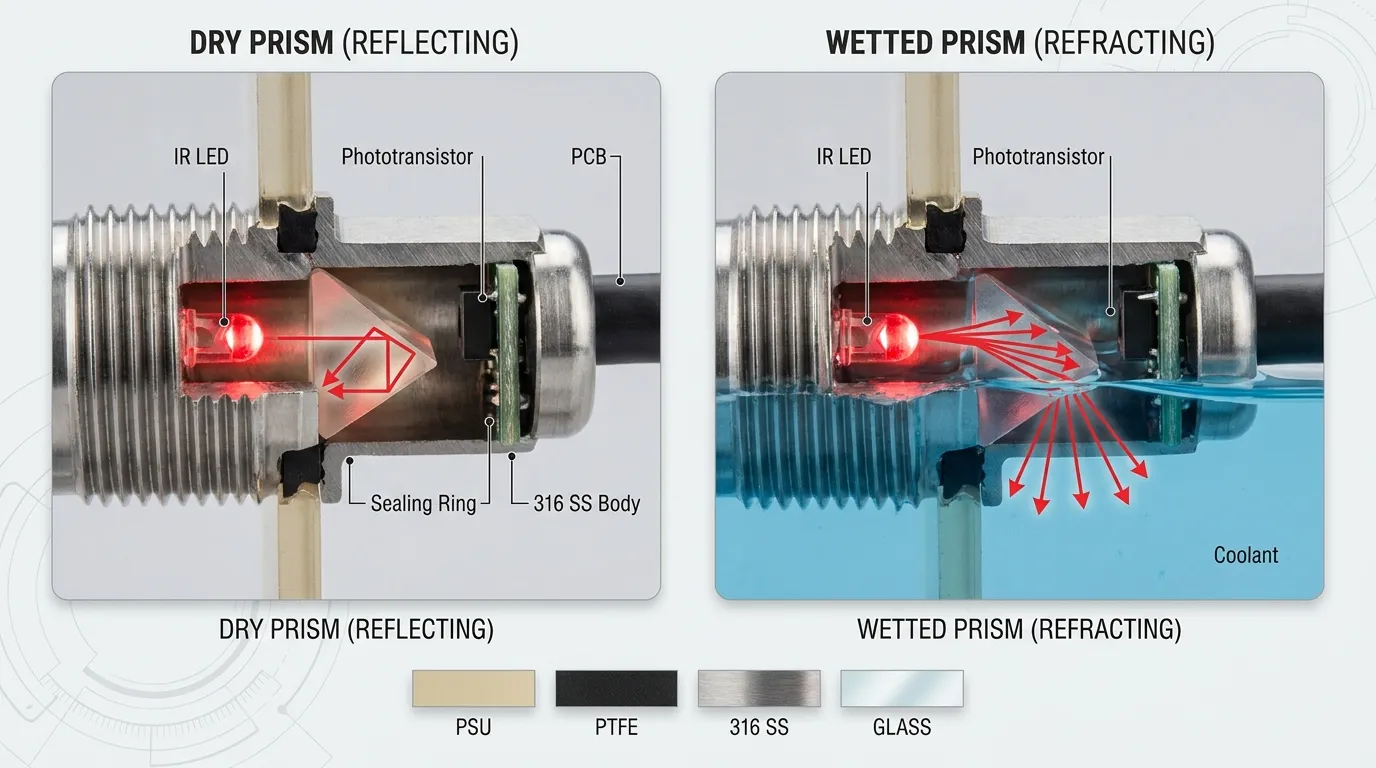
'n Foto-elektriese koelmiddelvlaksensor gebruik tipies 'n infrarooi LED, 'n fototransistor, en 'n prisma-vormige sensorpunt. Die sensorpunt word by die teikenalarmvlak binne of deur die muur van die koelmiddelreservoir geïnstalleer.
Wanneer die prismapunt in die lug is, Infrarooi lig weerkaats intern binne die prisma en keer terug na die ontvanger. Wanneer koelmiddel die prisma bedek, die lig breek in die vloeistof in plaas daarvan om terug te kaats. Die sensorelektronika bespeur hierdie verandering en skakel die uitsettoestand om.
Hierdie droë-teen-natgemaakte opsporingsmetode bied verskeie voordele in koelmiddeltenks:
- Geen bewegende dryfarm om vas te sit nie, Stok, of dra
- Kompakte sensortip vir klein reservoirs
- Vinnige puntvlakreaksie by die stelmonteringshoogte
- Stabiele deteksie vir baie watergebaseerde, Glikol-gebaseer, en olie-gebaseerde vloeistowwe
- Maklike laevlak-alarmintegrasie met elektroniese beheerstelsels
- Geskik vir horisontale symontering of pasgemaakte tenkintegrasie
Die sensor ontleed nie koelmiddelkwaliteit of chemiese formule nie. Sy taak is vlakopsporing: Of die sensorpunt droog of nat is by die alarmpunt.
Koelmiddelverenigbaarheid en Temperatuurkeuse
Koelmiddel-verenigbaarheid hang af van die vloeistoftipe, Konsentrasie, Bymiddels, Temperatuur, Druk, Skoonmaakproses, en natgemaakte materiaal. Om hierdie rede, Die sensorliggaam en prismamateriaal moet gekies word volgens die werklike koelmiddel wat in die tenk gebruik word, nie net die aansoeknaam nie.
Algemene natgemaakte materiaalopsies sluit PSU-plastiek in, PTFE, 316 Vlekvrye staal, en glas. Vir hoë-temperatuur reservoirs, Verhitte koelmiddelkringe, of harde industriële vloeistowwe, Die model en kabelmateriaal moet hersien word voor monsterneming. Vir verhoogde temperatuur toepassings, sien ons Hoë-temperatuur optiese sensor Seleksiebladsy.
| Koelmiddel / Vloeibare tipe | Tipiese Gebruiksgeval | Voorgestelde Sensormateriaalrigting | Temperatuuroorweging | Koper kontroleer voor bestelling |
|---|---|---|---|---|
| Watergebaseerde koelmiddel | CNC-masjiengereedskap, Masjineringsentrums, Algemene Verkoelingstenks | PSU of vlekvrye staal/glas, afhangend van bymiddels en tenkontwerp | Bevestig normale bedryfs- en skoonmaaktemperatuur | Kyk skuim na, Skyfies, Additiewe konsentrasie, en alarmhoogte |
| Glikol-gebaseerde koelmiddel | Chillers, Verkoelingsglyers, Enjinverwante industriële reservoirs | PSU, PTFE, of vlekvrye/glas na versoenbaarheidshersiening | Bevestig lae-temperatuur en hoë-temperatuur bedryfsreeks | Deel glikolkonsentrasie en reservoirtemperatuurreeks |
| Olie-gebaseerde koelmiddel / Snyolie | Metaalbewerking, Smeer-verkoelingstelsels | PTFE of 316 vlekvrye/glas word dikwels verkies vir skerper vloeistowwe | Bevestig viskositeitsverandering by bedryfstemperatuur | Toets met 'n werklike olie/koelmiddelmonster voor grootmaatbestelling |
| Verkoelingsmeermiddelemulsie | Masjienwerktuig-koelmiddeltenks | Materiaalkeuse hang af van emulsiechemie en besoedelingsvlak | Bevestig of die tenk warm loop tydens deurlopende werking | Kontroleer slib, Skuim, Skyfies, en skoonmaakmetode |
| Koelwater / Proseskoelmiddel | Industriële verkoelers en prosesverkoelingsreservoirs | PSU of vlekvrye/glasvrye krag, afhangend van vloeistof en installasie | Bevestig verkoelertemperatuursiklus en alarmreaksievereiste | Kontroleer laevlak-alarmlogika en pomp-interlockbedrading |
| Skerp of onbekende koelmiddel | OEM-masjiene, Spesiale prosestoerusting | PTFE, 316 Vlekvrye vlekvrye, of glas moet eers hersien word | Die temperatuurreeks moet by RFQ-fase bevestig word | Stuur koelmiddelbesonderhede of versoek monstervalidering |
Vir korrosief, Hoë-temperatuur, of metaaltenktoepassings, n 316 Vlekvrye staal sensor kan meer geskik wees as 'n plastiek-liggaam sensor.
Laevlak-alarmbedrading vir koelmiddelreservoirs
Die meeste koelmiddeltenkprojekte gebruik die optiese sensor as 'n laevlakskakelaar. Die uitset kan gekonfigureer word om by die masjienbeheerstelsel te pas, Alarmbord, PLC, of relaiskoppelvlak.
Algemene uitsetkeuses sluit in:
- NPN-uitset vir sinkende insetkringe
- PNP-uitset vir die verkryging van insetkringe
- NO- of NC-logika afhangend van of die alarm moet afgaan wanneer die punt droog of nat is
- Relay-koppelvlak wanneer die masjien geïsoleerde skakeling benodig
- Waarskuwingslamp of buzzer-uitset deur 'n beheerkring
- Pompstop-interlock om droë loop te voorkom
- 4–20 mA uitset wanneer 'n deurlopende vlaksensor gekies word in plaas van 'n puntvlakskakelaar
Vir lae-koelmiddel beskerming, Baie kopers verkies fail-safe logika: wanneer die sensor ontkoppel is, beskadig, of 'n droë punt opspoor, Die masjien moet in alarm- of stopmodus gaan in plaas daarvan om stil voort te gaan. Hierdie logika moet met jou beheeringenieur bevestig word voor produksie.
Die sensor in 'n koelmiddeltenk monteer
Die monteerposisie bepaal hoe nuttig die alarm sal wees. 'n Sensor wat te laag geïnstalleer is, kan die probleem eers opspoor nadat die pomp reeds begin het om lug te trek. 'n Sensor wat te hoog geïnstalleer is, kan gereelde oorlasalarms veroorsaak, selfs al het die stelsel nog genoeg bruikbare koelmiddel.
Vir die meeste koelmiddelreservoirs, Die sensor moet op die minimum veilige vlak bo die pompinlaat of suigpunt gemonteer word. Die presiese hoogte hang af van die tenkgeometrie, Pompligging, Vloeibare beweging, en hoeveel reserwevolume benodig word voor afsluiting.
Belangrike monteerpunte sluit in:
- Installeer die sensorpunt op die regte laevlak-alarmhoogte
- Hou die punt weg van swaar skyfie-opbou en slibsones
- Vermy montering waar skuim of sterk turbulensie voortdurend die prisma tref
- Gebruik 'n seëlmetode wat geskik is vir die tenkwand en koelmiddeltipe
- Bevestig draadgrootte, Kabelrigting, en installasievryheid
- Beskerm die kabel teen warm oppervlaktes, bewegende dele, Sny skyfies, en koelmiddelspuit
- Vir metaaltenks, Bevestig aarding, Elektriese geraas, en konnektorbeskerming
- Vir plastiektenks, bevestig wanddikte en draadsterkte
Tipiese monteeropsies sluit gedraaide symontering in, Pasgemaakte tenkbaasinstallasie, Kompakte interne montering, of OEM-reservoirintegrasie. Garing, Kabellengte, Konnektorstyl, en behuisingsmateriaal kan tydens die RFQ-fase aangepas word.
Laevlak-alarmkontrolelys voor bestelling
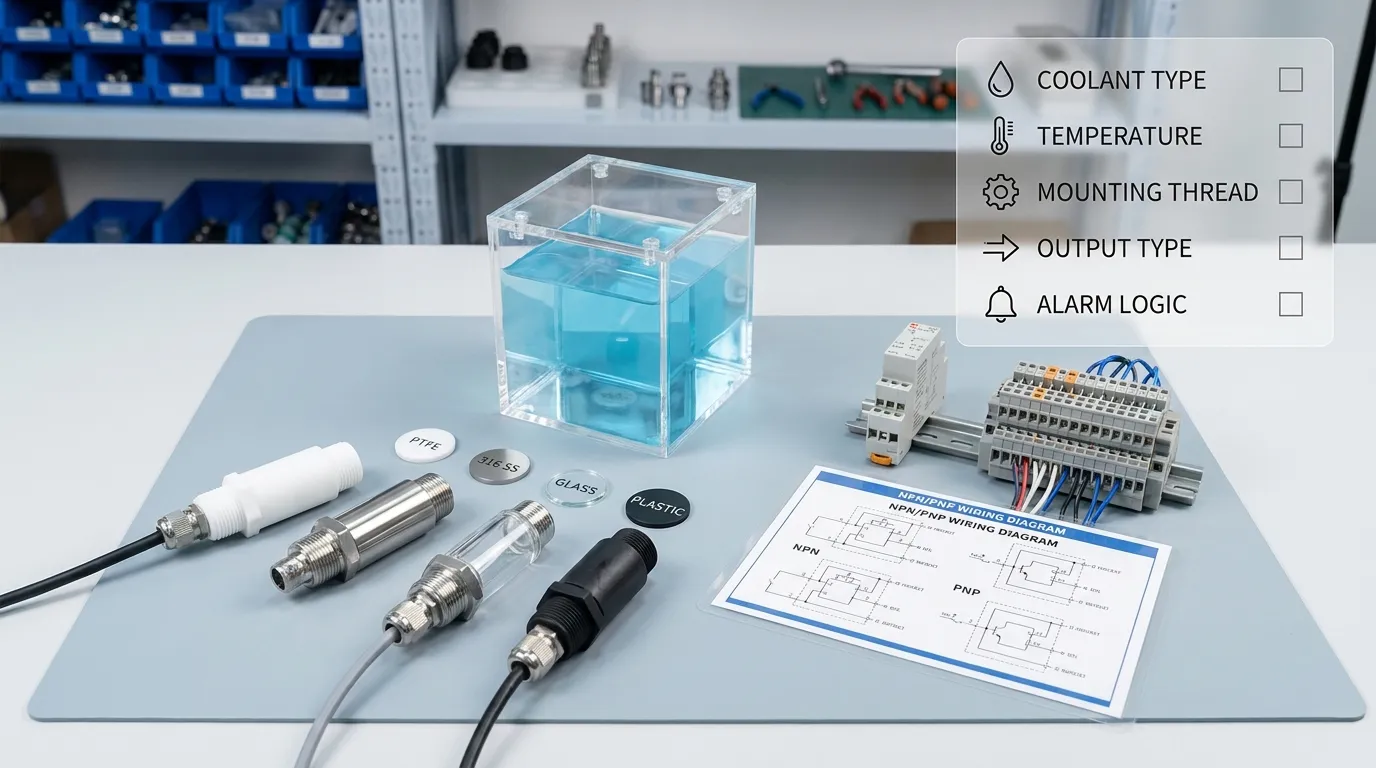
Voordat 'n optiese sensor vir koelmiddeltenkmonitering gekies word, Berei die volgende inligting voor:
- Koelmiddeltipe: Watergebaseerd, Glikol-gebaseer, Olie-gebaseerde, emulsie, Koelwater, of ander
- Werklike koelmiddel-handelsmerk of monster as versoenbaarheid onseker is
- Normale bedryfstemperatuur en maksimum skoonmaak- of prosestemperatuur
- Tenkmateriaal en wanddikte
- Monteringsstyl: Symuur, Skroefbaas, Flens, of doeanehouer
- Vereiste alarmvlak gemeet vanaf die tenkbodem of pompinlaat
- Uitsettipe: NPN, PNP, Aflos, of analoog deurlopende sein
- Alarmlogika: Normaalweg oop of normaalweg gesluit
- Toevoerspanning wat deur die masjienbeheerbord benodig word
- Verbindingsteiken: PLC, Aflos, Buzzer, Waarskuwingslamp, of pomp-interlock
- Kabellengte, Konnektortipe, en kabelmantelvereiste
- Blootstelling aan vibrasie, Sny skyfies, Skuim, Oliemis, of koelmiddelspuit
- Vereiste sensorliggaamsmateriaal: PSU, PTFE, 316 Vlekvrye staal, of glas
- Monsterhoeveelheid en toetsplan voor produksieorder
5-Stapdiensproses
1. Navraag
Stuur vir ons jou koelmiddeltenk-aansoek, Vloeibare tipe, Tenktekening of foto, Alarmhoogte, en bedradingvereiste per WhatsApp of e-pos.
2. Spesifikasie en Aanpassing
Ons ingenieurspan hersien natgemaakte materiaal, Monteringsdraad, Uitsettipe, Kabel, Konnektor, en alarmlogika. Vir OEM/ODM-projekte, Ons kan pasgemaakte sensorstruktuur en bedrading ondersteun.
3. Monstertoetsing
Monsters kan voorberei word vir validering met jou regte koelmiddel, reservoir, Beheerbord, en alarmkring. Hierdie stap is belangrik vir glikol-gebaseerde, Olie-gebaseerde, Hoë-temperatuur, of additie-ryke koelmiddels.
4. Produksie en kwaliteitsbeheer
Na monsterbevestiging, Die fabriek produseer volgens die ooreengekome konfigurasie. QC fokus op sensorfunksie, Uitsettoestand, Verseëling, Kabelkwaliteit, en voorkoms.
5. Versending en ondersteuning
Ons voer sensors uit vir kliënte in die VSA, ONS, Indië, en ander markte. Ondersteuning kan bedradingbevestiging insluit, Installasievoorstelle, en modelkeuse vir toekomstige projekte.
Vereistes en Spesifikasiepunte om te bevestig
| Vereiste | Waarom dit saak maak |
|---|---|
| Koelmiddeltipe | Bepaal die behoefte aan natgemaakte materiaal en monstertoetsing |
| Temperatuurreeks | Beïnvloed sensorliggaam, Prisma, Verseëling, en kabelkeuse |
| Montering van draad of struktuur | Verseker dat die sensor in die reservoir pas sonder lekkasie |
| Alarmpunthoogte | Voorkom oorverhitting en pomp droogloop voor skade |
| Uitsettipe | Moet ooreenstem met PLC, Aflos, Alarmbord, of beheerderinvoer |
| NO/NC-logika | Bepaal wanneer die laevlak-alarm geaktiveer word |
| Kabel en konnektor | Moet by die masjienuitleg en diensomgewing pas |
| Tenkomgewing | Skyfies, Skuim, Vibrasie, slyk, en spuit kan installasieontwerp beïnvloed |
Optiese sensor vs vlotskakelaar vir koelmiddeltenks
| Item | Optiese vlak sensor | Vlotskakelaar |
|---|---|---|
| Waarnemingsmetode | IR-foto-elektriese prisma detecteer droë of natgemaakte toestand | Meganiese vlot beweeg saam met vloeistofvlak |
| Bewegende dele | Geen bewegende sensormeganisme nie | Bewegende vlot kan vassteek of slytasie |
| Grootte | Kompakte, geskik vir klein tenks en OEM-reservoirs | Dit benodig dikwels meer interne ruimte |
| Koelmiddelbesoedeling | Benodig korrekte montering weg van modder of swaar skyfies | Float kan vasloop met skyfies, Vuil, of klewerige residu |
| Bedrading | NPN, PNP, Relaiskoppelvlak, of beheerderinvoer | Gewoonlik eenvoudige skakelaaruitset |
| Beste gebruik | Elektroniese laevlak-alarm, Kompakte reservoirs, OEM-ontwerpe | Eenvoudige tenks waar meganiese beweging aanvaarbaar is |
Hoekom HojellyTek kies
HojellyTek is 'n vervaardiger van optiese en vloeistofvlak-sensors in Shenzhen met 'n interne R&D- en foto-elektriese sensor-ervaring. Ons ondersteun OEM/ODM-aanpassing vir koelmiddeltenkmonitering, kompakte toerustingreservoirs, Nywerheidsbeheerstelsels, en slimtoestel-integrasies waar relevant.
Kopers werk saam met ons vir:
- Fabriek-direkte sensorontwikkeling en uitvoerondersteuning
- Optiese vlakskakelaarontwerp vir kompakte tenks
- Pasgemaakte kabel, Konnektor, gare, en uitsetkonfigurasie
- Materiaalopsies insluitend PSU, PTFE, 316 Vlekvrye staal, en glas
- Toepassingsondersteuning vir masjiengereedskap, Enjins, Chillers, en pompbeskerming
- Uitvoerervaring met kliënte in die VSA, ONS, Indië, en ander markte
Vrae
Kan 'n optiese vlaksensor-koelmiddeltenkoplossing lae koelmiddel voor pompskade opspoor?
Ja. Die sensor is op die minimum veilige koelmiddelvlak gemonteer. Wanneer die prismapunt droog word, Die uitset verander van toestand en kan 'n alarm aktiveer, PLC-inset, Aflos, Buzzer, Waarskuwingslamp, of pompstop-interlock.
Sal 'n optiese vlaksensor met glikol-gebaseerde koelmiddel werk??
Dit kan vir baie glikol-gebaseerde koelmiddeltoepassings gebruik word, maar verenigbaarheid moet bevestig word deur koelmiddelkonsentrasie, Temperatuur, Bymiddels, en natgemaakte materiaal. Vir OEM-projekte, Toetsing met die werklike koelmiddel word aanbeveel.
Kan die sensor olie-gebaseerde koelmiddel of snyolie opspoor??
Ja, optiese vlakwaarneming kan gebruik word met olie-gebaseerde koelmiddel of snyolie wanneer die korrekte sensormateriaal en monteerposisie gekies word. PTFE, Vlekvrye staal, of glasopsies kan oorweeg word vir harder vloeistowwe.
Waar moet die sensor in 'n koelmiddelreservoir gemonteer word?
Monteer dit op die vereiste laevlak-alarmhoogte, gewoonlik bo die pompinlaat of suigpunt. Vermy moddersones, Skyfie-akkumulasieareas, Sterk turbulensie, en posisies waar skuim oorlasalarms kan veroorsaak.
Moet ek NPN of PNP-uitset kies vir 'n koelmiddeltenk-sensor?
Kies die uitset wat by jou PLC pas, Beheerbord, of alarmkring. NPN en PNP is albei algemeen. NO/NC-logika moet ook bevestig word sodat die masjien korrek reageer wanneer die koelmiddelvlak laag is.
Is 4–20 mA nodig vir koelmiddeltenkvlakmonitering?
Nie altyd nie. Vir 'n eenvoudige laevlak-alarm, 'n optiese puntvlakskakelaar met NPN, PNP, of relaiskoppelvlak is gewoonlik genoeg. Gebruik 4–20 mA slegs wanneer jou stelsel deurlopende vlakmeting benodig in plaas van een alarmpunt.
Vra 'n kwotasie vir die Koelmiddeltenk-sensor aan
Stuur jou koelmiddeltipe, Tenkfoto of tekening, Alarmhoogte, Monteringsdraad, Uitsettipe, Spanningsvereiste, en voorkeur vir kabel/konnektor na HojellyTek via WhatsApp of e-pos. Ons span sal help om 'n optiese koelmiddelvlaksensor vir masjiengereedskap te kies of aan te pas, Enjins, Chillers, en OEM-reservoirstelsels.


