
Under the Hood: A Deep Dive into the 5 Core Technologies of Smart Waste Management
On the surface, the concept of smart waste management seems simple, almost magical. A waste container approaches its limit, and a collection vehicle is automatically dispatched for pickup at the perfect time. But this seamless efficiency isn't magic; it's the result of a sophisticated technological ecosystem where multiple components work in perfect harmony. Understanding this system requires looking "under the hood" at the specific hardware, software, and networks that form its foundation.
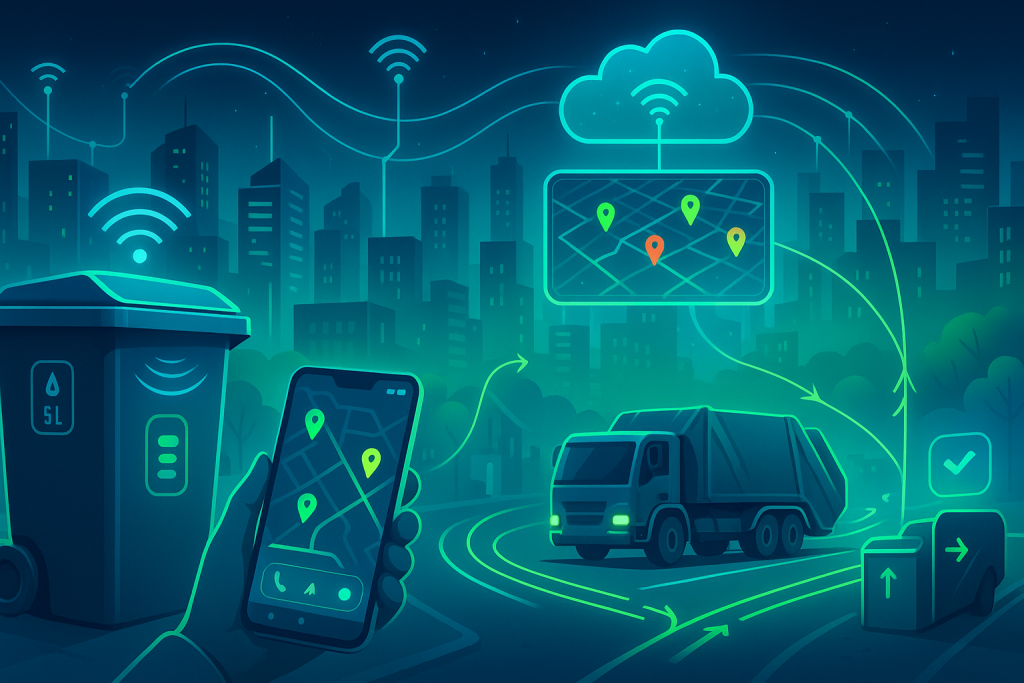
This article provides a deep dive into the five core technologies that are the true drivers of any modern smart waste management solution. These are the critical engines that transform a city's sanitation infrastructure from a rigid, inefficient machine into a responsive, intelligent, and sustainable network. Together, they are: Intelligent Sensors, IoT Connectivity Networks, a Centralized Cloud Platform, an AI-Powered Analytics Engine, and intuitive User Interface Applications.
Technology 1: Intelligent Fill-Level Sensors
The entire smart waste management system begins with a single point of data, captured deep inside the waste container. This is the role of the intelligent sensor, the primary eyes and ears of the network. These are not simple switches; they are rugged, sophisticated devices engineered for a challenging environment.
The most crucial technology used is the ultrasonic fill-level sensor. It operates by emitting a high-frequency sound pulse from its position at the top of the container's interior. This pulse travels down, reflects off the surface of the waste, and returns to the sensor. The device measures the precise time this round trip takes, a principle known as "time-of-flight." By knowing this duration and the speed of sound, it can calculate the exact distance to the waste material. This measurement is then instantly converted into a percentage, providing a real-time understanding of how full the container is.
Beyond just measuring volume, these advanced sensors are often equipped to gather other vital data. An integrated thermometer can monitor the internal temperature, sending an immediate alert if a sudden spike indicates a potential fire hazard. Furthermore, an accelerometer can detect movement, triggering a notification for vandalism or if a bin has been accidentally knocked over. These sensors are designed for extreme durability and efficiency, encased in robust, waterproof shells and powered by long-life batteries that can operate for years without maintenance.
Technology 2: Low-Power Wide-Area Networks (LPWAN)
Once a sensor gathers its data, it faces a critical challenge: how to transmit this information across a vast and complex urban landscape reliably and efficiently. Sending data from potentially tens of thousands of devices requires a special kind of network—one that doesn't demand significant power or incur prohibitive data costs. This is where Low-Power Wide-Area Networks (LPWAN) become essential.
LPWAN technologies are the invisible data superhighways of the smart city. Two leading protocols in this space are LoRaWAN (Long Range Wide Area Network) and NB-IoT (Narrowband Internet of Things). LoRaWAN is known for its exceptional range and ability for signals to penetrate deep into dense urban environments and even underground containers. NB-IoT leverages existing cellular infrastructure to provide strong, reliable coverage.
Both technologies are engineered to send small packets of data—like a sensor's fill-level reading—over long distances using very little power. This efficiency is what enables the sensor batteries to last for many years. Data from the sensors is securely transmitted to strategically placed gateways. These gateways act as bridges, collecting data from all nearby sensors and relaying it to the central cloud platform via a standard internet connection, such as fiber optics or cellular backhaul.
Technology 3: The Centralized Cloud Platform
If the sensors are the eyes and the network is the nervous system, then the centralized cloud platform is the brain of the entire operation. This powerful software, accessible from any web browser, is where all the incoming data is aggregated, processed, stored, and visualized. It provides a single source of truth for waste management operators, transforming a flood of raw data points into a clear, coherent picture of the city's real-time sanitation status.
A state-of-the-art cloud platform presents this information on an intuitive dashboard. Operators can view a geographic map of the entire service area, with each waste container represented by a pin. These pins are color-coded to show their current status at a glance—for instance, green for empty, yellow for partially full, and red for requiring immediate attention. Users can click on any individual bin to see its detailed history, fill-level trends, and sensor status. This platform is built for immense scalability, capable of handling data from millions of devices simultaneously, and is protected by robust security protocols to ensure the integrity and safety of the operational data.
Technology 4: The AI-Powered Analytics Engine
Collecting and visualizing data is powerful, but the true revolution lies in turning that data into intelligent, automated decisions. This is the function of the AI-powered analytics engine, the component that elevates the system from a simple monitoring tool to a strategic operational asset. This engine is where raw data is converted into profound efficiency gains.
Its primary function is dynamic route optimization. Traditional waste collection follows the same fixed path every day, but the analytics engine creates unique, optimized routes for each collection cycle. It analyzes the real-time fill-level data from the cloud platform and identifies only the containers that need service. It then calculates the most efficient route to collect them, factoring in variables like vehicle capacity, current traffic conditions, and landfill or recycling center locations. This single capability can slash fuel consumption and collection times by up to 50%.
The engine's second critical function is predictive analytics. By applying machine learning algorithms to historical fill-level data, the system can identify patterns and accurately forecast when a specific bin is likely to be full in the future. By harnessing the combined power of AI and IoT, this engine allows managers to move from a reactive to a proactive stance, anticipating needs, allocating resources more effectively, and preventing overflows before they ever happen.
Technology 5: User Interface Applications
The final technological pillar ensures that all this powerful data and optimization reaches the people who need it most: the collection crews on the ground and the managers in the office. This is achieved through dedicated user interface applications designed for specific roles.
For the collection crews, a mobile application installed on a smartphone or an in-cab tablet is their guide. It provides drivers with their dynamically generated route for the day, complete with turn-by-turn navigation to each designated bin. The app updates in real-time, allowing for adjustments on the fly. It also serves as a reporting tool, enabling drivers to easily log issues such as a blocked container or necessary bin maintenance, creating a direct feedback loop to the operations center.
For managers and city planners, the interface is the comprehensive web-based administrative dashboard of the cloud platform. From here, they can monitor the entire fleet's progress, oversee operations in real-time, generate detailed reports on collection efficiency and waste generation trends, and use the system's analytical tools for long-term strategic planning. These user-centric applications make the sophisticated technology accessible and actionable for the entire team.
Conclusion: An Interconnected Ecosystem of Innovation
These five core technologies do not operate in isolation. They form a deeply interconnected and interdependent ecosystem. A sensor's data is meaningless without the network to transmit it. The network is useless without the cloud platform to process the information. The platform's value is fully unlocked only by the analytics engine that provides actionable insights. And those insights only become effective when delivered through user applications to the people on the ground.
Understanding these individual components reveals the true complexity and elegance of a smart waste management system. It is a testament to how modern technology, when thoughtfully integrated, can solve some of our oldest and most fundamental urban challenges, paving the way for cleaner.
Of course. Here is a 5-question FAQ section designed for the article "Under the Hood: A Deep Dive into the 5 Core Technologies of Smart Waste Management," written with short sentences for high readability.
Frequently Asked Questions
1. How are the sensors powered inside the waste bins? The sensors use powerful, long-life batteries. They are designed for very low energy use. This allows them to run for 5 to 10 years before needing a replacement.
2. Is the data transmitted from the sensors secure? Yes, security is a critical feature. All data is fully encrypted during transmission. The cloud platform also uses advanced security protocols to protect against unauthorized access.
3. Can these sensors withstand harsh weather conditions? Absolutely. The sensors are housed in rugged, waterproof casings. They are engineered to operate reliably in extreme heat, cold, rain, and snow.
4. What is the main difference between LoRaWAN and NB-IoT networks? Both are excellent low-power networks. LoRaWAN is often ideal for its long-range capabilities in custom-built networks. NB-IoT leverages existing cell tower infrastructure for widespread, reliable coverage.
5. How does the analytics engine improve over time? The engine uses machine learning. It constantly analyzes new data to learn waste generation patterns. This process makes its future predictions and route optimizations progressively more accurate and efficient.


