
More Than Cleanliness: How Intelligent Waste Management Drives Urban Sustainability
The definition of a "smart city" has evolved. It is no longer a concept solely defined by technological prowess or digital connectivity. Today, a truly smart city is measured by its resilience, its livability, and, most critically, its sustainability. As urban centers around the globe grapple with the urgent challenges of climate change and resource scarcity, the pursuit of a sustainable future has become the central organizing principle of modern urban planning.
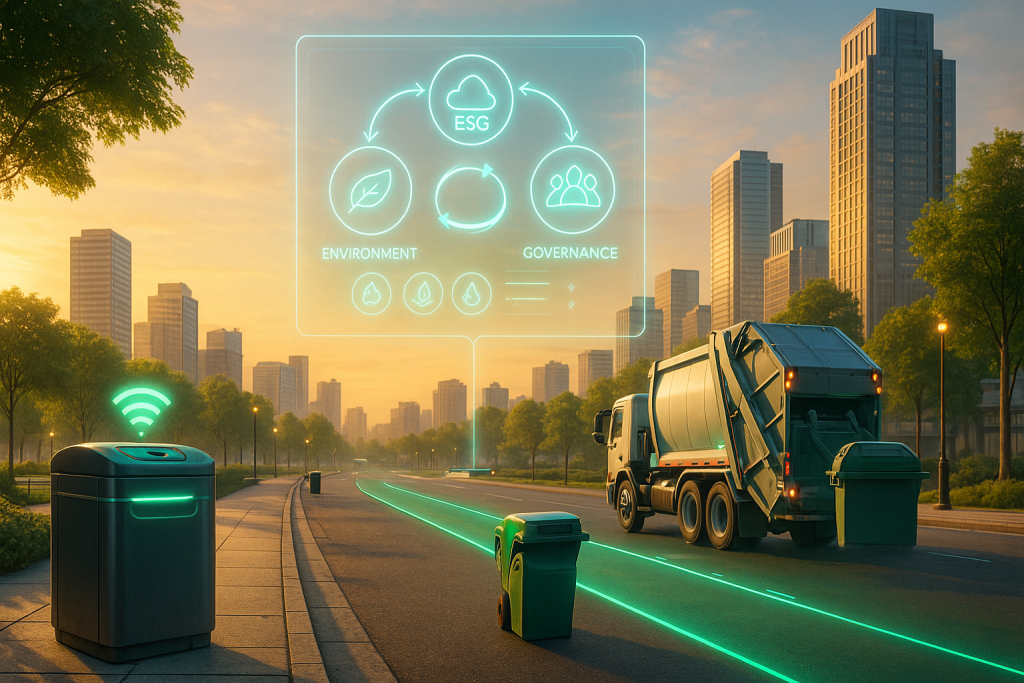
In this context, municipal services can no longer be viewed in isolation. They must be re-evaluated as interconnected parts of a larger sustainability ecosystem. Perhaps no service has been more overlooked, yet holds more potential, than waste management. For decades, traditional waste collection has been a significant impediment to environmental goals—a linear, inefficient process contributing to landfill overflow, excess emissions, and wasted resources.
To build the sustainable cities of tomorrow, we must fundamentally change our relationship with waste. This is where a modern Smart Waste Management system becomes not just an operational upgrade, but a foundational pillar for comprehensive urban sustainability. It directly accelerates progress toward Environmental, Social, and Governance (ESG) objectives, provides the critical data infrastructure for a circular economy, and offers a measurable pathway to achieving ambitious climate targets.
Beyond the Balance Sheet: Aligning Waste Management with ESG Goals
The ESG framework—Environmental, Social, and Governance—has become the gold standard for measuring the sustainability and ethical impact of an organization or a municipality. An intelligent waste management system offers profound, quantifiable improvements across all three ESG pillars.
The Environmental Impact (E)
This is the most direct and powerful area of impact. By transforming waste collection from a brute-force, schedule-based operation into a data-driven, surgical process, cities can achieve dramatic environmental gains. The primary benefit comes from a massive reduction in the carbon footprint of the collection fleet. Route optimization algorithms ensure that trucks are only dispatched to containers that need service, via the most efficient path. This systematic reduction in "windshield time" leads to industry-reported fuel consumption decreases of up to 50%, which translates to a direct and significant cut in greenhouse gas emissions and other air pollutants.
Furthermore, intelligent systems are crucial for reducing landfill dependence. By providing granular data on waste generation patterns, cities can better design and manage recycling and composting programs. This enhanced waste diversion means less material ends up in landfills, mitigating the production of methane, a greenhouse gas over 25 times more potent than carbon dioxide.
The Social Impact (S)
The social benefits of a clean, well-managed city are profound and contribute directly to a higher quality of life for all residents. The most immediate social positive is the improvement in public health and sanitation. An intelligent system virtually eliminates the persistent problem of overflowing bins, which are known breeding grounds for pests, bacteria, and pathogens. This leads to cleaner streets, parks, and public spaces, reducing health risks and fostering a greater sense of civic pride.
Beyond cleanliness, the data generated by a smart system can enhance social equity. Planners can use this data to ensure a fair and equitable distribution of waste management resources across all neighborhoods, preventing the disproportionate burden of overflowing waste in underserved communities. For the sanitation workforce, the technology improves safety and job satisfaction by providing clear, optimized instructions and reducing the physical strain of unnecessary collections.
The Governance Impact (G)
Effective governance in the 21st century is data-driven. An intelligent waste management system provides municipal leaders with an unprecedented level of insight and control. The continuous flow of data enables transparent, evidence-based policymaking. City managers can track key performance indicators, measure the effectiveness of recycling campaigns, and generate verifiable reports on their progress toward sustainability targets.
This data infrastructure also opens the door to innovative governance models, such as "Pay-As-You-Throw" (PAYT) programs. With the ability to accurately measure waste output, cities can implement fairer systems where waste generation is directly linked to cost, creating a powerful financial incentive for residents and businesses to reduce, reuse, and recycle.
The Engine of the Circular Economy
For generations, our global economy has operated on a linear model: we take resources, make products, and dispose of them as waste. This "take-make-dispose" system is inherently unsustainable. The future demands a transition to a circular economy—a model where resources are kept in use for as long as possible, extracting the maximum value from them before recovering and regenerating materials at the end of their service life.
While the concept is powerful, its practical implementation depends on logistics and data. An intelligent waste management system is a critical enabler of this transition.
The system's ability to segregate data from different waste streams (e.g., general waste, mixed recycling, organics, glass) is a game-changer. By understanding the fill rates and patterns of recycling bins versus landfill-bound bins, cities can dynamically adjust collection schedules to prioritize recycling. This prevents the contamination that occurs when recycling containers overflow and their valuable contents are mixed with general trash.
Furthermore, the data provides invaluable insights into consumer behavior. By analyzing disposal patterns, municipalities can identify areas with low recycling participation rates and design targeted educational campaigns to address specific challenges. Looking forward, the integration of advanced sensors and AI-powered image recognition in smart bins will allow for the detection of contamination at the point of disposal, radically improving the quality of the recyclable material stream and making it more valuable for reprocessing.
A Powerful Tool in the Fight Against Climate Change
Cities are at the forefront of the global response to climate change, with many committing to ambitious carbon neutrality goals. Achieving these targets requires action across all sectors, and intelligent waste management offers one of the most cost-effective and immediate ways to make a significant impact on a city's carbon emissions.
The most direct contribution is the drastic reduction of emissions from the sanitation fleet. A typical garbage truck has very low fuel efficiency and is a significant source of CO2, NOx, and particulate matter. By eliminating unnecessary mileage through route optimization, a smart system effectively takes the carbon equivalent of hundreds of vehicles off the road. This provides city administrators with a clear, auditable metric they can include in their climate action plan reporting.
The indirect impact is equally important. Landfills are a major source of anthropogenic methane emissions, produced as organic matter decomposes in an anaerobic environment. Every ton of organic waste that is diverted from a landfill—through better composting programs informed by smart data—is a direct reduction in future methane emissions. By providing the tools to maximize diversion rates, an intelligent waste system is a powerful weapon in mitigating this potent greenhouse gas.
Building Healthier, More Equitable Communities
The ultimate goal of any urban initiative is to improve the lives of its citizens. The sustainability benefits of intelligent waste management extend deep into the social fabric of a community, fostering healthier, more pleasant, and more equitable living environments.
A city free from the blight of overflowing trash and litter is not just more beautiful; it has tangible economic benefits. Cleanliness positively impacts tourism, attracts new businesses, and can increase property values. It creates a virtuous cycle where residents feel more pride in their community, leading to greater engagement in civic life and a stronger social cohesion.
Moreover, the data-driven nature of the system promotes environmental justice. In traditional models, resource allocation can be subject to historical bias, often leaving lower-income neighborhoods with poorer service levels. A smart system operates on impartial data. It identifies needs based on real-time fill levels, ensuring that collection resources are dispatched to where they are actually required, regardless of zip code. This data-backed approach helps ensure that all citizens benefit equally from a clean and healthy environment.
Conclusion: A Strategic Imperative for the Future-Ready City
To view intelligent waste management as merely a way to collect trash more efficiently is to miss its true significance. It is a multi-faceted sustainability tool with synergistic benefits that ripple across a city's entire ecosystem. It is a direct pathway to achieving ESG goals, a foundational technology for enabling a circular economy, and a powerful instrument for meeting climate action targets.
By transforming an essential municipal service into a source of valuable data and intelligence, cities can unlock a new level of performance in their sustainability efforts. It represents a strategic imperative for any municipal leader, urban planner, or policymaker dedicated to building the resilient, resource-efficient, and truly livable cities of the future.


